
Your Week’s Volatility Market Commentary — Information Is Your Edge
Good News Is Bad News For The Market This Week
Jump Directly To:
Equity Index |Investor Optimism |NDX | TLT | GLD | IBIT | Commentary
Equity Index Volatility
Weekly Takeaway:
-
The S&P 500 lost 1.94% during the week in a “good news is bad news” setting
-
VOLI gained 21.23%% to close at 15.93 for the week. It is at just the 33rd percentile of its 52-week trading range meaning at-the-money options are not overly expensive
-
The 10-year treasury note yield rose to a high of 4.790% on Friday before closing at 4.776% marking a new 52-week high and adding to the pressure on equity prices
-
TailDex (ticker TDEX) rose by 26.37% on the week to close at 13.34
-
The S&P 500 opened higher on Tuesday and briefly traded above 6000 before an inflationary reading from ISM Services data spooked investors who sold the index down 1.11%
-
The S&P 500 lost 1.54% on Friday as the U.S. economy created more new jobs in December than expected. Yes, good news was bad news for stocks because the week’s data points to higher inflation, strong growth, and less rate cutting from the Fed
-
VolDex on treasury bonds rose by 5.22% and PutDex rose by 10.06% as higher yields mean lower prices and investors now believe the Fed is less likely to cut rates in 2025
-
VolDex on the Nasdaq-100 rose by 17.11% to close the week at 21.10 as investors started to worry about the highest flier in the equity market
-
VolDex on the individual names we cover was generally higher but VolDex on NVDA fell by 1.13% and on TSLA by 2.99%
-
The Investor Optimism Index fell 46.40% to a pessimistic reading of 21.90
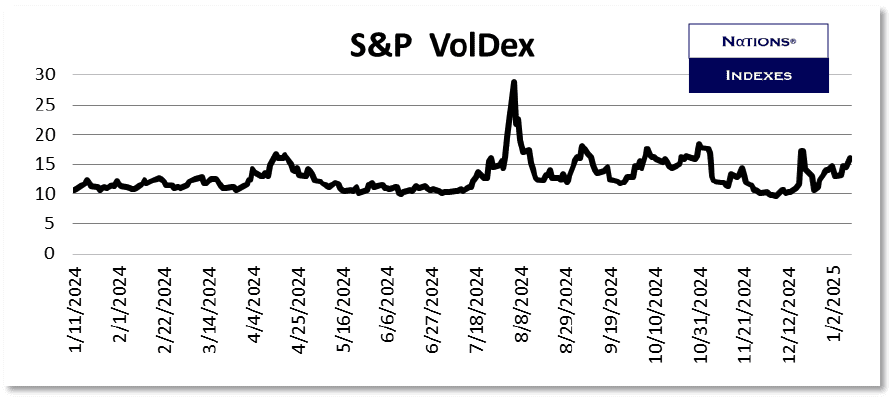
Figure 1
Equity Index Volatility:
Thursday was a market holiday due to the funeral and day of remembrance for former U.S. President Jimmy Carter. The market had two minor “up” days on Monday and Wednesday but those gains were overwhelmed by Tuesday’s 1.11% loss and Friday’s 1.54% loss.
Tuesday’s price action followed the ISM Services index for December coming in at a much stronger than expected, and inflationary, reading of 54.1 (53.2 was expected). Friday’s price action followed the release of jobs data for December. Nonfarm payrolls increased by 256,000 when 157,000 was expected. The unemployment rate ticked down to 4.1%.
Yes, good news in the form of more jobs being created was bad news for the stock market and that may seem nonsensical but it highlights the market’s reliance on the Federal Reserve’s anticipated rate cutting in 2025 to support very lofty valuations. One month ago the market believed the odds of the Fed cutting twice in 2025 were 30% and the odds of cutting more than twice were 46%. Those odds have now been adjusted to just 23% for two cuts and less than 9% for more than two cuts. Live by the sword…
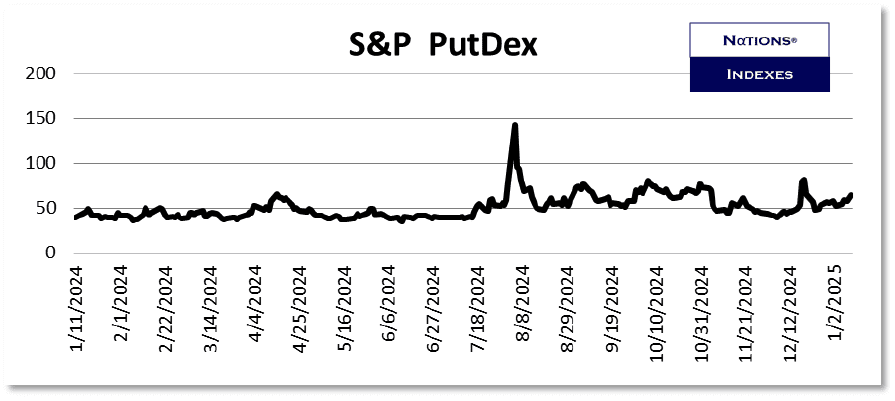
Figure 2
Despite the ugly price action, PutDex rose just 21.99% for the week and Friday’s close of 64.41 is at just the 27th percentile of the 52-week range. Some of this is due to the big spike in August when PutDex traded 142.95. The average close for the 52-week period is 51.29.
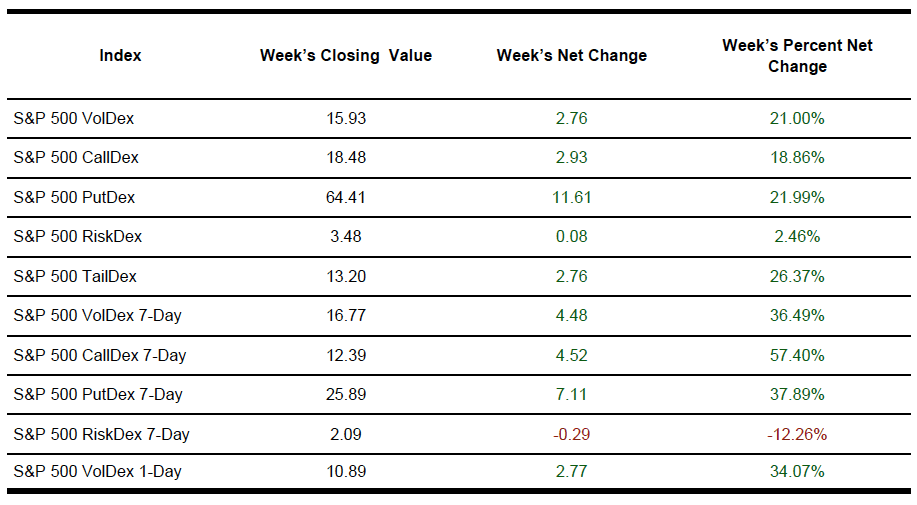
Table 1
Why It Matters… Option prices are certainly higher than they were a month ago so it would be easy for an investor to think they’ve missed their opportunity to put on protective positions but RiskDex closed the week at 3.40 which is below its historical average closing price (1/30/2005 through 12/31/2024) of 3.75 and it historical median closing price of 3.42. This means that a collar strategy in SPY (short an out-of-the-money covered call and long an out-of-the-money protective put) can still be done at a reasonable level.
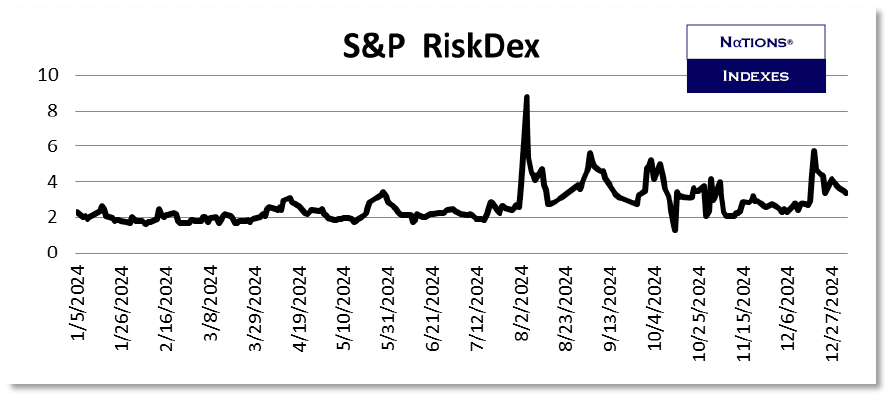
Figure 3
Nations Investor Optimism Index

Figure 4
Investor optimism fell by 46.40% to close at a horrible 21.90. Any reading below 50 is pessimistic. The index is still a long way from 2024’s lowest closing level of 0.70 posted on August 5 when the S&P 500 fell by 3.00%.
Why It Matters… Our Optimism Index can be used as a contrarian indicator for BOTH equity prices and option prices but it is often advantageous to wait for extremes. For example, 20 trading days after that August 5 level, the S&P had gained 6.61%.
Deconstructing S&P Skew
It’s important to deconstruct S&P option skew to understand what the option market is really saying. In a disappointing week, like this week, seeing if option flows have been focused on a certain portion of the skew can be instructive.
Below you can see the weekly change in constant 30-day to expiration normalized option prices by their distance out-of-the-money. Fear was clearly in charge and options were being bought across the entire range of strike prices but puts gained more than calls and deep out-of-the-money puts gained the most.
We often get asked why out-of-the-money call option prices are higher when stocks are selling off and it is simply of function of institutional option traders reaching to buy nearly any option in order to get long “gamma” or convexity.
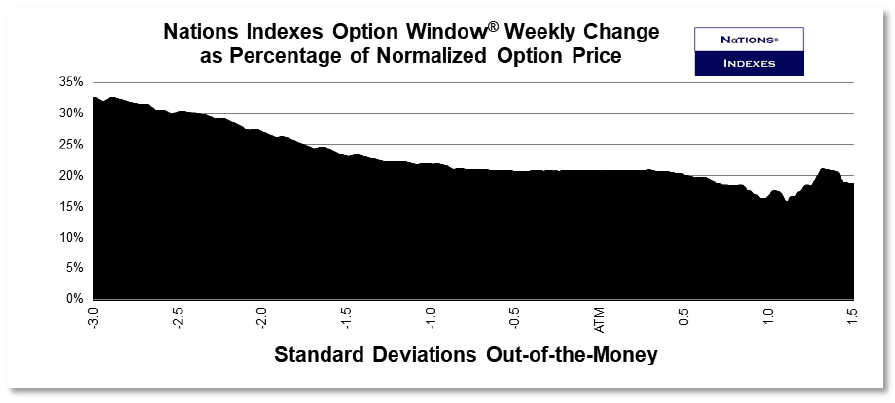
Figure 5
NASDAQ 100 & Russell 2000 Volatility Picture
Other Equity Indexes
In the Nasdaq-100, option prices were up across the skew and term structure. Short-dated options were heavily bid as you can see below.
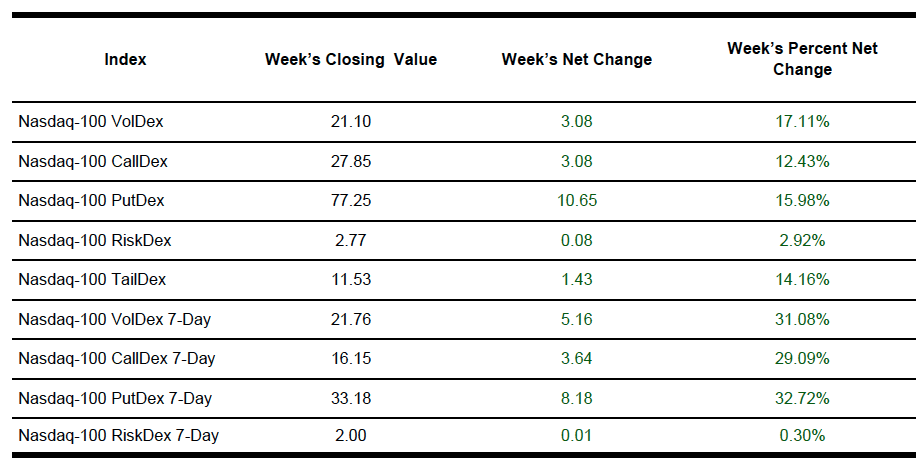
Table 2
WHY IT MATTERS… As we pointed out last week, VolDex on the Nasdaq-100 closed at just the 20th percentile of the 52-week range on January 3. At-the-money options could be considered relatively inexpensive and anyone who bought those was rewarded.
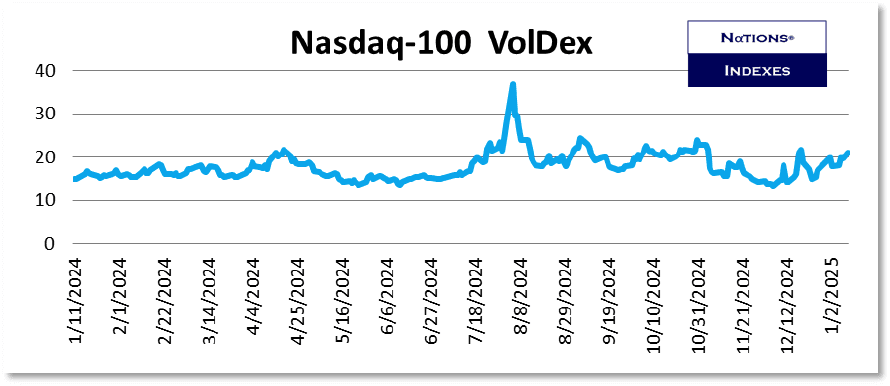
Figure 6
VolDex on the Nasdaq-100 is now at the 33rd percentile for its 52-week range. PutDex on the Nasdaq-100 is at just the 30th percentile of its 52-week range.
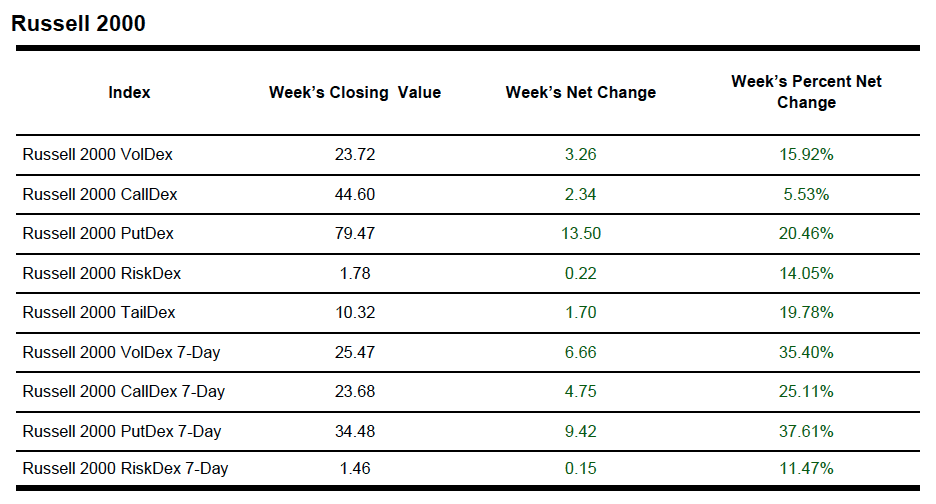
Table 3
Other Asset Volatility
Treasury Bonds
VolDex on treasury bonds
VolDex on treasury bonds rose by 5.22% as the 10-year yield made a new 52-week high.
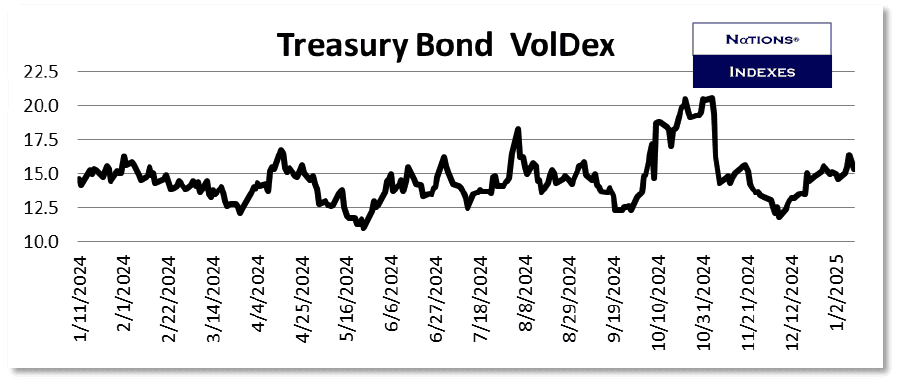
Figure 7
At Friday’s closing level of 15.33, VolDex on treasury bonds is at the 46th percentile for the past 52 weeks meaning option prices are still reasonably priced although we would not consider them cheap at these levels but, given the new 52-week high in yields, they are certainly not expensive.
All our measures for treasury bond option prices rose on the week. It can be instructive to watch CallDex on treasury bonds because if equity losses accelerate speculators will buy out-of-the-money treasury bond calls in anticipation of a “flight to quality” out of stocks and into treasures.
WHY IT MATTERS…As we have been saying for some time, treasury bond prices are likely to become very volatile as the market rethinks its optimistic outlook for rates in the first half of 2025. PutDex closed the week at the 42nd percentile of its 52-week range which is surprising given the new high in bond yields.
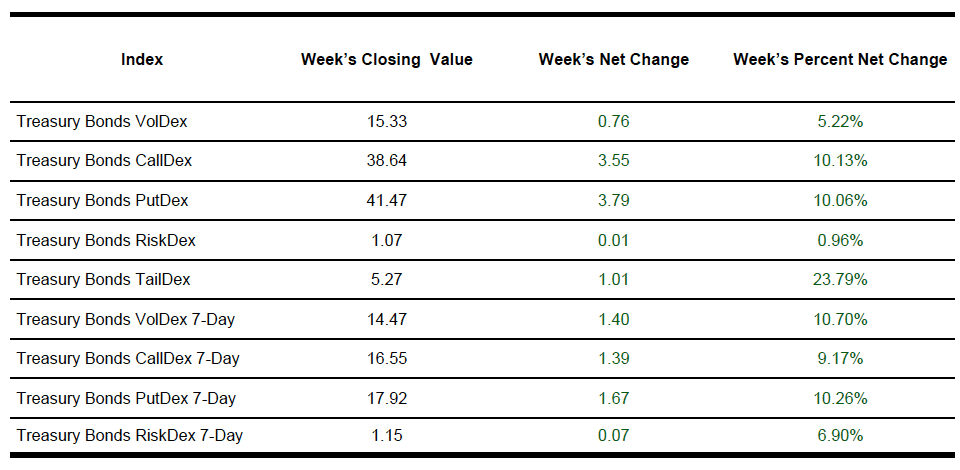
Table 4
Bitcoin
VolDex on Bitcoin
VolDex on bitcoin closed at 54.92 on Friday, down from 55.45 for the close of the previous week. Bitcoin prices have been very volatile this year and the past week was no exception with moves of 3.95%, -5.81%, and -2.65% on the first three days of the week. VolDex seems to be staging a breakout to the downside as traders become familiar with the new spot ETF products. This week’s close in Bitcoin VolDex is another new closing low.

Table 5
0DTE and 1DTE Options
Zero day to expiration (ODTE) options continued to dominate the trade in SPY with 56.81% of all the SPY options traded last week being 0DTE. One-Day S&P 500 VolDex closed the week at 10.89, a jump of 34.07% which was driven by the break in equity prices. You can see the end-of-day history since the end of November for 1-Day VolDex below.
Very short-dated volatility measures which use a variance swap methodology, as VIX does, in-ject significant error into the resulting measure because of the way out-of-the-money options trade in the hours before expiration. The VolDex at-the-money methodology is particularly suit-ed for these situations.
These 0DTE options are trading vehicles rather than investment vehicles and it’s important to remember that 0DTE volume tends to decline relative to other expirations when equity markets break hard, but 1-Day VolDex seems cheap. It might be, but some of this is due to the jobs data catalyst passing.
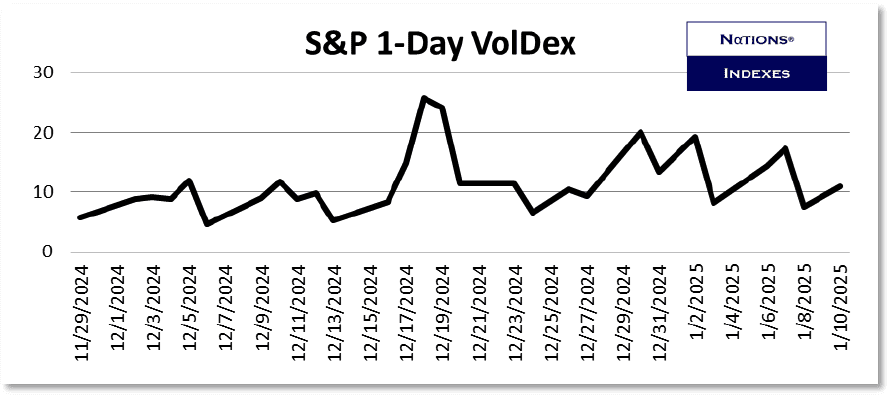
Figure 8
Equities
The Nasdaq-100 fell by 2.24% for the week and, among the names we cover, only Google and META bucked the trend and Google did so just barely with a weekly gain of 0.13%. META was the real outlier with a weekly gain of 1.86% thanks to perceptions that the likelihood of TikTok being banned in the U.S. is increasing.
AMD was the worst performer of the names we cover with a loss of 7.44%. NVDA was second, completing the theme that chip makers had a tough week, with a loss of 5.93%. It is to be expected that the highest fliers will feel more pain when the music stops. This isn’t a comment on expectations for future performance, just a matter of setting expectations.
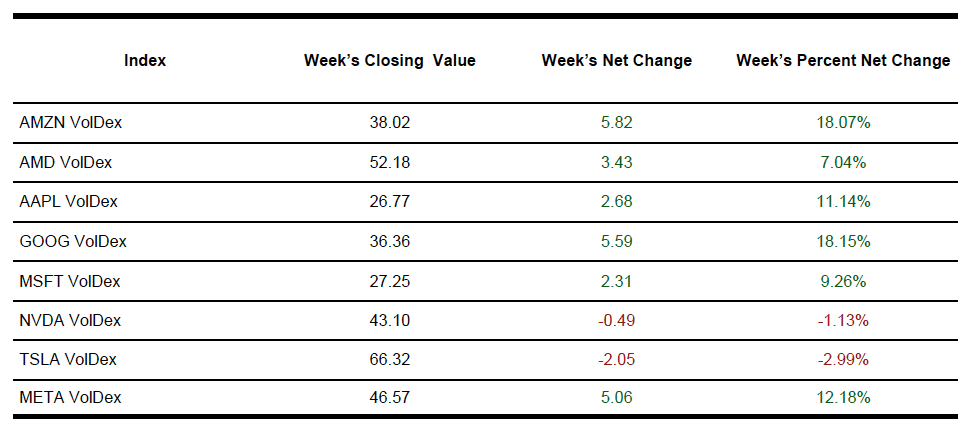
Figure 9
It’s interesting that GOOG VolDex rose the most for the week as the stock gained slightly. GOOG reports earnings on February 4.
TSLA fell by another 3.83% for the week to close at $394.74. This follows last week’s loss of 4.92%. It is now 17.74% below the 52-week high made on December 17. However, it is still significantly above the $275 level which was the high of TSLA’s range in 2024 until election day. Every 30-day TSLA option price metric fell for the week, despite the decline in share price in a continued example of TSLA options marching to their own drummer. For example, TSLA is the only name among the 10-largest in the S&P 500 to show call skew (meaning CallDex is higher than PutDex).
The decline in NVDA VolDex is surprising given that shares lost 5.93% on the week and the entire chip sector was weak. It’s only by deconstructing skew that you can see the decline comes from traders losing some optimism for NVDA shares as CallDex fell by 5.90% while PutDex rose by 1.71%. You have to deconstruct skew to understand what markets are really saying.
WHY IT MATTERS…NVDA has been the stock market’s darling for the past year, gaining 150.06% over the past 52 weeks. It spent much of the first half of 2024 and much of the autumn, displaying call skew in an echo of VERY bullish sentiment. But RiskDex closed at 1.15 on Friday displaying a fair amount of put skew. If option traders were so right in the first half of last year why would we not pay attention to what the NVDA option market is saying now?
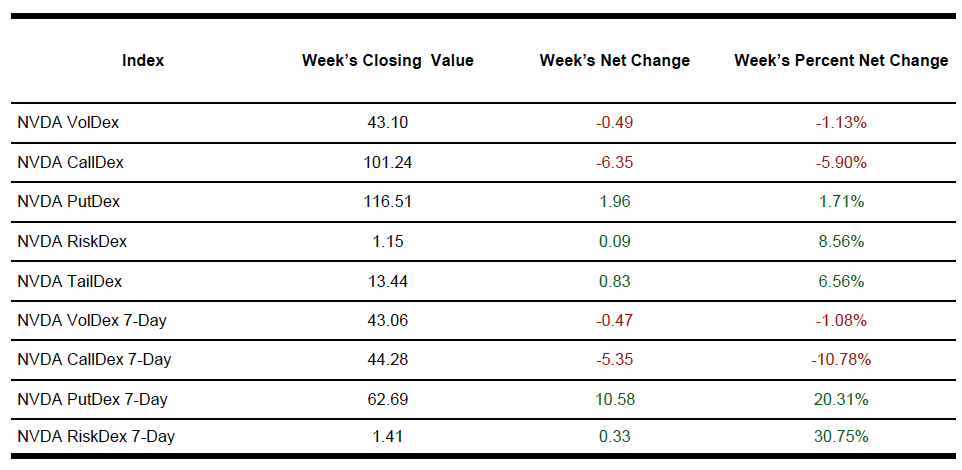
Table 6
Regarding TSLA, in last week’s newsletter we pointed out that TSLA PutDex closed at 158.36 which was very high versus other equity names but which was “reasonably” priced given its re-cent historical range.
We pointed out that concerned investors might buy put spreads for protection and suggested the 350-400 put spread at 17.73 in the February 7 expiry. That 400 strike put is now in-the-money and the spread closed at 21.35 on Friday.
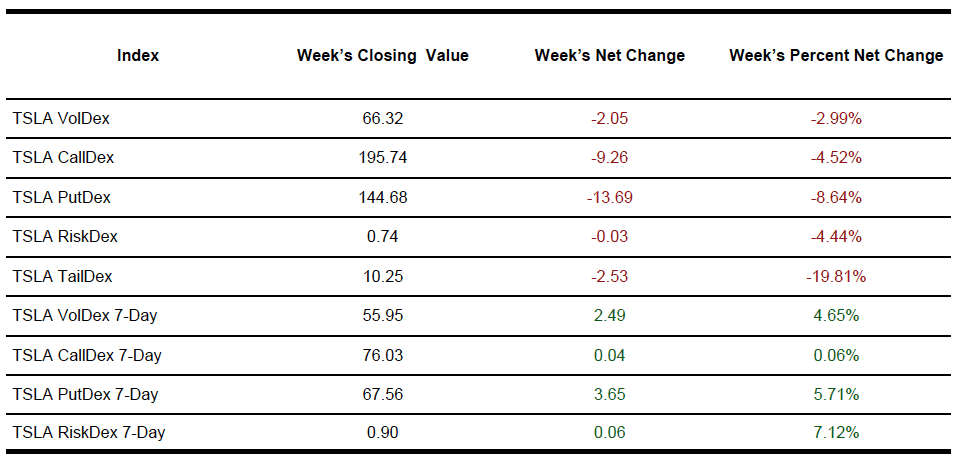
Figure 10
Scott’s Weekly Commentary
Last week was disappointing despite 2 up days and 2 down days for the S&P. That doesn’t help when the down days are as ugly as Tuesday and Friday were.
The equity market became much too optimistic that the Federal Reserve was going to blindly continue on its “easier money” path only to be confronted by an inflationary ISM number on Tuesday and the better-than-expected jobs number on Friday which points to continued strong economic growth. As I’ve said before, inflation at 2.5%, economic growth of 2.8%, and an unemployment rate of 4.1% is no time for rate cutting. The Fed should just stand back and not throw any fuel (in the form of lower interest rates) on the inflationary fire. History shows the Fed does the most damage to the stock market and the economy when it keeps rates too low for too long.
In the coming week, traders will be watching the 10-year yield which is at its 52-week high. We get PPI data on Tuesday and CPI data on Wednesday so hold onto your hat because if inflation comes in higher than expected the hopes for Fed rate cuts in 2025 will continue to evaporate.
The two main drivers of stock market returns over the long run are interest rates (moving in the wrong direction for equities) and earnings and a better than expected earnings season will be a tonic for the equity market.
Everyone at Nations Indexes hopes you have a great and profitable week!
Scott
