
Your Week’s Volatility Market Commentary — Information Is Your Edge
S&P Continues Its Rally – New All-Time Highs With Low Volatility
Jump Directly To:
Equity Index |Investor Optimism |NDX | TLT | GLD | IBIT | Commentary
Equity Index Volatility
Weekly Takeaway:
-
The S&P 500 gained another 1.74% this week as concerns about punitive tariffs eased
-
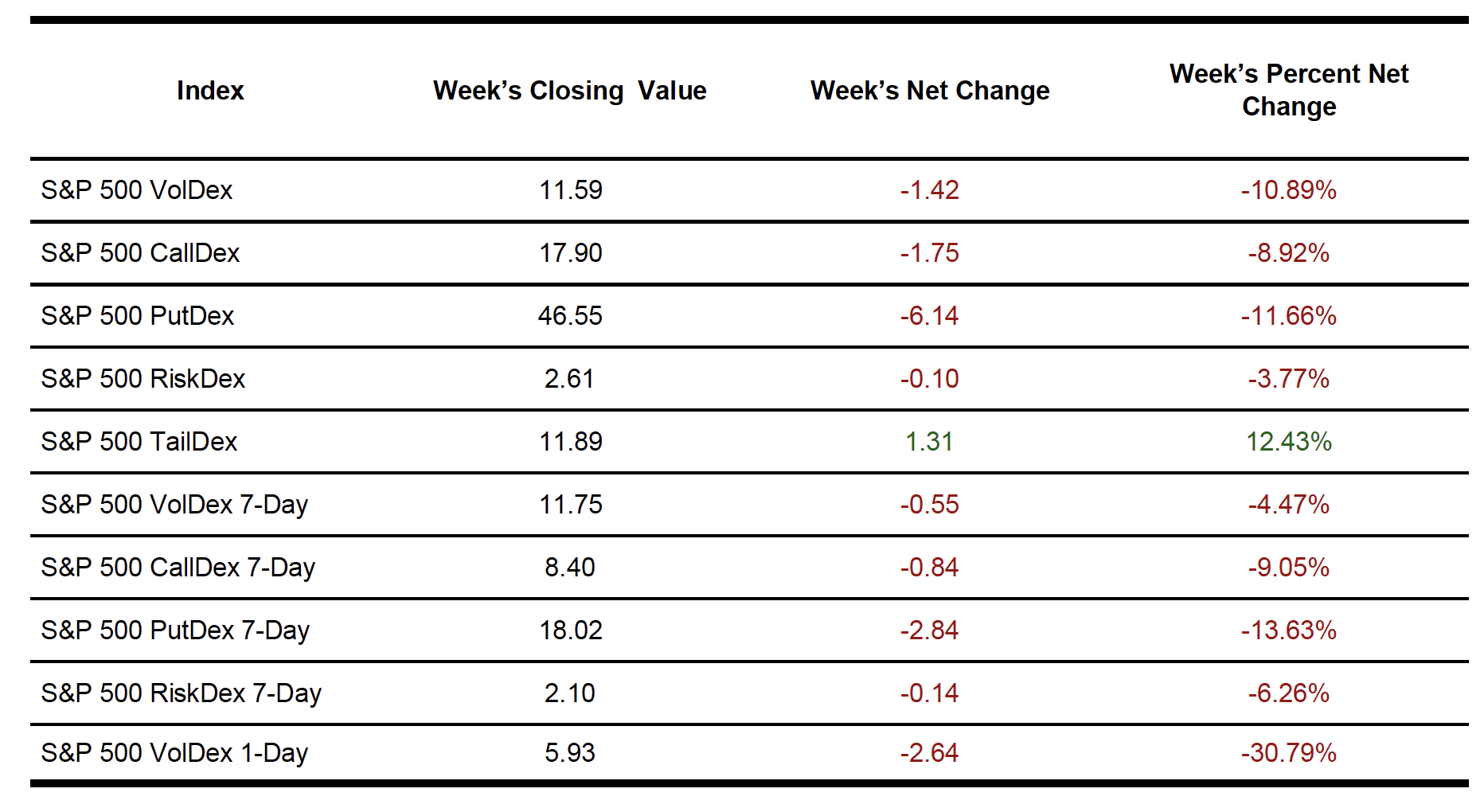
VolDex (ticker VOLI) fell another 10.89% to close at 11.59. This follows last week’s decline of 18.56%. VOLI is now at just the 10th percentile of the 52-week range
-
The S&P made a new all-time closing high of 6118.71 on Thursday, January 23
-
TailDex (ticker TDEX) rose by 12.43% for the week and closed at 11.89. It appeared investors realized deep out-of-the-money puts had gotten very cheap and that hedging was appropriate at these levels
-
The S&P rallied on Tuesday, gaining 0.88%, after Goldman Sachs published a note saying the administration’s tariff policies seem “more benign” than originally expected. This helped the S&P make gains on Wednesday and Thursday as well
-
The yield on the 10-year Treasury note was little changed on the week providing some relief for equity investors. The yield closed at 4.626%, an increase of just 1.7 basis points
-
CallDex on the S&P eased on the week, falling 8.92%, following robust buying of out-of-the-money calls in recent weeks. CallDex is still high relative to other measures and closed the week at the 45th percentile of its 52-week range
-
VolDex on the individual names we cover was mixed with VolDex on TSLA falling by 13.27% while for AAPL it rose 6.69% and for NVDA it rose 8.34%
-
The Investor Optimism Index rose 6.92% to a reading of 53.03 after getting above 60.00
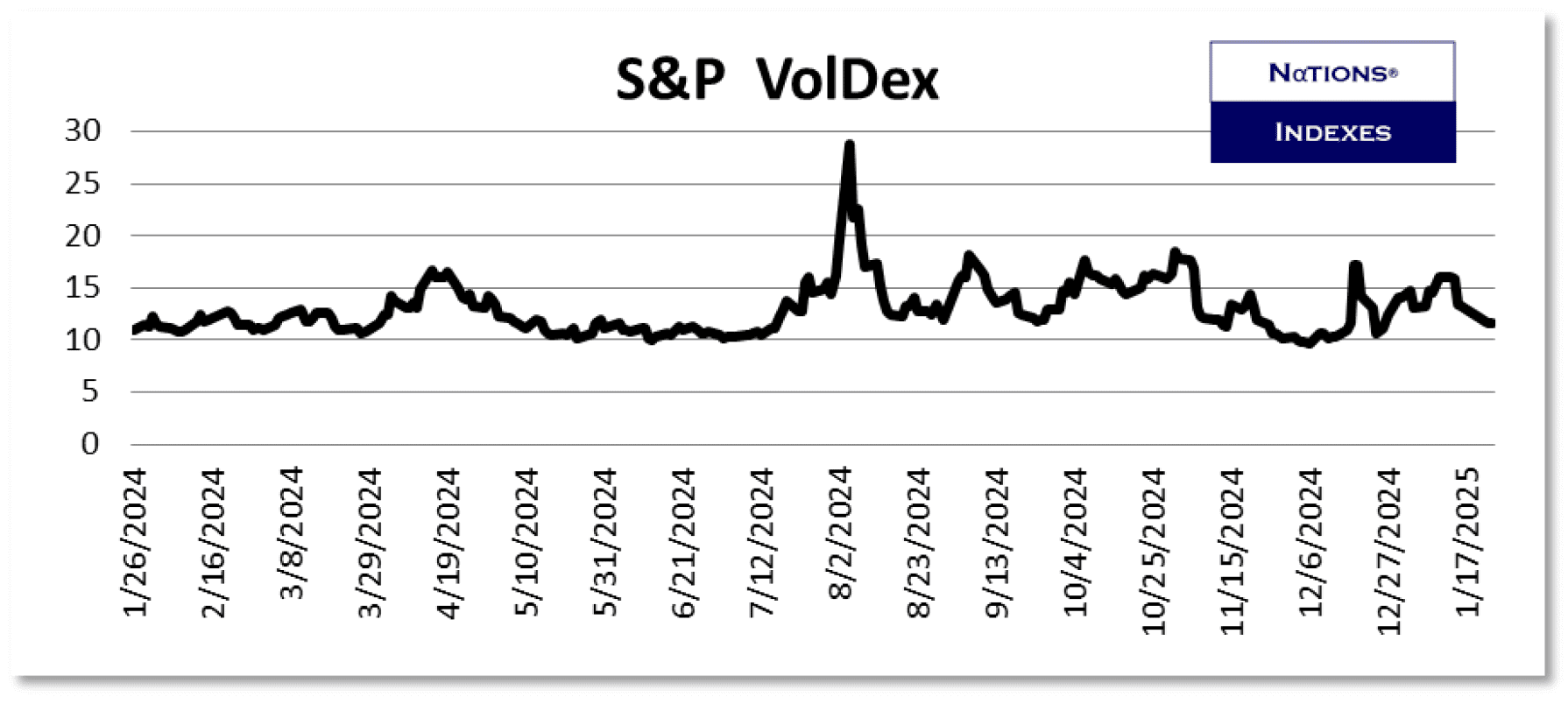
Figure 1
Equity Index Volatility:
Tuesday’s price action in the S&P 500 followed Goldman Sachs note regarding punitive tariffs and echoed on Wednesday and Thursday when the S&P made a new all-time closing high of 6118.71 and a new intraday high of 6118.73.
CallDex, a measure of the normalized price of 30-day, 1 standard deviation out-of-the-money call options in SPY, held its bullish tenor most of the week, remaining above 19, until falling to 17.90 on Friday’s close. All price levels in 30-day SPY options remain very sanguine, some uncomfortably so. While TailDex rallied on the week it is still at historically moderate levels.
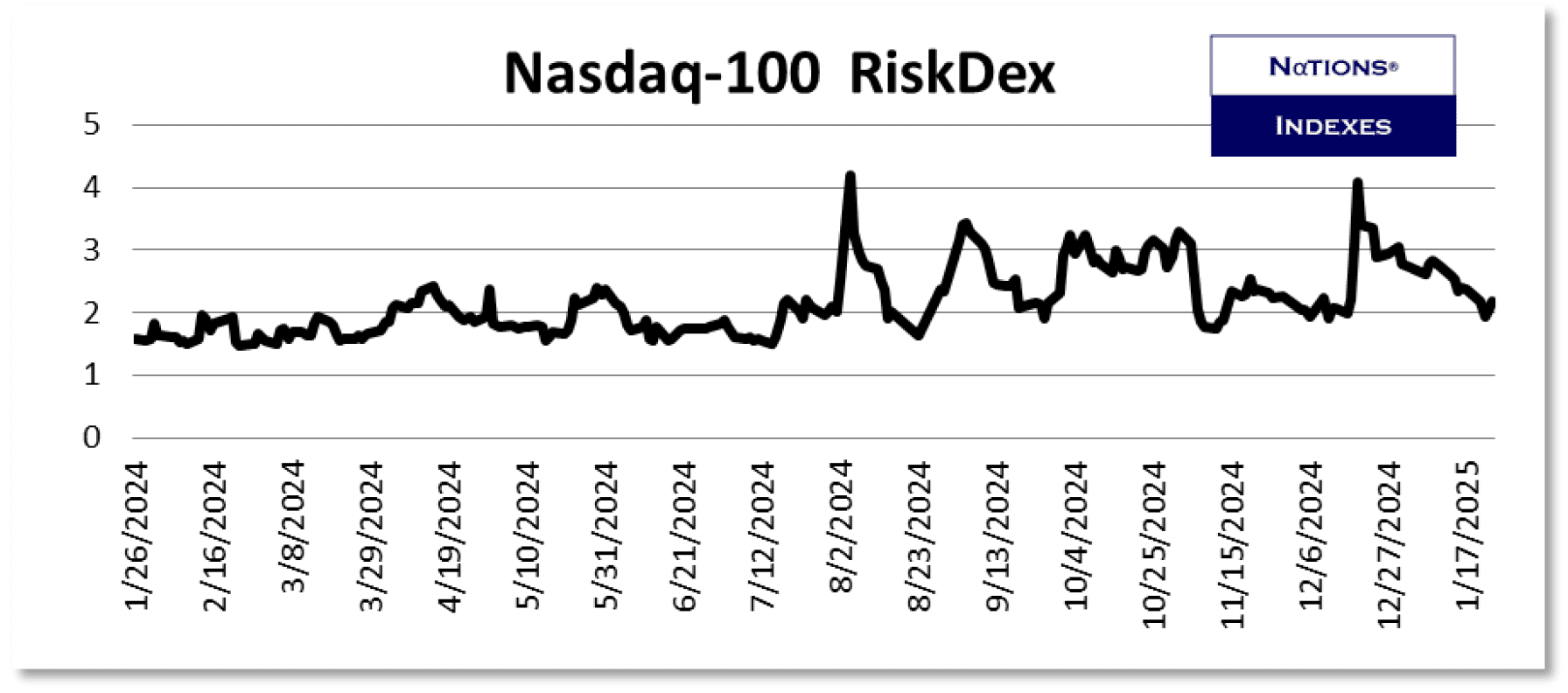
The Nasdaq-100 gained 1.55% on the week, a smaller gain than the S&P enjoyed, despite the announcement of grand plans for the Stargate AI consortium. VolDex on NDX fell by 7.07% (closing at the 12th percentile) and PutDex fell by 8.11% (14th percentile). TailDex rose by 4.63%.
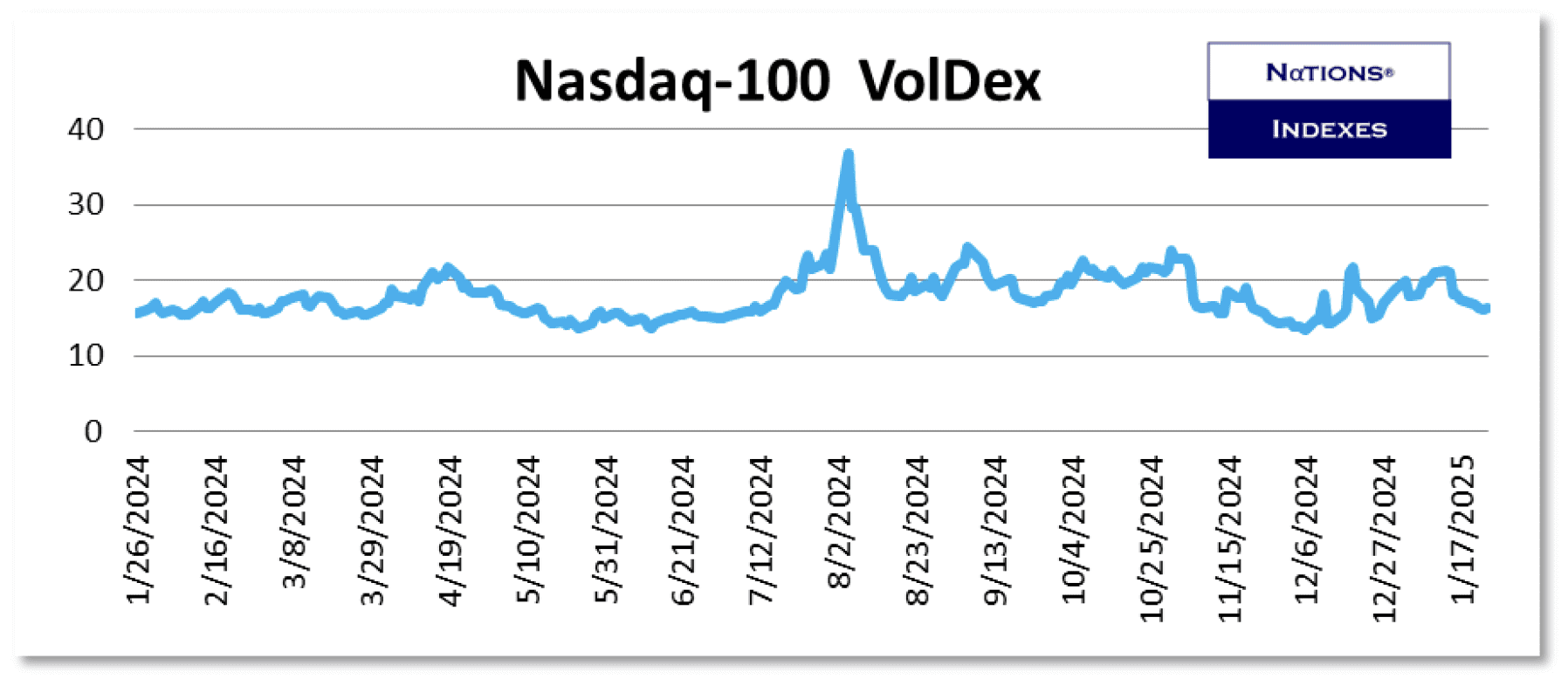
Figure 2
Implied volatility and option prices for the major equity indexes remain in “risk on” mode.
Why It Matters…Option prices are relatively low and equity prices are high. Option prices can certainly get cheaper and equity prices can certainly go higher but traders should be aware of the relationship as VolDex is at just the 10th percentile of its 52-week range.
The rampant buying of out-of-the-money calls as seen via CallDex has eased which suggests the most bullish traders are reassessing. Much of that buying interest has been tempered by concerns about technology earnings following AAPL’s downgrades this week. Technology investors remain very bullish but it appears many of them now want to see the coming week’s earnings reports before making any moves.
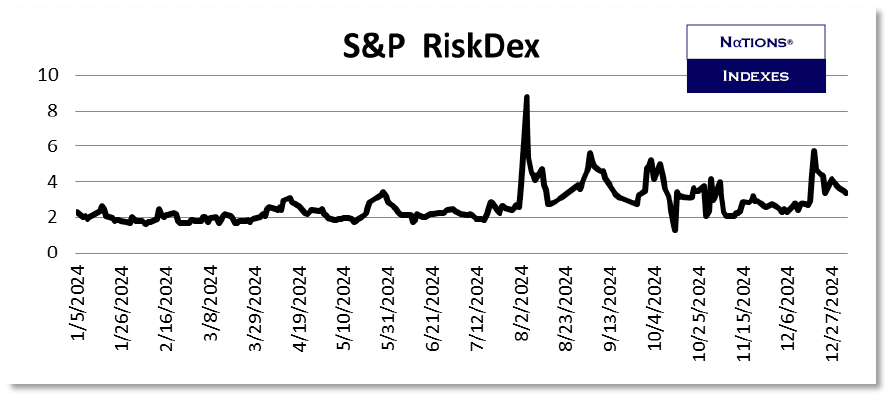
Figure 3
Nations Investor Optimism Index
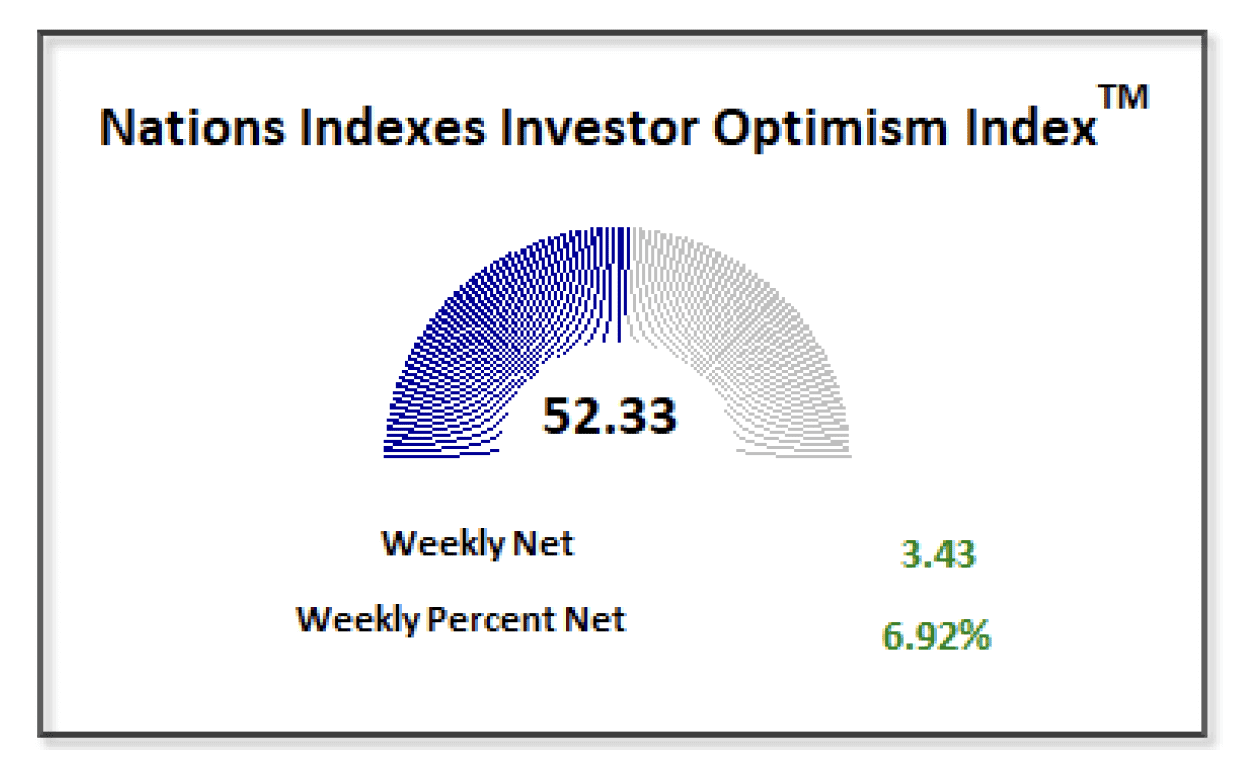
Figure 4
Investor optimism rose by 6.92% to close at a middle-ground value of 52.33 which is mildly bullish. The Optimism Index is not even higher because TailDex gained on the week and remains in the top half of the 2-year range we use for the Optimism Index.
Why It Matters…Our Optimism Index can be used as a contrarian indicator for BOTH equity prices and option prices. Any level below 20 can be considered a contrarian “Buy” signal in the S&P 500 and any level above 80 can serve as a warning to investors.
Deconstructing S&P Skew: It is important to deconstruct S&P option skew to understand what the option market is really saying. In a satisfying week, like this week, it can detail at which strike prices S&P option flows were concentrated.
As we continue to note, since VIX includes nearly all strike prices listed in the relevant expirations, it is impossible to know what is driving changes in VIX – is VIX higher because traders are reaching for call options or is it higher because they’re afraid and are buying puts?
This week saw uniform selling of options above the point that is 2.2 standard deviations below at-the-money (approximately $567.50 in SPY). Above that point, the selling was steady. Below that point put buyers prevailed. The fact that slightly out-of-the-money puts were sold on the week is another expression of the “risk on” mentality.
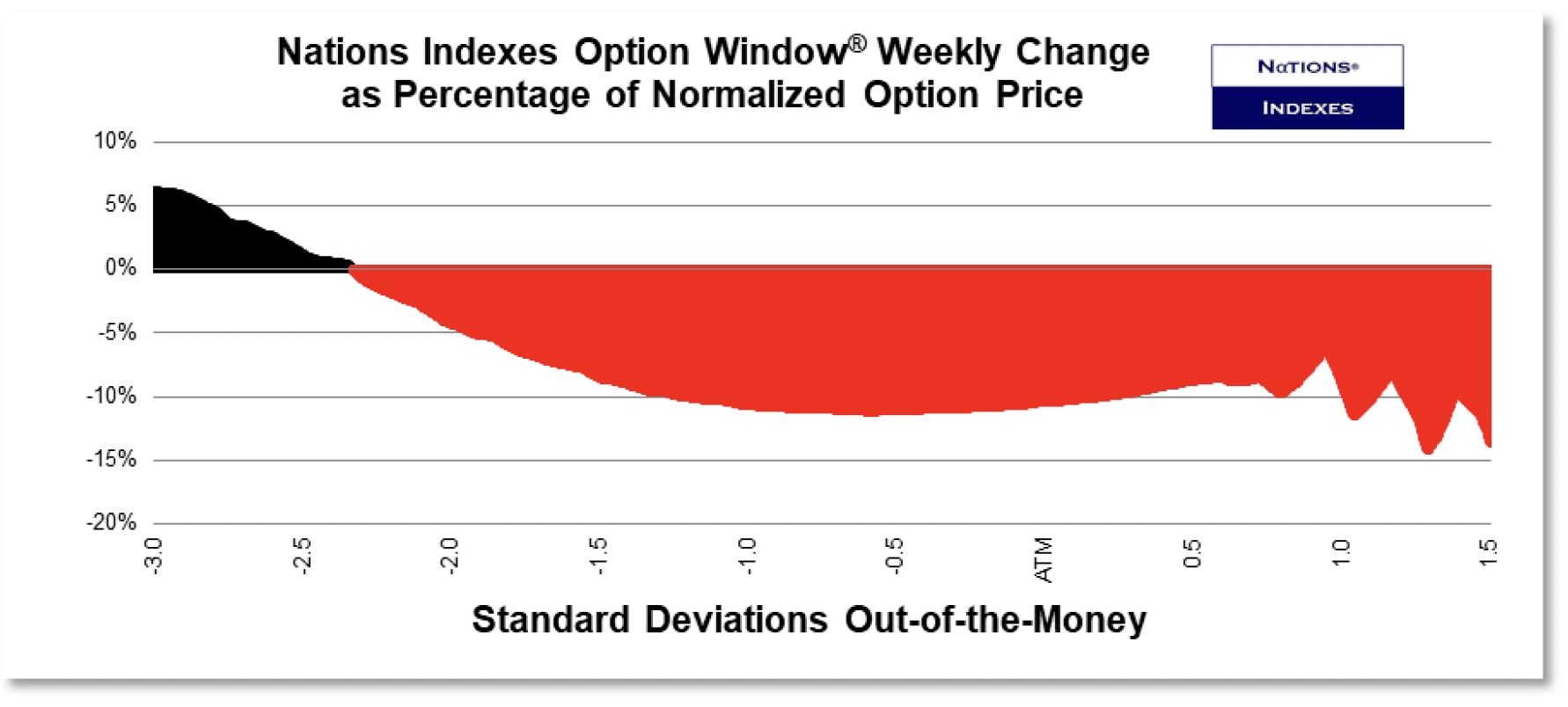
Figure 5
Other Equity Indexes
As we have discussed, the Nasdaq-100 rose less than the S&P 500 this week and Implied volatility for the Nasdaq-100 fell but by less than for the S&P 500.
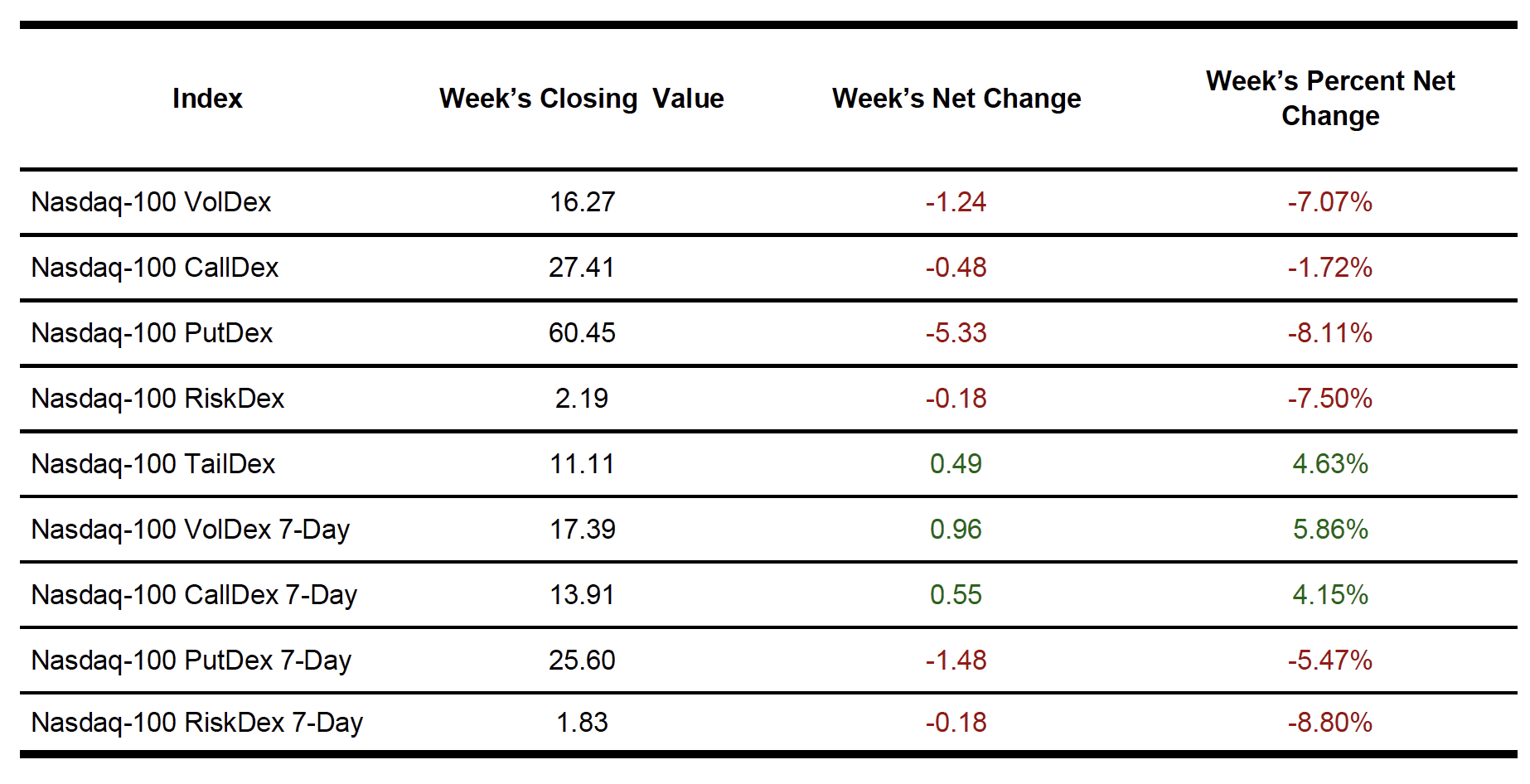
Table 2
WHY IT MATTERS…As we have pointed out the last two weeks, VolDex on the Nasdaq-100 is at a very low level which is surprising with tech earnings on tap for the coming week and con-cerns following the AAPL downgrade and loss of 3.13% on the week. NDX VolDex closed at the 12th percentile of its 52-week range. Nasdaq-100 PutDex closed at the 14th percentile.
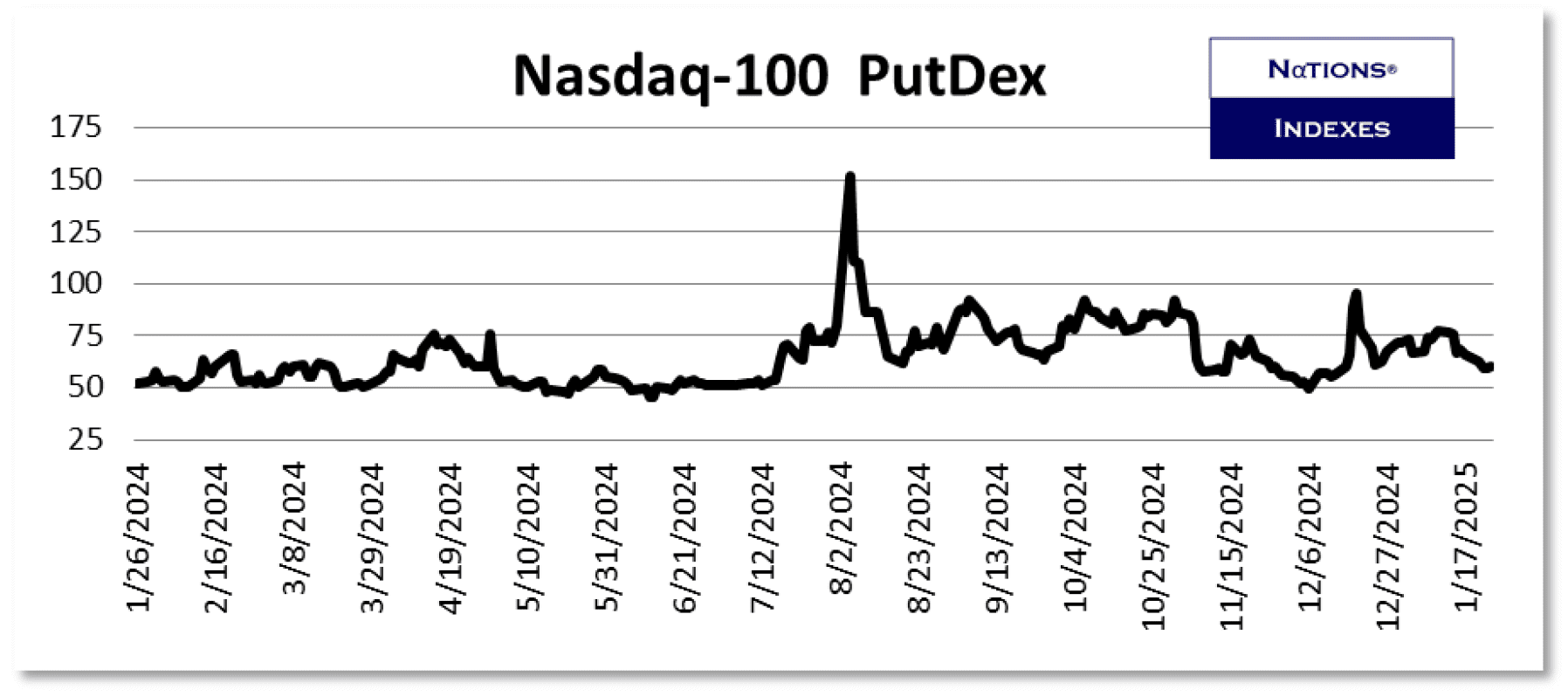
Figure 6
Buying outright puts can be very expensive but owning protective put spreads can be a much cheaper way of getting protection. For example, in the QQQ February 21 expiration, the 525/500 put spread could have been purchased for 4.95 on Friday’s close with QQQ at 529.63.
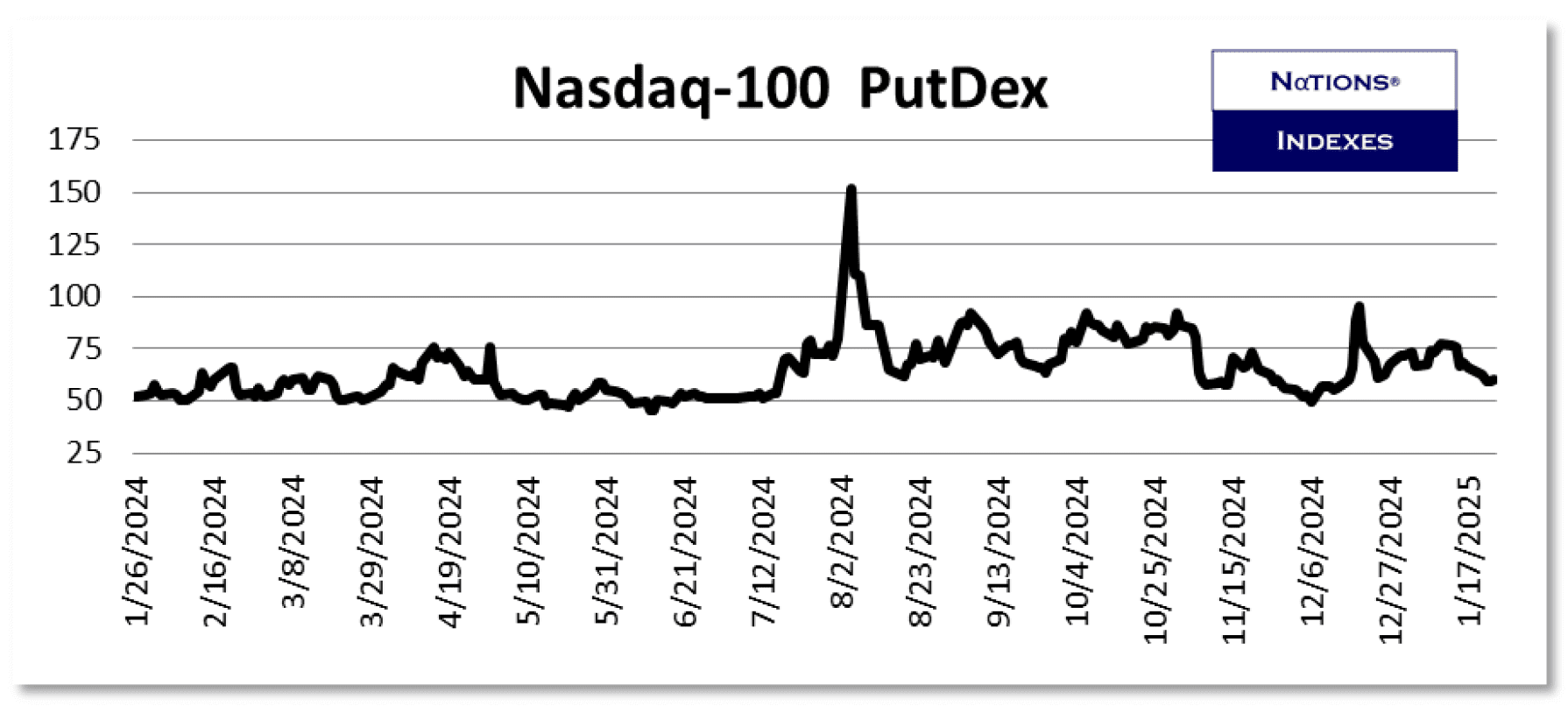
Table 3
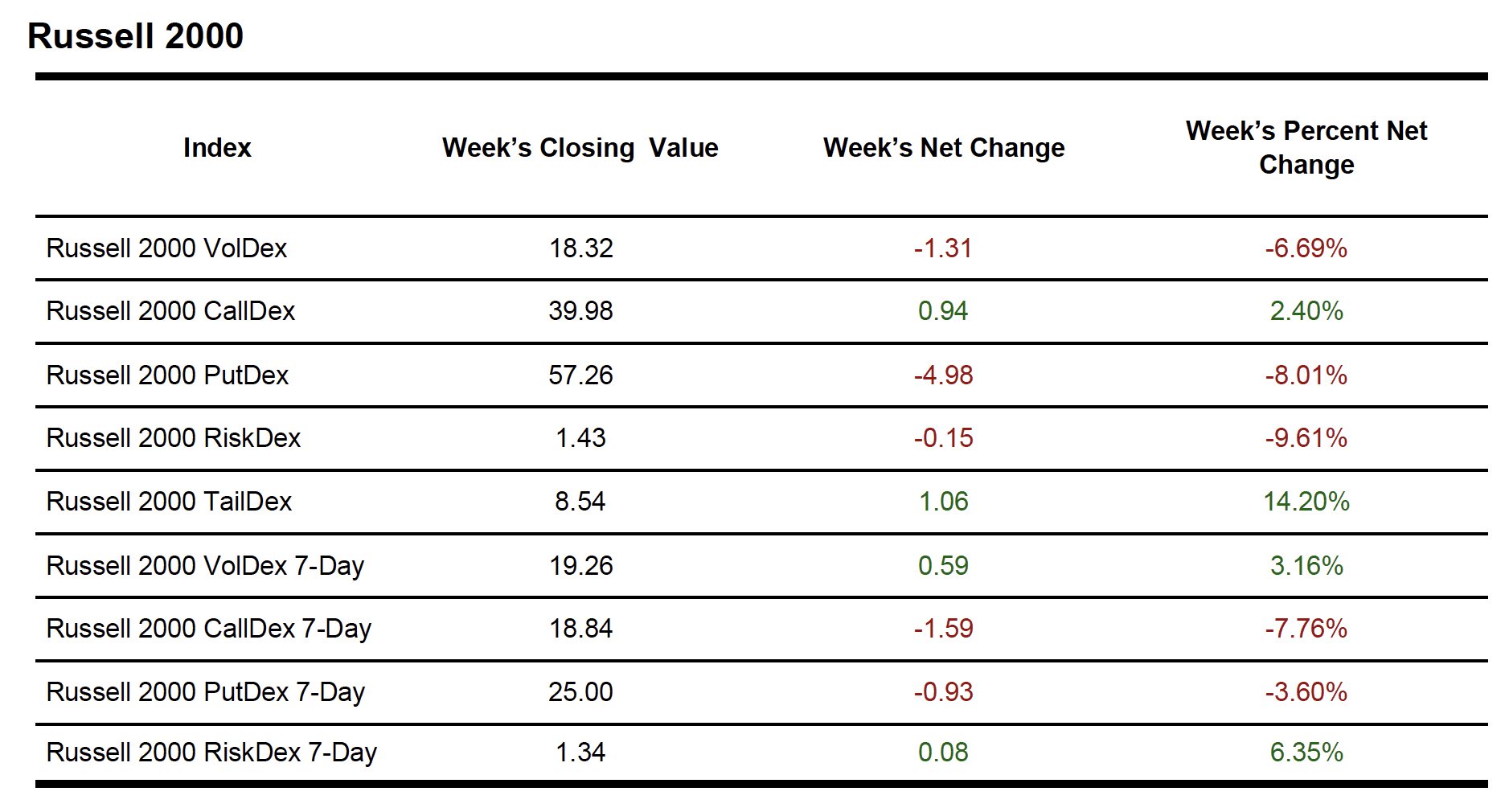
Other Asset Volatility
Treasury Bonds
VolDex on treasury bonds
Our 30-day Dexes on treasury bonds fell across the board this week as rates remained below last week’s new 52-week highs.
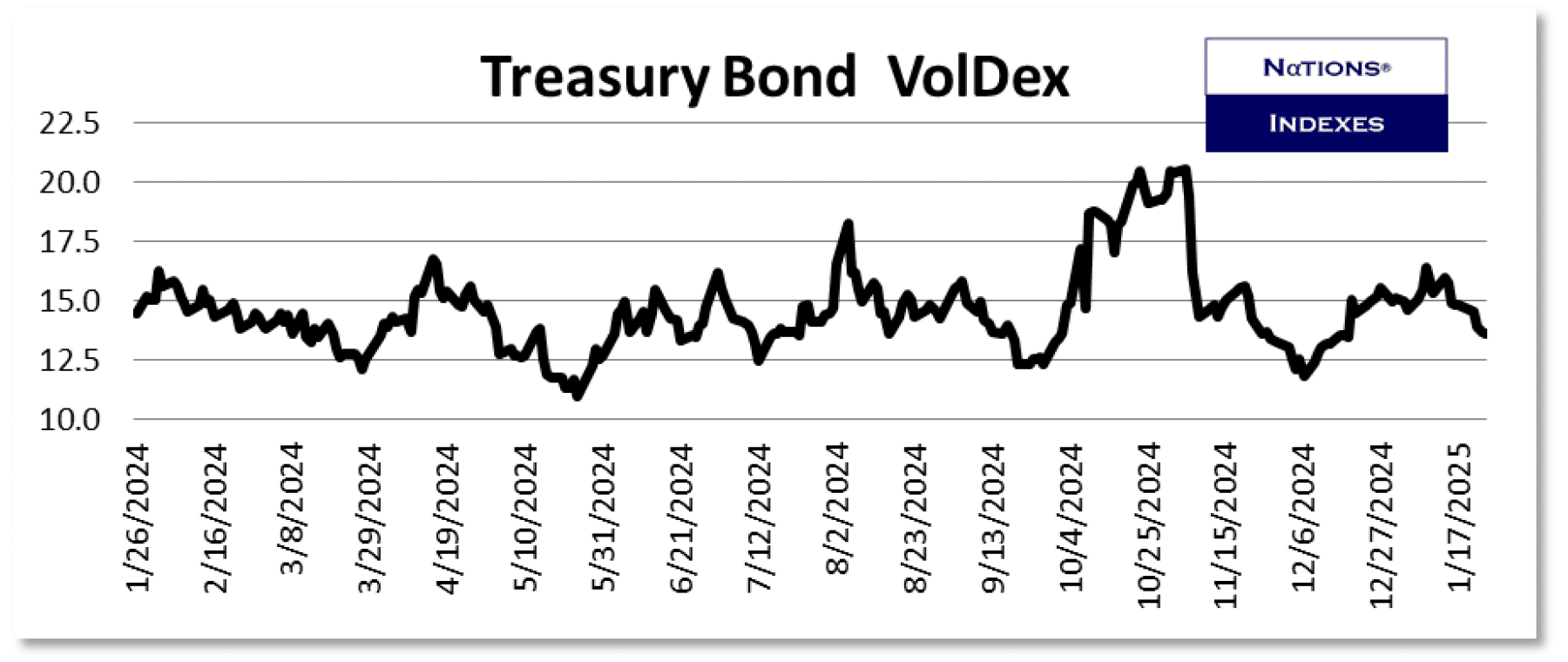
Figure 7
At Friday’s closing level of 13.58, VolDex on treasury bonds is at its 28th percentile while PutDex is at its 47th percentile and CallDex is at its 36th percentile. It is interesting that out-of-the-money options, both puts and calls, are higher in their respective 52-week ranges than VolDex.
WHY IT MATTERS…Relative positions in the 52-week ranges means traders see a reasonable likelihood for bond prices to move but they’re choosing to buy out-of-the-money options rather than at-the-money options to participate. This can mean they expect relatively large moves. 30-day RiskDex of 1.04 means traders believe the move could be in either direction.
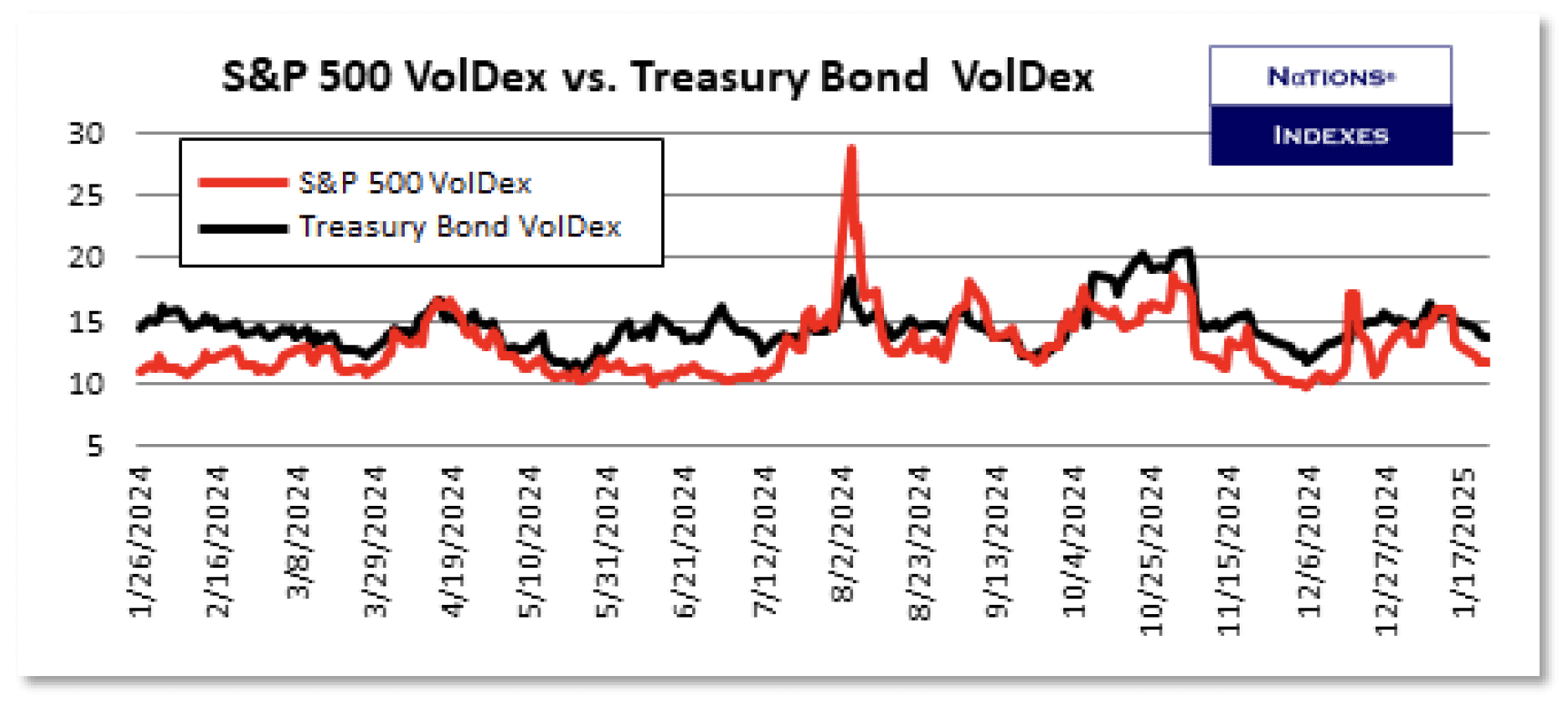
We have found that comparing VolDex on the S&P 500 and VolDex on treasury bonds can be instructive. VolDex on the S&P 500 is more volatile than VolDex on treasury bonds but their rel-ative levels can lead to innovative trade structures.
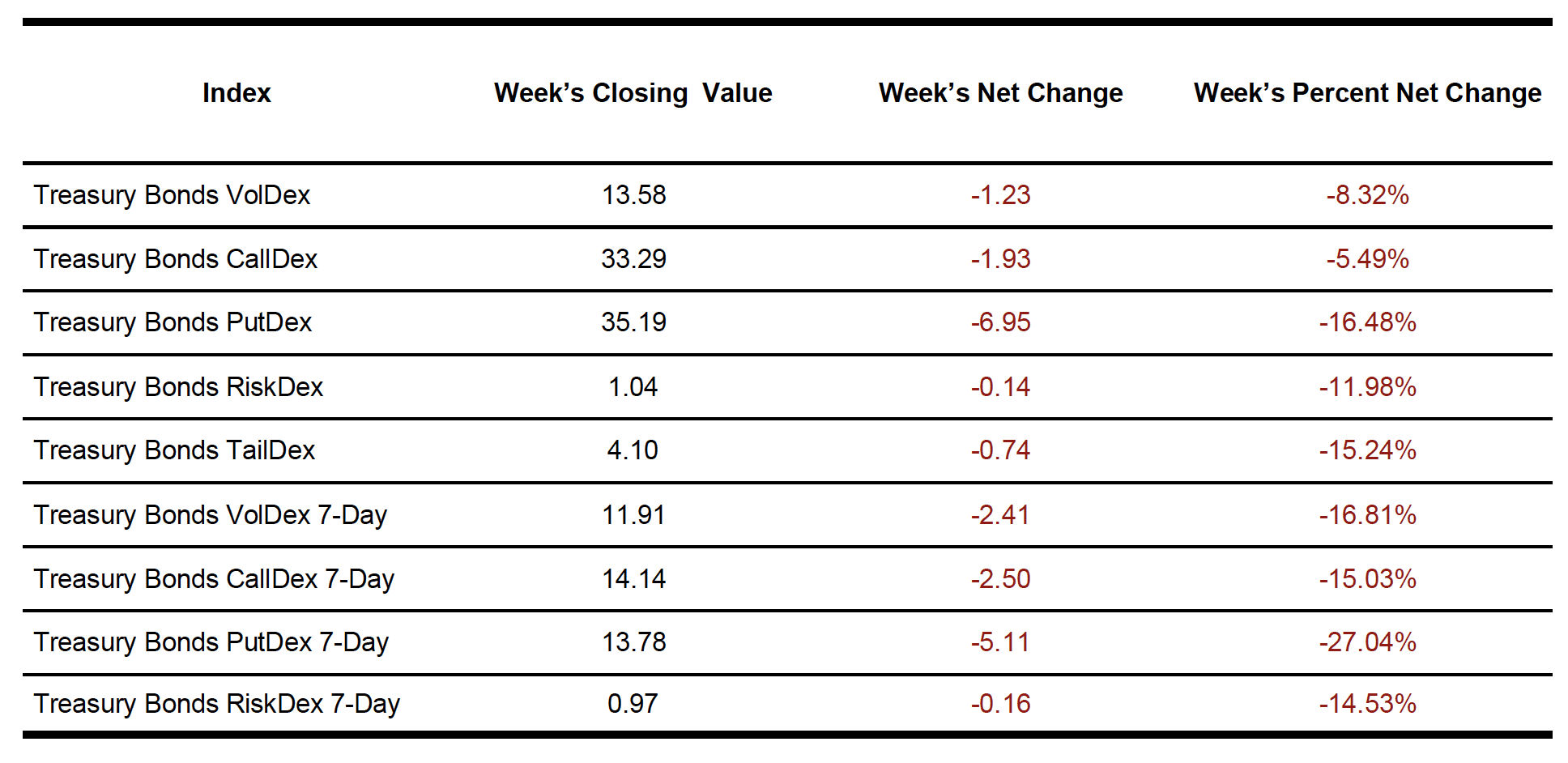
Table 4
Bitcoin
VolDex on Bitcoin
VolDex on bitcoin closed at 55.83 on Friday, a decline of 8.73% for the week. VolDex on bitcoin seems to be falling out of its initial range which was above the 60.00 level but it is do-ing so in fits and starts, closing at 60.11 on Thursday. Defined-risk positions which are short volatility in bitcoin continue to make sense.

Table 5
0DTE and 1DTE Options
Zero day to expiration (ODTE) options continued to account for the majority of SPY option volume, with 52.36% of this week’s SPY option trading being 0DTE.
Very short-dated volatility measures which use a variance swap methodology, as 1-day VIX does, inject significant error into the resulting measure because of the way out-of-the-money op-tions trade in the hours before expiration. The VolDex at-the-money methodology is particularly suited for these very short-dated tenors.
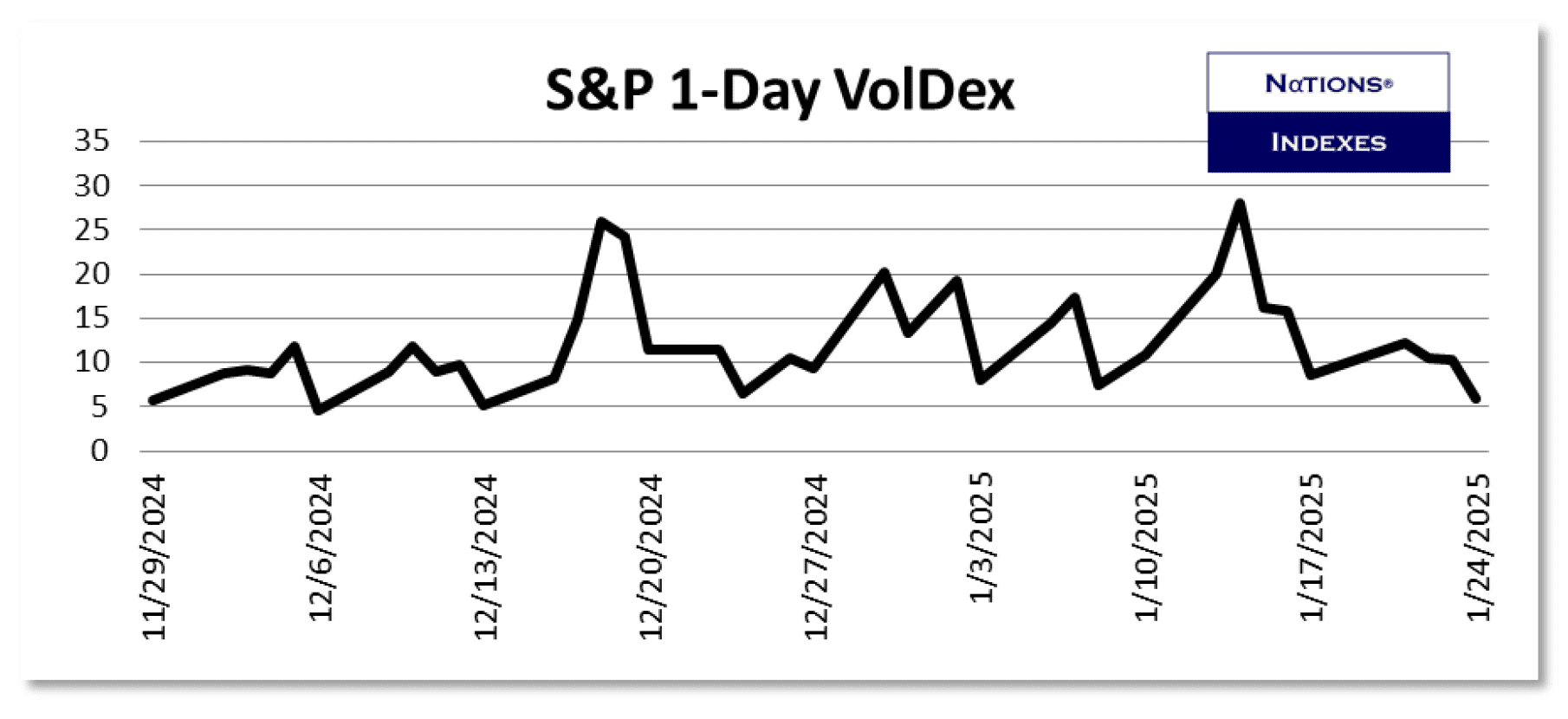
Figure 8
Equities
News among the individual names we cover was dominated by AAPL’s downgrade and subsequent 3.13% decline and speculation regarding the impact of the Stargate AI initiative. The optimism for the $500 billion spend to advance AI waned later in the week as many questioned the ability of the participants to raise that much capital.
AAPL’s decline followed the previous week’s loss of 2.90% and VolDex on AAPL rose 6.69%. NVDA saw its implied volatility rise the most with VolDex gaining 8.34%.
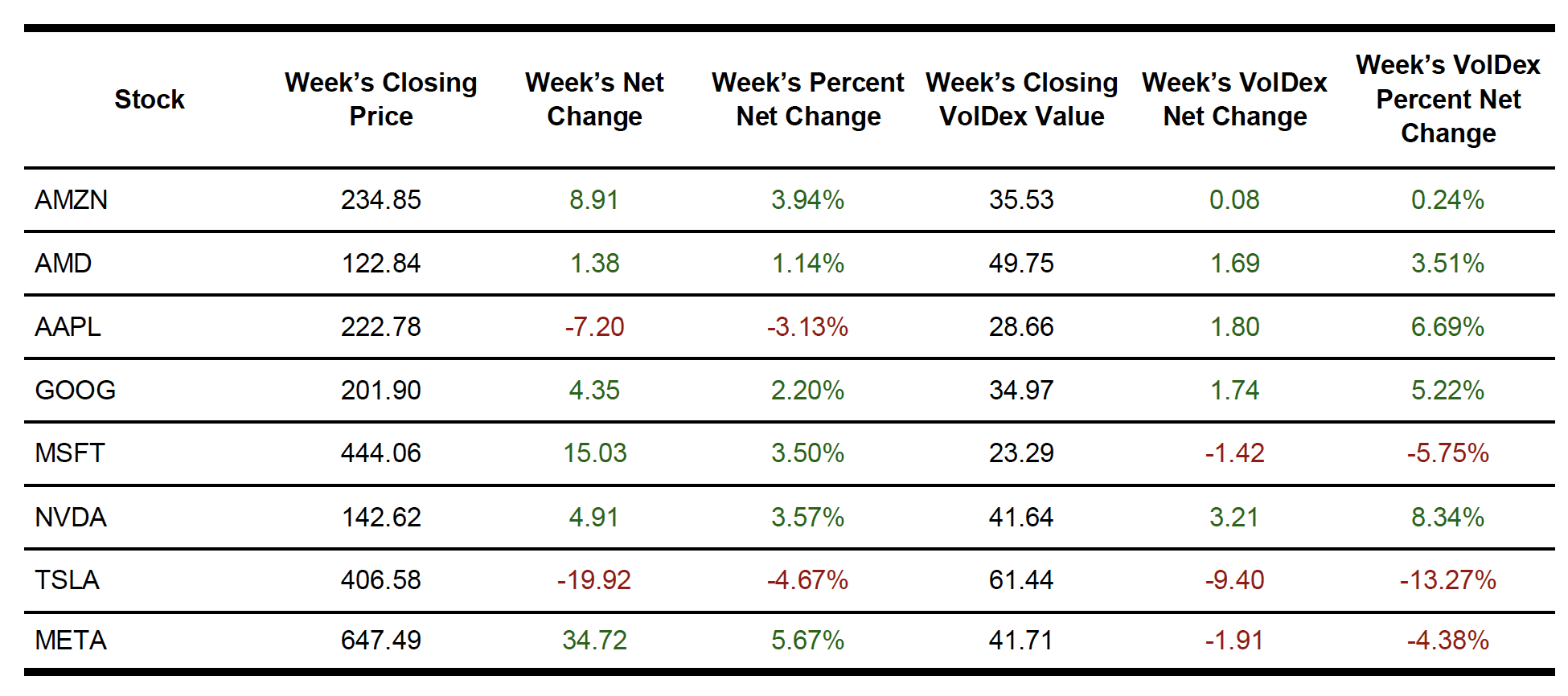
Figure 9
Scott’s Weekly Commentary
The last two weeks have been very satisfying for bulls as the equity market remains in “risk on” mode as the worst fears regarding tariffs faded. The talk regarding tariffs by this administration seems more of a bargaining position than a strongly held belief and I now believe we will see some minor tweaking of, or minor increases in, some tariffs which will lead the administration to declare victory and move on to initiatives that are less concerning for investors.
The looming tech earnings are the thing to watch in the coming week and while the price action in AAPL shares is concerning. The fact that the best performers of the last week (AMZN, +3.94%; GOOG, +2.20%; and MSFT, +3.50%) are the less flashy names is generally good for the broad equity market. Something really disappointing from NVDA, now the largest name in the S&P 500, would be really ugly but I think management would have given some sort of warn-ing if results were going to fall short of expectations. That said, what they have to say about guidance is the market’s inkblot in that it can be interpreted many different ways.
Last week I mentioned that breadth in the S&P is pretty poor with the average drawdown from the 52-week high for all constituents coming in at 14.40%. That improved this week and now that number is 13.74%. The number of constituents within 10% of their 52-week high also im-proved from 224 to 238. That is still distressingly less than half but breadth continues to im-prove which is good news.
Regarding traders, option prices on equity indexes remain relatively low despite the most im-portant earnings releases due this week. Long option positions can be used to support nearly any outlook, bullish or bearish. That said, remember that the volatility crush in individual names can be daunting following release of earnings.
Everyone at Nations Indexes hopes you have a great and profitable week!
Scott
