

Your Week’s Volatility Market Commentary — Information Is Your Edge
Slowing Growth, Disappointing Sentiment, and Rising Inflation.
The Weekly Takeaway:
- The S&P 500 fell by 1.66% for the week thanks to a loss of 1.71% on Friday;
- Friday’s loss was due to reports of slowing economic growth, disappointing consumer sentiment, expectations for increases in inflation, and uncertainty regarding the impact of new tariffs;
- VolDex (ticker VOLI) rose 22.10% on the week to close at 14.42 ending a series of 4 declines in the previous 5 weeks. It closed the previous week at just the 12th percentile of its 52-week range and closed this week at just the 25th percentile of that range;
- TailDex (ticker TDEX) rose by 38.29% and closed at 18.14. That is the 3rd consecutive weekly increase; TailDex is now at the 32nd percentile of its 52-week range and investors continue to buy deep out-of-the-money puts for protection;
- Expectations for upside in the S&P have collapsed. CallDex fell by 16.70% for the week and closed at just 12.84. That is the 1st percentile of the 52-week range;
- VolDex on the individual names we cover was generally higher with TSLA bucking the trend as VolDex on TSLA fell by 0.78%. However, VolDex on every individual name we cover is still below the 50th percentile of its 52-week range. PutDex on every individual name we cover is below the 50th percentile of the 52-week range;
- The Nations Investor Optimism Index fell 72.19% to close at just 12.37. That is the lowest daily close since 12/19/2024.

Equity Index Volatility:
The market’s worst fears about nearly everything were fueled on Thursday and Friday as it seems the economy is slowing, inflation is increasing, and uncertainty is rampant. There were also headlines which hurt the market, led by the Wall Street Journal report that UnitedHealth is being investigated by the Department of Justice for gaming the Medicare reimbursement system. The company later denied the allegations and questioned the story but the stock, a member of the Dow Jones Industrial Average, still lost 7.17% on the day.
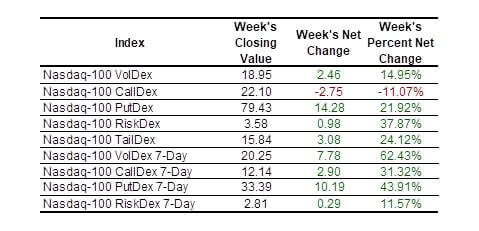
The Nasdaq-100 didn’t do any better than the S&P. The NDX lost 2.26% for the week.
Option implied volatility was up nearly across the board, as you would expect. S&P 500 PutDex rose by 30.27% on the week to close at 66.82 and RiskDex, the ratio of PutDex to CallDex, rose by 56.24% to close at 5.17. That is the 49th percentile of its 52-week range so the level of fear is rising and, as CallDex shows, optimism is fading.

The volatility picture in the Nasdaq-100 was very similar with every metric other than CallDex gaining on the week. RiskDex rose by 37.87% to close at 3.58. As we’ve pointed out in the past, RiskDex in NDX tends to be lower than on the S&P because investors are unwilling to truncate gains on the Nasdaq-100 by selling covered calls. This means collars can be executed at reasonable prices, albeit ones that are decidedly less advantageous than they were last week. Of course, that requires selling the covered call that would finance the long put.

Why It Matters…Last week’s bullish tone—with option prices relatively low and buyers rushing to buy out-of-the call options when the market was higher, has shifted. Will the current doubt about the market continue? We can’t know, but VOLI is still below its historical average closing price of 17.15. All our other option metrics point to option prices that are relatively low as well. This is to be expected when the market is making new highs, as it has done recently. But the VERY low CallDex value suggests stock replacement in the S&P 500 makes sense. With CallDex on the Nasdaq-100 at just the 7th percentile of its 52-week range, and below its historical average of 25.98, stock replacement with calls for QQQ is also logical.

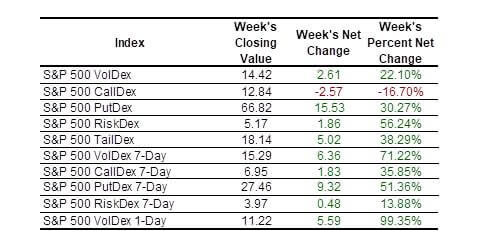
Why It Matters…Systematic call selling products focused on the S&P 500 have driven out-of-the-money call option prices down versus their ultimate value but this week’s price action in CallDex was extreme. This was likely caused by traders selling out-of-the-money calls to get short exposure to the market. Savvy traders can take advantage of this even if their outlook is bearish.
We like to pay attention to the relationship between PutDex and TailDex. If PutDex gains quite a bit more than TailDex that let’s us know that traders are bearish but reasonably so and don’t expect a “tail event.” The two rose more or less in tandem this week so there’s a moderate, and likely healthy, amount of fear.
Nations Investor Optimism Index:
The Investor Optimism Index collapsed, falling 72.19% and closing at just 12.37.
For the history of the Investor Optimism index going back to 2007, the average gain for the S&P 500 Total Return Index over the next 20 trading days when the Investor Optimism index closes between 10 and 20 is 1.07%. It is 1.48% when the index is below 20.

The Optimism Index is calculated using the 2-year range for VolDex, RiskDex, and TailDex and signals less fear and more optimism when those measures, and option prices, are low and less optimism, as it is signaling now, when those measures are relatively high.
The Investor Optimism Index has not closed above 50 since 1/24/2025 yet during that period the S&P Total Return Index has gained 1.39%. It can clearly serve as a contrarian indicator.
Deconstructing Skew:
We deconstruct S&P option skew to understand what the option market is really saying. Since VIX includes nearly all strike prices listed in the relevant expirations, it is impossible to know what is driving changes in VIX – is VIX higher because traders are optimistically reaching for call options or is it higher because they’re afraid and are buying puts?
Last week saw buying of all strike prices below the point that is 0.70 standard deviations above the at-the-money level in the S&P. That corresponds to approximately $619 in SPY.
The nature of the buying of puts is instructive. On Thursday we saw buyers of put spreads (i.e., buying of out-of-the-money puts and selling deeper out-of-the-money puts) to reduce the cost of the trade while taking advantage of put skew. That was indicative of hedging against a moderate decline. The increase in deeper out-of-the-money puts on Friday resulted in the action you see below.

Other Equity Indexes:
The Russell 2000 index of small capitalization stocks did even worse than the S&P or Nasdaq-100, losing 3.71% on the week.
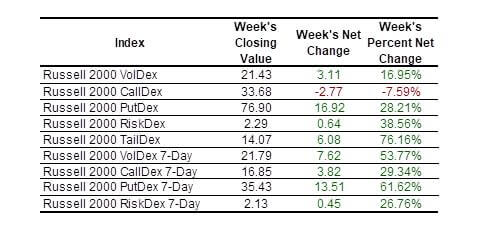
As we noted last week, Russell 2000 VolDex closed that week at just the 10th percentile, and 7-day VolDex closed at just the 5th percentile. Traders who took advantage of those levels to buy protection or to implement a bearish position had a very profitable week.
VolDex on the Russell 2000 closed this week at the 25th percentile and 7-Day VolDex closed at the 27th percentile. Mimicking the other equity indexes, CallDex fell by 7.59% and the 33.68 closing level is just the 3rd percentile of the 52-week range.
Other Asset Volatility:
Treasury Bonds:
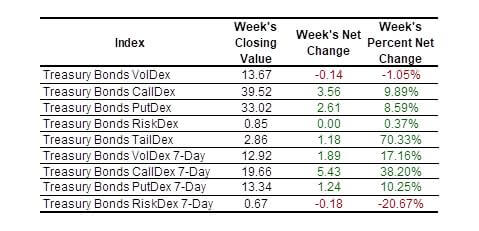
The yield on 10-year treasury notes fell from 4.472% to 4.420%. Some of the decline is a response to expectations for slowing economic growth and some was a move out of stocks on Friday.
Our Dexes on treasury bonds were mostly higher for the week with VolDex ticking slightly lower. The more interesting move was the increase in CallDex which gained 9.89%. RiskDex closed at 0.85, a slight gain, meaning traders still prefer call options to put options.
The rally in TailDex was from a very low level. The TailDex on treasury bonds closed at the 52-week low on Friday, 2/14/2025.

Since TLT, the security underlying our treasury bond metrics, is displaying call skew (out-of-the-money call prices higher than out-of-the-money put prices as evidenced by RiskDex being below 1.00), buying call spreads can be a lower cost way to protect against a decline in EQUITY prices. Any steep drop in equity prices is likely to fuel flight to quality buying in treasuries. And buying call spreads (i.e., buying at– or just out-of-the-money calls and selling further out-of-the-money calls) takes advantage of that call skew since the implied volatility of the higher strike call options is higher than the implied volatility for at-the-money calls.
Bitcoin:
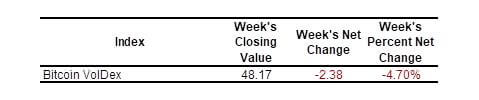
VolDex on bitcoin fell slightly on the week so our previous remark that “Defined-risk positions which are short volatility in bitcoin continue to make sense” worked out.
Bitcoin VolDex continues to fall and clearly continues to seek its equilibrium level having initially been above 60 when IBIT options launched. Current option prices make directional and long-volatility trades in IBIT unattractive.
0DTE and 1DTE Options:
Zero day to expiration (ODTE) options continued to account for the majority of SPY option volume, with 53.21% of this week’s SPY option trading being 0DTE. As we pointed out last week, 0DTE SPY volume no longer falls off dramatically when prices are particularly volatile. This is a positive for the SPY option market.
Very short-dated volatility measures which use a variance swap methodology, as 1-day VIX does, inject significant error into the resulting measure because of the way out-of-the-money options trade in the hours before expiration. The VolDex at-the-money methodology is particularly suited for these very short-dated tenors.

An Additional Note:
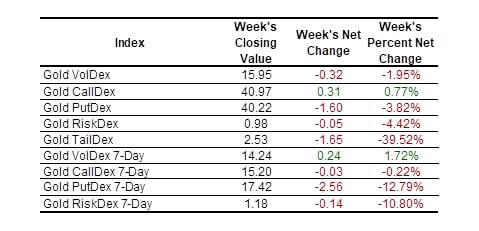
While we calculate all the Dexes on gold and silver and make that data available in real time at NationsIndexes.com, we don’t talk about them very often. VolDex on gold has shown very little volatility over the past year as you can see.

The 52-week high is 20.60 while the low is 9.79 and Friday’s close was 15.95 which is the 57th percentile of this range. While it seems equity options should be used in long-volatility structures given pricing, gold options at these lends lend themselves to a wider variety of structures including defined risk positions that are short volatility. RiskDex closed at 0.98 meaning out-of-the-money calls and out-of-the-money puts are trading at parity as you can see below.
Equities:
This week’s news was nearly universally bad for the individual names we cover as you would expect during a week when the NDX falls 2.26%.

VolDex increased for every name but one; TSLA VolDex fell slightly. VolDex for AMZN gained 13.36% and for MSFT it gained 11.22%.
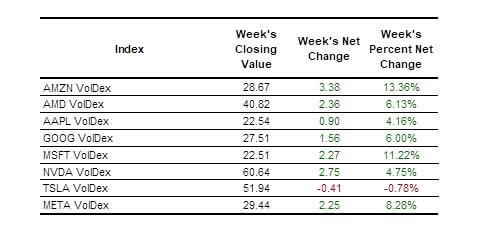
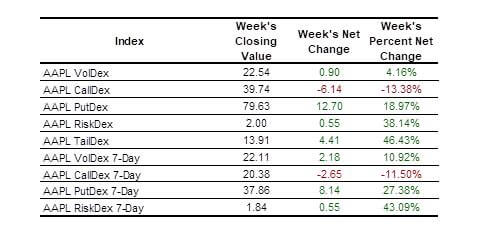
Given the movement in AAPL shares it seems the maker of the iPhone is viewed as more defensive than the other single names we cover. That makes it less susceptible to the tides of emotion surrounding AI but makes it unlikely to benefit from the hype.
TSLA continues to puzzle. In the previous week VolDex for all names fell with the exception of TSLA. This week that is reversed as you can see. The important news in TSLA is that RiskDex is above 1.00 suggesting a very small amount of put skew. This is the first time TSLA RiskDex has closed above 1.00 since 9/10/2024.
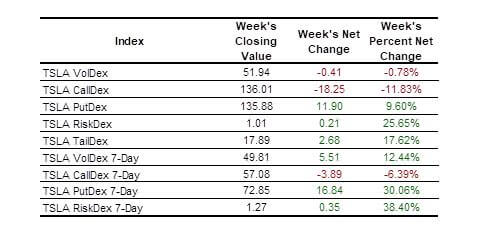
You can see the 52-week chart for TSLA RiskDex below.

Scott’s Weekly Commentary:
The market has focused on inflation in the context of the Federal Reserve cutting interest rates further and did an admirable job of shaking off worrying CPI data earlier this month. Now the concerns are spreading to economic growth which has been good if not great. If consumer and investor sentiment weakens, and investors hate uncertainty which we seem to have in abundance right now, at least in the political realm, then stocks will continue to very volatile and are likely to weaken.
Last week I pointed out that traders were back to buying dips but the across-the-board collapse in CallDex in both equity indexes and individual names means we should be watching very carefully for dip buyers to return. They have arrested recent declines including the DeepSeek and CPI induced ones.
NVDA earnings on February 26 will be critical for the market in the wake of the DeepSeek news. NVDA is up 99.24% for the past 52 weeks and much of that has been fueled by the belief that AI names had an insatiable appetite for NVDA chips at whatever prices NVDA demanded. We’ll see if that means true and I’ll pay particular attention to the guidance and listen for what the leadership has to say about DeepSeek’s ability to created a champagne caliber model on a beer budget.
We’ll get durable-goods data and the second reading of Q4 GDP on Thursday and PCE inflation data (the Federal Reserve’s preferred measure of inflation) on Friday. Buckle up if growth is slowing and inflation is climbing.
Everyone at Nations Indexes hopes you have a great and profitable week!
Scott
