

Your Week’s Volatility Market Commentary — Information Is Your Edge
Market has its worst week since September on tariff turmoil.
The Weekly Takeaway:
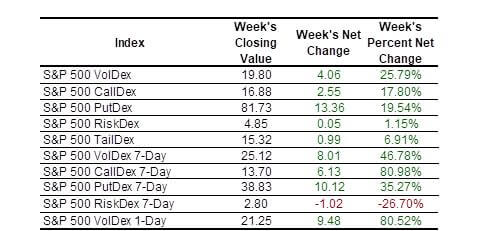
- The S&P 500 fell 3.10% for the week. That is its worst weekly performance since September. The S&P fell below its 200-day moving average for the first time since November 2023;
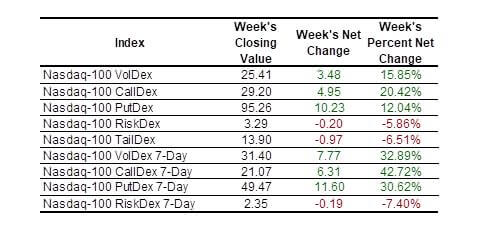
- The Nasdaq-100 fell by 3.27% after falling 3.38% during the previous week as AMZN, NVDA, TSLA, and META all lost more than 6% this week;
- VolDex (ticker VOLI) rose 25.79% on the week to close at 19.80 after trading as high as 24.65 on Thursday. It is now at the 53rd percentile of its 52-week range;
- TailDex (ticker TDEX) rose by 6.91% to close at 15.32 but this comes after it fell by 21.00% in the previous week. It is now at just the 26th percentile of its 52-week range. TailDex on the Nasdaq-100 fell by 6.51% to close at 13.90 after falling 6.09% during the previous week. It is now at just the 34th percentile of its 52-week range;
- CallDex and PutDex on the S&P 500 rose by 17.80% and 19.54% respectively as traders were buying options aggressively across the skew with the exception of deep out-of-the-money puts as measured by TailDex;
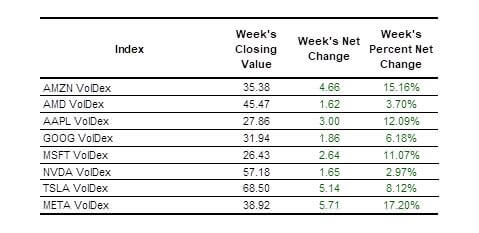
- VolDex rose for every single name we cover and META led the way with an increase of 17.20%;
- The Nations Investor Optimism Index fell by 49.39% to close at 6.90.

Equity Index Volatility:
The S&P had a horrible week. It lost more than 1% on three days and managed to stage another end-of-week rally (+1.77% during the last four hours of the trading day on Friday) to prevent a loss on the week of nearly 5%.
Markets were whipsawed by news that tariffs were going to be implemented or delayed. As one of our founders likes to point out, this is the sort of risk for which investors are not compensated.
The disparity between VOLI and TDEX has become a theme in the equity index space: traders and hedgers are bidding up at-the-money and just out-of-the-money options but are ignoring deep out-of-the-money puts. One reading is that traders and hedgers think any volatility will be sharp but contained and a “tail event” (a decline in share price of at least three standard deviations) is unlikely. Another is that hedgers bought deep out-of-the-money puts at high levels in August 2024 (TDEX closing high of 40.39) and again in December 2024 (TDEX closing high of 38.43) and “aren’t going to fall for that again.” Friday’s closing TDEX level of 15.32 is a long way from either of those peak levels but the market will determine who is correct.
The Nasdaq-100 lost 3.27% after losing 3.38% and 2.26% in the previous two weeks. It is now lower for the year by 3.86% and is 9.10% below its 52-week high.
Nasdaq-100 VolDex rallied by 15.85% this week to close at 25.41 but that is just the 51st percentile of its 52-week range.

S&P CallDex has rallied sharply from the 52-week closing low of 12.73 it made on February 25 and ended this week at 16.88. The high for the week was 23.35 made with the S&P on its low on Friday.

Why It Matters…For the past few weeks we have been pointing out that out-of-the-money SPY calls are a bargain and smart traders have been buying them delta-neutral (buying calls and shorting SPY to take the directionality out of the trade and turn it into a volatility trade) which has been very profitable. Savvy investors did as we suggested and used these calls for stock replacement and that has also been very profitable versus simply owning the stock market.
This is the real value of incorporating options into a portfolio; it offers the ability to create unique payoff structures that are superior to simply buying or shorting stocks and ETFs.
Interestingly, S&P RiskDex remains elevated despite the rebound in CallDex. It closed at 4.85 which is well above its historical median value of 3.42.
You can find the RiskDex fact sheet here:
The volatility picture in the Nasdaq-100 remains surprisingly calm given the decline in the index and even worse declines in the biggest names; AMD is more than 50% below its 52-week high, TSLA is down 46.23%, NVDA is down 26.41% and only AAPL has managed to avoid falling more than 10% below its 52-week high.
Nasdaq-100 PutDex gained 12.04% for the week but it remains below the midpoint for the past 52 weeks. These puts may be too expensive to buy outright now, but buying a put spread will reduce the cost of the position substantially and will take advantage of skew.

Why It Matters…For example, on the close on Friday with QQQ at 491.79, in the April 4 expiry, you could buy the 470 strike put for 6.60. But you could buy the 440/470 put spread (buying the 470 put and simultaneously selling the 440 put) at 4.30. This would reduce the cost of the trade by more than a third although it would truncate profits if QQQ is below 440 (a decline of at least 10.6%) at option expiration. This is not a recommendation but is simply an illustration of the type of structure options can generate.
Nations Investor Optimism Index:
The Investor Optimism Index fell again and is now at just 6.90 on a scale of 0 to 100.
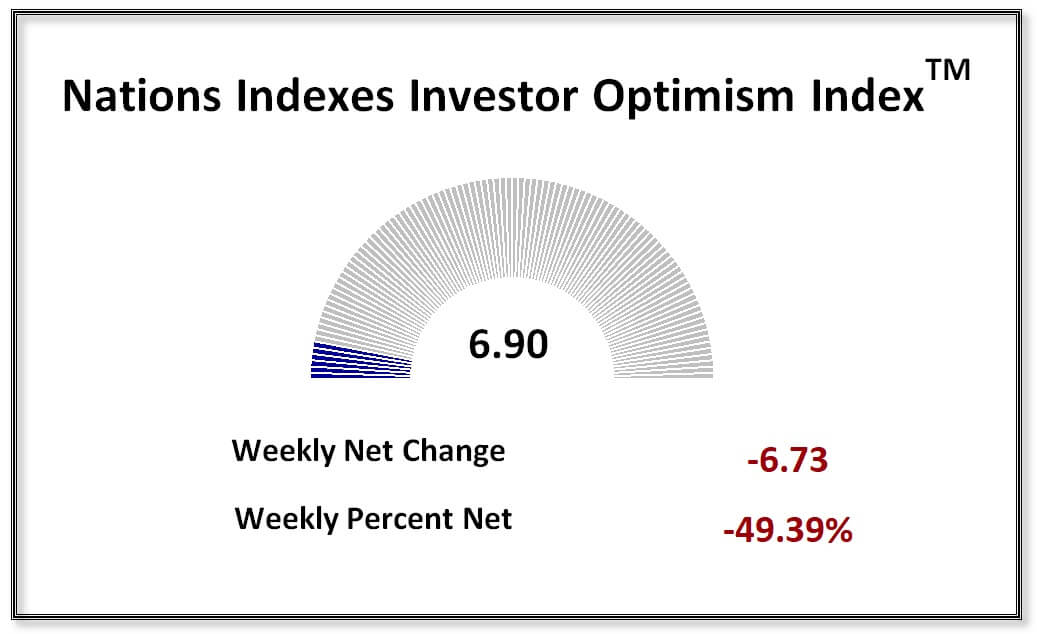
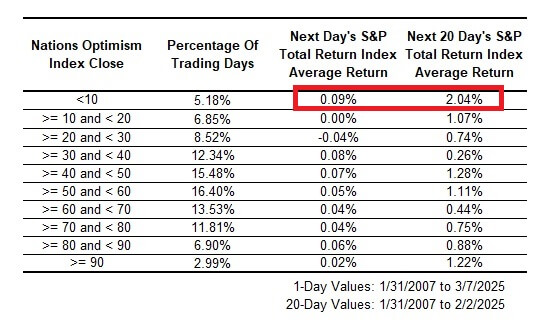
The index takes into account the current levels of S&P VolDex, TailDex, and RiskDex. It has not closed above 50 since January 24. The Index spends little time at extremes and has closed below 10 on just 5.12% of all trading days (initiation was on 1/31/2007).
It can serve as a great contrary indicator; you’ll notice both the best average 1-day and 20-day returns are generated when the index closes below 10 as it did on Friday. It doesn’t work all the time but it’s worth watching.
Deconstructing Skew:
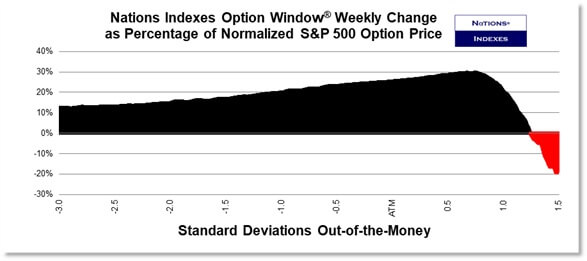
We deconstruct S&P option skew to understand what the option market is really saying. Since VIX includes nearly all strike prices listed in the relevant expirations, it is impossible to know what is driving changes in VIX – is VIX higher because traders are optimistically reaching for call options or is it higher because they’re afraid and are buying puts?
Why It Matters…Out of the money options were purchased at all strikes below 1.24 standard deviations above at-the-money (approximately $620 in SPY). The buying tapered off as strike prices got further below at-the-money as we’ve discussed above. Again, this means most traders expect continued volatility but don’t expect a dramatic decline in prices of at least 3 standard deviations (approximately $485 in SPY which would be a decline of 15.8%) during the next 30 days.
Other Equity Indexes:
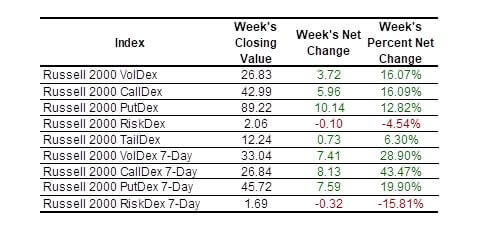
The Russell 2000 index of small capitalization stocks fell by 4.05% for the week. That’s worse than both the S&P 500 and Nasdaq-100.
Other Asset Volatility:
Treasury Bonds:
The yield on 10-year treasury notes rose slightly to 4.317%.
Our Dexes on treasury bonds were mixed as the catalyst of the unemployment data, which is particularly important for fixed income assets, passed on Friday with 151,000 new jobs created, in line with the 160,000 consensus estimate. Options that are just out-of-the-money fell, as you can see. Interestingly, TailDex on treasury bonds rose as some were hedging against, or speculating on, a sharp decline in treasury bond prices.
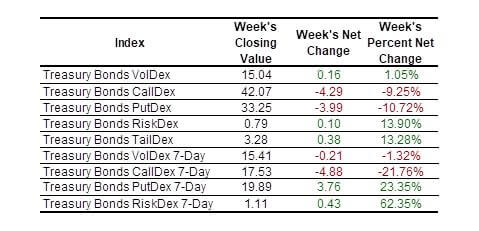
Why It Matters…You’ll note that while TailDex rose, PutDex fell. It closed at just the 17th percentile of its 52-week range. The likely thinking is that it is unlikely that treasury bond prices will fall, and the jobs catalyst is passed, so let’s sell out-of-the-money puts but let’s buy deep out-of-the-money puts to define risk in the event of unexpected news in the political sphere.

Bitcoin:
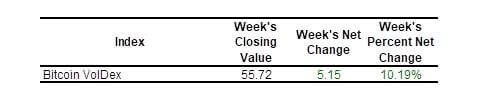
VolDex on bitcoin rose 10.19% after an anemic rally during the previous week as substantial volatility in bitcoin prices continued.
It certainly seems there are traders willing to sell gamma in bitcoin but some were buying back those positions this week as new option sellers are waiting for a return to less realized volatility.

0DTE and 1DTE Options:
Zero day to expiration (ODTE) options continued to account for the majority of SPY option volume, with 52.68% of this week’s SPY option trading being 0DTE. 0DTE options accounted for at least half of all SPY volume each day this week.
Very short-dated volatility measures which use a variance swap methodology, as 1-day VIX does, inject significant error into the resulting measure because of the way out-of-the-money options trade in the hours before expiration. The VolDex at-the-money methodology is particularly suited for these very short-dated tenors.
Equities:
This week’s news was again bad for the individual names we cover as you would expect during a week when equities are falling across the board. AMD managed to gain slightly on the week but it is more than 50% below its 52-week high so the gain doesn’t help much.

Love or hate Elon but his high profile seems to be hurting TSLA’s share price more than it is helping, although it has been a tremendous help in the past. The air continues to come out of the NVDA balloon and shares are now down 16.08% YTD. They’re now up only 21.60% over the past 52-weeks.
VolDex increased for every name we cover.
The decline in META’s share price and the jump in VolDex both deserve attention and we’ll continue to comment during the week via our X account, @Nations_Indexes.
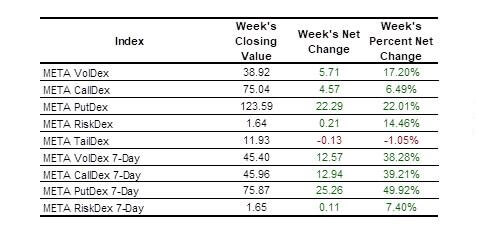
However, META VolDex is still in the middle of its recent range.
Why It Matters…This means a wide range of strategies are reasonable for a wide range of directional trade ideas in META. When VolDex is extremely high it makes more sense to use defined-risk strategies which are short volatility (e.g., selling vertical spreads) and when VolDex is very low it makes sense to buy options to express an opinion (e.g., buying outright options or buying vertical spreads).

Scott’s Weekly Commentary:
Last week I remarked that we are decidedly in “risk off” mode and that remains the case now, maybe even more so. It’s axiomatic that investors hate uncertainty and there is plenty of uncertainty right now with tariffs leading the way, at least from an economic point of view.
I hope, but can no longer be as certain as I was a month ago, that the administration’s position(s) regarding tariffs are just a negotiating ploy and that we’ll return to something similar to the status quo ante but with certain concessions from our trading partners. It seems Mexico is making the changes demanded but the risk is that China refuses to play this game and decides to shift from purely defensive to something offensive. That would make the things we buy more expensive and would likely stymie growth, a painful combination.
The Atlanta Federal Reserve’s estimate for Q1 GDP is troubling – they now believe it will decline by 2.4%. It is amazing how quickly the stock market pivoted from focusing on inflation to growth.
While all of the single names we cover are down more than the S&P 500, that index hasn’t done badly, losing just 1.89% YTD and 6.14% from its 52-week high.
Our implied volatility measures are back at reasonable levels for the amount of risk there seems to be – and the risk of a miscalculation on the part of a government regarding tariffs is a critical risk – but there’s no panic yet. I think the refusal of TDEX to rally is more a function of traders bidding up those deep out-of-the-money options back in August and December only to see the S&P recover leaving them with a bunch of worthless options. Are they learning the wrong lesson? Somewhat. Occasionally it makes sense for investors to buy those options for protection against something really ugly. You can’t own them all the time because they’re too big a drag on performance but being long those options as a hedge and then kicking yourself when they expire worthless is a little like owning life insurance and being unhappy it didn’t pay off.
Everyone at Nations Indexes hopes you have a healthy and profitable week.
Scott
