

Your Week’s Volatility Market Commentary — Information Is Your Edge
Tariffs Continue To Take Their Toll Despite Friday’s Rally.
The Weekly Takeaway:
- The S&P 500 fell 2.27% for the week after falling 3.10% during the previous week. The S&P was down 4.31% this week as of Thursday’s close but Friday’s rally of 2.13% cut that loss nearly in half;
- The Nasdaq-100 fell by 2.46% for the week after falling 3.27% during the previous week. It gained 2.49% on Friday;
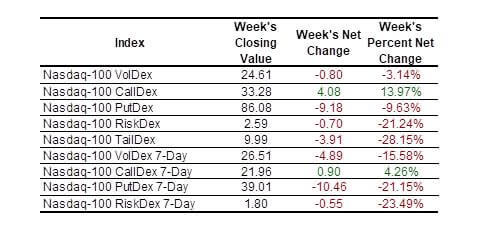
- VolDex (ticker VOLI) fell by 2.53% for the week to close at 19.30. It fell by 13.87% on Friday thanks to a combination of relief at Friday’s rally and the weekend effect. It closed at the 51st percentile of its 52-week range;
- TailDex (ticker TDEX) fell by 25.07% to close the week at 11.48. We have noted an unwillingness on the part of traders to buy deep out-of-the-money puts during this selloff but on Friday they took the opportunity to sell them aggressively. TailDex is now at just the 14th percentile of its 52-week range;
- PutDex on the S&P 500 fell by 10.27% as the same put selling pressure seen in TailDex extended to puts closer to at-the-money;
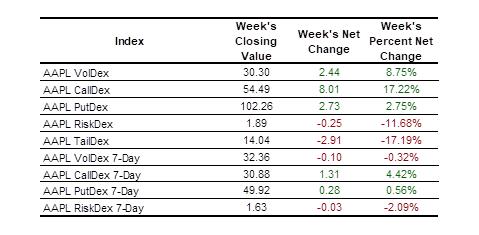
- VolDex fell for most of the single names we cover but rose by 8.75% in AAPL as the stock lost 10.70% for the week, and it rose by 0.85% in TSLA as the shares lost another 4.83%;
- The Nations Investor Optimism Index rose by 248.31% to close at 24.03.

Equity Index Volatility:
The S&P had a horrible first four days of the week with the only gain coming on Wednesday (0.49%). It’s loss of 1.39% on Thursday put it into a “Correction,” a decline of at least 10% from its recent high. It ended up losing just 2.27% for the week thanks to a 2.13% gain on Friday. Much of that gain was attributed to a lack of news about tariffs and buying by investors who were happy to snap up stocks at discounted prices.
The Nasdaq-100 was down 4.83% for the week as of Thursday’s close but cut that loss in half with a rally of 2.49% on Friday. The biggest names in the index had led the way downward with TSLA more than 50% below its 52-week high and NVDA more than 24% below its own 52-week high.
Investors have avoided purchasing index puts for protection despite the intensity of the sell off. S&P TailDex closed on Friday at just the 14th percentile of its 52-week range as mentioned above. S&P PutDex closed at its 39th percentile. Nasdaq-100 PutDex closed at the 41st percentile. Russell 2000 PutDex closed at the 36th percentile of its 52-week range despite the small cap stock index being 17.13% below its 52-week high. In fairness, Russell 2000 investors may believe the damage has already been done to small cap stocks.
Last week we mentioned that the disparity between VOLI and TDEX had become a theme in the equity index space, saying, “traders and hedgers are bidding up at-the-money and just out-of-the-money options but are ignoring deep out-of-the-money puts.” Friday’s rally seems to have shown them to be correct. However, the disparity is at an extreme level as you can see from the chart of the TDEX/VOLI ratio.
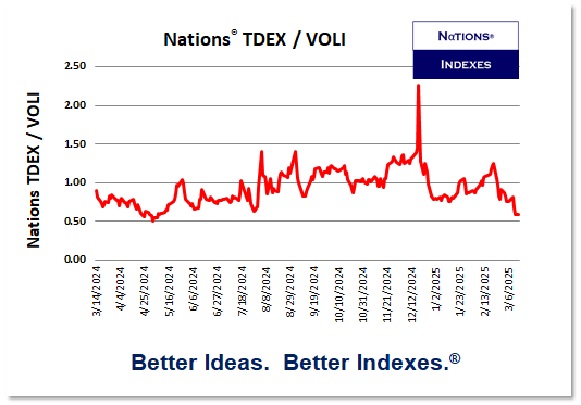
Traders and hedgers raced to buy protective puts in August when the S&P fell due to the Bank of Japan increasing interest rates and traders and hedgers bought puts again in December when inflation and interest rate policy troubled investors. TailDex spiked on both occasions but traders and investors are now refusing to buy deep out-of-the-money put options at nearly any price and were waiting for the opportunity to sell them, which they did on Friday.

Nasdaq-100 VolDex closed at 24.61 and lost 3.14% for the week thanks to a decline of 13.20% on Friday. That was its lowest close since March 5.
S&P CallDex continues to rally sharply from the 52-week closing low of 12.73 it made on February 25 and ended this week at 20.63. It was the only volatility measure on the S&P that gained ground for the week.
Why It Matters…For the past few weeks we have been pointing out that out-of-the-money SPY calls were a bargain in February and were good candidates for long volatility trades (by buying them delta-neutral) or for stock replacement. They are now fairly priced with Friday’s close at the 64th percentile of the 52-week range.

You can find the CallDex fact sheet here:
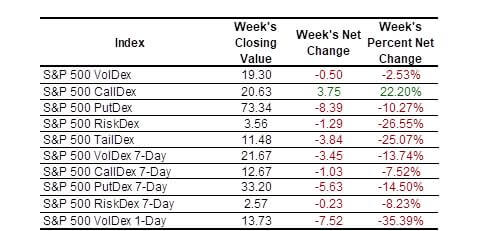
The volatility picture in the Nasdaq-100 was similar to that in the S&P with most metrics falling and only CallDex gaining on the week. Nasdaq-100 VolDex fell by 3.14% while CallDex rose 13.97%.

Why It Matters…Last week we illustrated the purchase of a QQQ put spread to take advantage of Nasdaq-100 PutDex being below the midpoint of its 52-week range despite losses in the Nasdaq-100 and its biggest names. In the April 4 expiry at the end of the previous week, you could buy the 440/470 put spread (buying the 470 put and simultaneously selling the 440 put) at 4.30. This week that spread closed at 6.10. This was not a recommendation but an illustration of the power of this data.

Nations Investor Optimism Index:
The Investor Optimism Index rose by 248.31% albeit from a VERY low level.
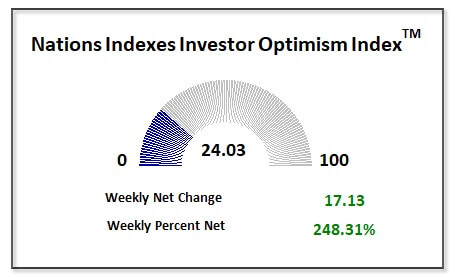
The index takes into account the current levels of S&P VolDex, TailDex, and RiskDex. It has not closed above 50 since January 24.
Historically, the S&P has averaged a 0.74% gain in the 20 trading days subsequent to the Optimism Index closing between 20 and 30.
Deconstructing Skew:
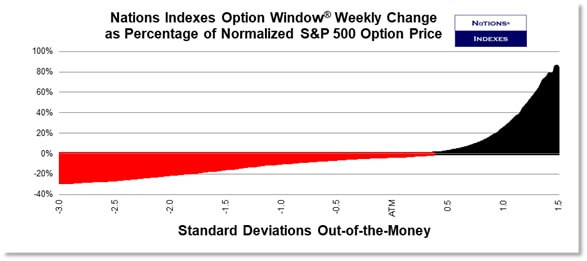
We deconstruct S&P option skew to understand what the option market is really saying. Since VIX includes nearly all strike prices listed in the relevant expirations, it is impossible to know what is driving changes in VIX – is VIX higher because traders are optimistically reaching for call options or is it higher because they’re afraid and are buying puts?
Why It Matters…This week marked a reversal of the price action from last week with strike prices below approximately $578 in SPY being sold. Does this action, and Friday’s rally in equity prices mark the turning point? We’ll continue to w
Other Equity Indexes:
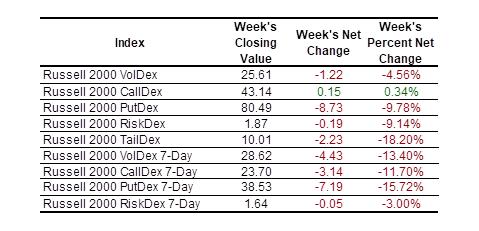
The Russell 2000 index of small capitalization stocks fell by 1.51% after falling 4.05% during the previous week. It is now down 8.34% YTD (worst of all the major equity indexes) and is 17.13% below its 52-week high (again, worst of all indexes).
All the option metrics for the Russell 2000 fell on the week with the exception of CallDex which rose only slightly. Compare this Russell 2000 CallDex action to that for the S&P and Nasdaq-100 and there is little reason to think the market is optimistic regarding small cap stocks. Russell 2000 CallDex is now at the 31st percentile of its 52-week range.
Other Asset Volatility:
Treasury Bonds:
The yield on 10-year treasury notes fell slightly to 4.308% on the back of fears about slowing growth and rotation from equities into the safe haven of treasuries.
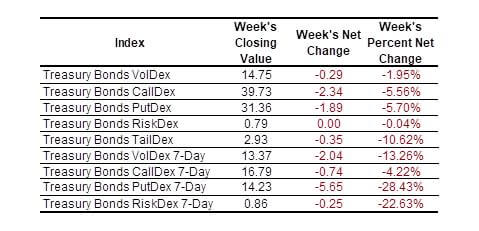
Why It Matters…The fact that ALL our option metrics on treasury bonds fell on the week is likely to be the best evidence that traders believe the worst is over for EQUITY markets. Since treasury bond prices would be expected to spike on a significant downdraft in equity prices, the decline in Treasury Bond CallDex is particularly noteworthy.

Buying out-of-the-money treasury bond call options continues to be an interesting way to hedge against a steep drop in equity prices although the price action in S&P TailDex means it is likely to be a better, and certainly more direct, way to hedge that exposure.
Bitcoin:
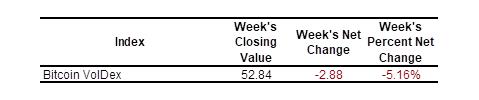
VolDex on bitcoin fell by 5.16%, consistent with the theme of volatility dropping. The price action in bitcoin brands it as a “risk on” asset rather than a “risk off” asset like gold.
Traders continue to be willing to sell options in bitcoin to take advantage of elevated volatility levels.
Gold:
Gold traded above $3000 an ounce for the first time this week as rates fell slightly and fears about growth, and even lower rates in the future, eased the opportunity cost of owning gold.
Gold VolDex rose by 3.08% and CallDex rose by 7.80%, reinforcing the bullish tone to gold. One unpredictable factor driving gold prices is the fear of tariffs on gold imported into the United States. That would likely drive prices even higher. Some call buyers in gold are opportunistic speculators willing to make defined-risk trades that would take advantage of such a spike.
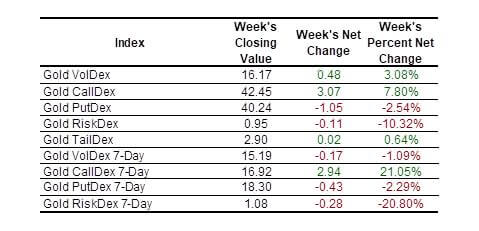
Gold CallDex has shown very little volatility of its own over the past year.

0DTE and 1DTE Options:
Zero day to expiration (ODTE) options continued to account for the majority of SPY option volume, with 54.61% of this week’s SPY option trading being 0DTE. 0DTE options accounted for at least half of all SPY volume each day this week but it continues to be higher on days when the S&P gains ground than on days when it loses ground. For example, the highest percentage occurred on Friday when 56.99% of all SPY option volume was in the 0DTE expiration.
Very short-dated volatility measures which use a variance swap methodology, as 1-day VIX does, inject significant error into the resulting measure because of the way out-of-the-money options trade in the hours before expiration. The VolDex at-the-money methodology is particularly suited for these very short-dated tenors.
Equities:
This week’s news was mostly bad for the individual names we cover with the exception of NVDA which arrested its decline as you can see. The drop in AAPL shares was surprising as it had been the best relative performer among these names. TSLA continued to decline and it seems clear the share price is being driven by external factors rather than fundamentals for the EV maker.

VolDex declined in most of the names we cover. AAPL is one exception, as you would expect during a week when the shares fell by more than 10%.
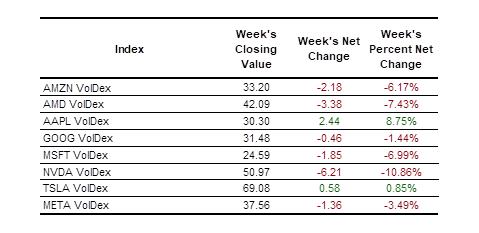
The decline in Apple’s share price and the jump in VolDex both deserve attention because AAPL shares had held up so well prior to this week. We’ll continue to comment during the week via our X account, @Nations_Indexes.

Scott’s Weekly Commentary:
No news was good news on Friday as the market rallied strongly thanks to a lack of any tariff turmoil. As I’ve said recently, using tariffs as a negotiating ploy is one thing, but the risk is that some country’s leadership makes a strategic error or over reacts, and tariffs are actually implemented and remain in place long enough to do significant damage. A 25% surcharge for electricity coming over the border from Canada would be an example.
I think the market’s sigh of relief was overdone as the array of imports that might be subject to tariffs continues to grow in size and now includes alcohol. California wine makers have over-produced recently and a 200% tariff on “Old World” wines would clear out the surplus in California but what American product does Europe then impose tariffs on?
Inflation continues to fade as the number one threat to the economy and it is being replaced by economic growth, or the lack thereof. The Atlanta Federal Reserve will update its estimate of Q1 GDP on Monday but the previous estimate was a decline of 2.4%.
I was struck by the respective price action of AAPL and NVDA this week. I think some investors who bailed on NVDA in the post-DeepSeek sell off cycled into AAPL shares as a pseudo-safety trade. That seems to have reversed this week. NVDA is down 9.40% YTD and is now up “just” 38.35% over the past 52 weeks. The forward PE is 27.0. That is a situation that can draw dubious investors back. I’ll continue to watch these two closely.
Everyone at Nations Indexes hopes you have a healthy and profitable week.
Scott
