

Your Week’s Volatility Market Commentary — Information Is Your Edge
Stocks Fall as Renewed Tariff Talk Liberates Sellers
The Weekly Takeaway:
- The S&P 500 lost 1.53% for the week as Monday’s optimism faded. The index lost ground each of the last three days of the week including 1.97% on Friday;
- The Nasdaq-100 lost 2.39% for the week. Every single name we cover fell for the week with the exception of TSLA. AMD, GOOG, MSFT, NVDA, and META all lost more than 3%;
- VolDex (ticker VOLI) gained 13.81% to close at 19.12. It is at the 50th percentile of its 52-week range;
- TailDex (ticker TDEX) gained just 4.07% for the week despite gaining 16.28% on Friday. We have noted an unwillingness on the part of traders to buy deep out-of-the-money puts during the “tariff” selloff and while they paid up on Friday, the trend was evident during the first four days of the week;
- TailDex is near its lowest level compared to VolDex of the past 52 week;
- PutDex on the S&P 500 rose by 9.51% but fell by 13.56% in the previous week. It is at just the 35th percentile of its 52-week range;
- Option prices for the Nasdaq-100 increased across the skew with VolDex gaining 11.88% as PutDex rose 11.80% as CallDex rose 10.85%;
- Implied volatility generally rose for treasury bonds but, interestingly, PutDex fell by 2.06%;
- VolDex rose for all the single names we cover. It is now above 75 for TSLA and above 40 for AMD, NVDA, and META;
- The Nations Investor Optimism Index fell by 25.20% for the week to close at 22.17. It has not closed above 50 since January 24th.

Equity Index Volatility:
The S&P enjoyed a nice rally on Monday (1.76%) but that was more than undone during the final three days of the week. It avoided falling back into “correction” territory and closed 9.22% below its 52-week high.
PutDex is at just the 35th percentile of its 52-week range indicating only moderate fear despite the price action. RiskDex, the ratio of PutDex to CallDex, closed the week at just the 32nd percentile of its 52-week range so out-of-the-money puts in SPY are still reasonably priced in relation to out-of-the-money call options. This offers an opportunity for investors contemplating a collar strategy on SPY shares they own (a collar includes selling a covered call and using the proceeds to purchase a protective put).

The Nasdaq-100 lost 2.39% for the week as the biggest names lost more ground. VolDex closed at the 47th percentile of its recent range and PutDex closed at the 38th percentile of its 52-week range. As in the S&P, there is relatively little fear for the Nasdaq-100.

Why It Matters…Over time, options cost more than they are worth. This means that constantly owning protective put options is a drain on your portfolio. But owning them tactically or as a speculative trade when they are cheap in relation to history and current risks can be wise.

You can find the PutDex fact sheet here:
Below you’ll see the week’s results for our indexes on the S&P 500.
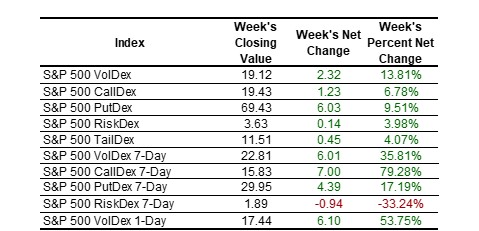
Why It Matters…Our index values are intended to provide option traders with objective data so they can trade with insight rather than a hunch or intuition.
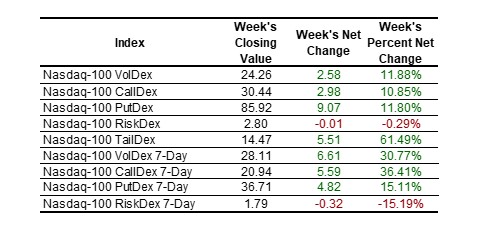
We have pointed out in the past that different underlying assets show different RiskDex levels. Nasdaq-100 RiskDex is lower than S&P 500 RiskDex because NDX investors are less willing to sell covered calls and have less interesting in buying protective puts. Savvy traders can take advantage of this by spreading QQQ options versus SPY options in defined-risk structures.
Nations Investor Optimism Index:
The Investor Optimism Index fell 25.20%, giving back the previous week’s gains. The subsequent 20 trading day total return for the S&P 500 after the Optimism Index closes between 20 and 30 is 0.74% but returns are asymmetric with a largest gain of 12.54% and a largest loss of 30.81%.
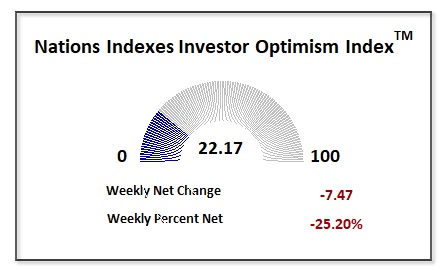
The index takes into account the current levels of S&P VolDex, TailDex, and RiskDex and compares them to their rolling 2-year ranges. It has not closed above 50 since January 24.
Deconstructing Skew:
We deconstruct S&P option skew to understand what the option market is really saying. Since VIX includes nearly all strike prices listed in the relevant expirations, it is impossible to know what is driving changes in VIX – is VIX higher because traders are optimistically reaching for call options or is it higher because they’re afraid and are buying puts?
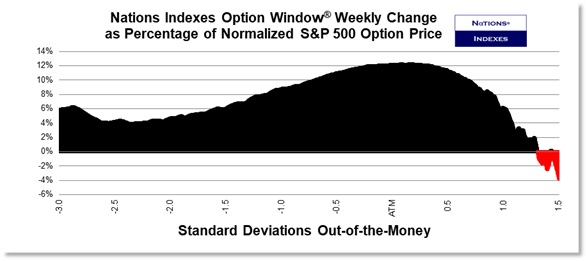
As you can see, buying was focused on at-the-money strike prices and fell off slightly in strike prices below at-the-money. This is consistent with recent action.
Why It Matters…This broadcasts the market’s general opinion about what is going to happen over the next 30 calendar days. The market still believes there will be additional volatility (as evidenced by the buying at at-the-money strike prices) but is less convinced that there will be a significant decline in equity prices (as evidenced by less buying interest in deep out-of-the-money puts.
Other Equity Indexes:
The Russell 2000 index of small capitalization stocks fell by 1.64% this week. The Russell 2000 remains the worst performer on the year (down 9.28%) and is 17.97% below its 52-week high.
All the option metrics for the Russell 2000 fell rose on the week with the exception of CallDex which fell by 0.56%. This was likely due to traders selling out-of-the-money calls to get short exposure to Russell 2000.
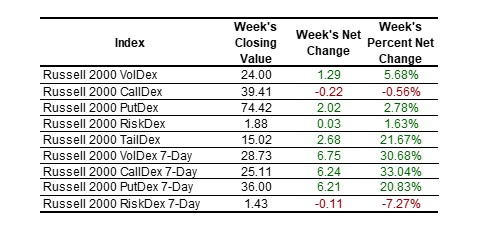
The relatively modest increase in Russell 2000 implied volatility is interesting and bears watching. This may be another indication that traders do not expect a substantial move down in equity prices.

Other Asset Volatility:
Treasury Bonds:
The yield on 10-year treasury notes was little changed this week thanks to a 10 basis point decline on Friday as the money fleeing the stock market was put into treasuries.
Treasury bond VolDex and CallDex rose while PutDex fell. This suggests traders are setting up for more volatility in treasury prices and some expect (fear) a spike in treasury bond prices either because of continued economic weakness or continued weakness in equity prices driving more flows into treasury bonds.
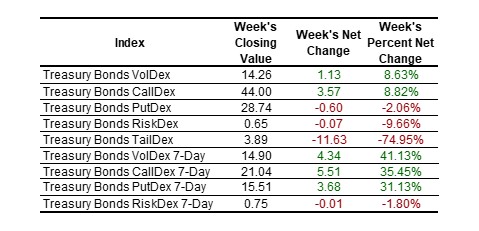
Why It Matters…Treasury bond option volatility can be a signal of directionality for equities since fear of substantial declines in equity prices will be transmitted to treasury bond option prices.

Bitcoin:
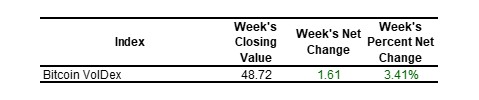
VolDex on bitcoin rose by 3.41% after bitcoin prices fell nearly 4% on Friday. Bitcoin VolDex continues to seek a lower value level since opening at the 60 level when we started calculating it.

Gold:
Many traders start to pay more attention to gold when the stock market declines as factors beyond pure fundamentals play a part in the price action.
Implied volatility in gold rose this week with the exception of TailDex which fell substantially as some traders believe the problems in the equity market mean there is very little likelihood of a steep drop in gold prices.
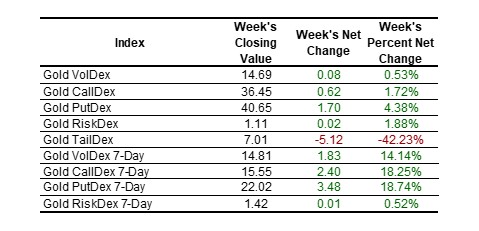
Gold VolDex has traded in a narrow range over the past 52-weeks and is in the lower portion of that range. Long volatility trades in gold make sense given cheaper option prices and the possibility of substantial upheaval in all asset prices.

0DTE and 1DTE Options:
Zero day to expiration (ODTE) options continued to account for the majority of SPY option volume, with 56.35% of this week’s SPY option trading being 0DTE.
Very short-dated volatility measures which use a variance swap methodology, as 1-day VIX does, inject significant error into the resulting measure because of the way out-of-the-money options trade in the hours before expiration. The VolDex at-the-money methodology is particularly suited for these very short-dated tenors.

Equities:
This week’s news was bad for all the single names we cover with the exception of TSLA which bounced back by 5.97%. But NVDA fell 6.82% and even MSFT fell 3.18%.

VolDex rose in all the names we cover including TSLA.
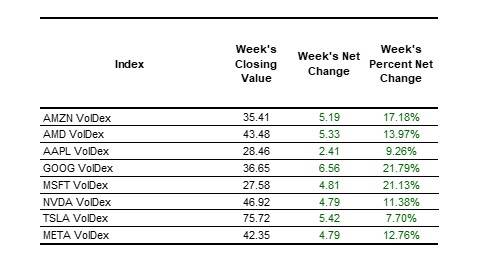
The increase in implied volatility in MSFT is striking in that it and AAPL display less implied and realized volatility than the other names we cover. MSFT is down 10.13% year-to-date and concerns about its AI capabilities seem to be weighing.
MSFT and AAPL are the only single names we cover with PutDex values below 100.

We’ll continue to comment during the week via our X account, @Nations_Indexes.
Scott’s Weekly Commentary:
The week started well with the S&P gaining more than 100 points on Monday before renewed fears regarding tariffs surfaced. I have always hoped that tariffs are a bargaining ploy and that the administration would get some concessions, call that a victory, and pull back without implementing any major tariffs. At some point I wonder if they’ll be able to pull back. This sort of gamesmanship leaves very little room for error or miscalculation. And we should remember there are several other parties involved here and not all of them have to answer to an electorate.
Consumer confidence data has been horrible for the last several cycles and that is likely to weigh on the market until tariff uncertainty is extinguished and stocks rebound. The wealth effect created by a rising stock market becomes “self-reinforcing” in a really powerful way.
The other important data in the coming week is the jobs data due on Friday. Right now the median forecast is for 140,000 nonfarm jobs to have been added in March.
Everyone at Nations Indexes hopes you have a healthy and profitable week.
Scott
