

Your Week’s Volatility Market Commentary — Information Is Your Edge
Stocks Rebound as Most Tariffs are Delayed
The Weekly Takeaway:
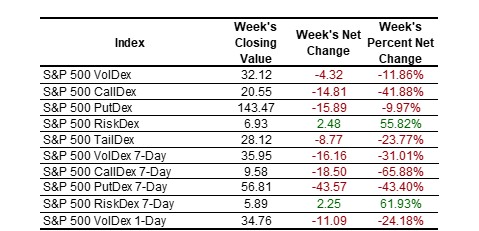
- The S&P 500 gained 5.70% for the week thanks to a gain of 9.52% on Wednesday. The index is now down 8.81% year-to-date but is only 12.75% below its 52-week high;
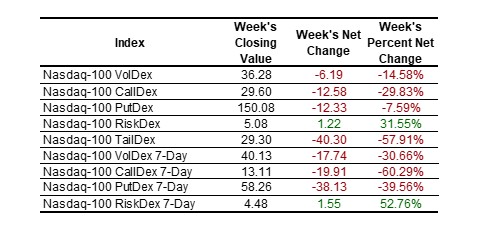
- The Nasdaq-100 gained 7.43% for the week thanks to a gain of 12.02% on Wednesday. It had slipped into “Bear Market” territory last week but closed on Friday down 11.05% for the year and 15.90% below its 52-week high;
- VolDex (ticker VOLI) fell 11.86% to end the week at 32.12. It closed at 42.32 on Wednesday. That was the highest level and first close above 40 since March 2020;
- TailDex (ticker TDEX) fell by 23.77% to close at 28.12 as traders and investors now believe tariff policy will be responsive to market volatility, particularly in treasuries;
- S&P 500 CallDex fell by 41.88% despite the market rally. We’ll discuss this further;
- Nasdaq-100 VolDex fell by 14.58% and TailDex fell by 57.91%;
- VolDex fell for all the individual names we cover although it did not fall by more than 20%;
- Implied volatility rose for treasury bonds with VolDex gaining 32.45% to close at 23.78. Treasury Bond PutDex rose by 87.24% and CallDex fell by 9.33% as the potential for treasury buying as a flight to quality from equities gives way to fears of falling bond prices. The yield on the 30-year treasury bond rose by 49 basis points on the week to close at 4.877%;
- Gold VolDex gained 34.90% to close at 25.39 and Gold CallDex gained 63.94% as gold gained 6.51% on the week and traded at a new all-time high thanks to safe haven buying;
- The Nations Investor Optimism Index fell 65.56% for the week to close at 1.03. It spent most of the week below 1.00. It has not closed above 50 since January 24th.

Equity Index Volatility:
Implied volatility spiked early in the week in response to profound weakness in the S&P including a close below 5000 (4982.77) on Tuesday. Implied volatility then fell on Wednesday in response to the administration’s pause regarding tariffs and the S&P’s intraday rally of more than 10% from that day’s low.
VOLI closed at its highest level since the COVID pandemic on Tuesday. It remains very high as realized volatility remains very high; end-of-day realized volatility for the S&P over the previous 21 trading days (approximately 30 calendar days) was 47.66% as of Friday’s close and this does not reflect the significant amount of intraday volatility experienced.
S&P CallDex fell by 41.88% for the week, the largest decline in any of our 30-day volatility measures on the S&P. Traders should be aware that this is a common phenomenon when the S&P bounces following a significant break in prices. Out-of-the-money call option prices are pressured by volatility traders who want to be short the strike prices they believe the market will rally to.
Why It Matters…Buying out-of-the-money call options to profit from a bounce following a steep selloff is very unlikely to be effective because of this tendency. Buying options when volatility is very high leaves one “swimming against the tide” of falling volatility. Defined-risk trades that sell volatility (such as selling a put spread) are more likely to be effective as the market rallies in a high volatility environment.

Short-dated volatility spiked and fell back as well. 1-Day VolDex closed above 80 on Monday and Tuesday before closing the week at 34.76. That level says the option market is expecting a move of 2.17% for the next 24 hours.

We have commented recently that traders and investors were unwilling to buy the deep out-of-the-money puts represented by TailDex and how that had only recently changed. But traders were again quick to sell these once the S&P rebounded. This is a market to pay attention to as sellers rushing in to sell these aggressively after a rally in the S&P can be taken advantage of.
The Nasdaq-100 gained 7.43% for the week. Nasdaq-100 VolDex fell by 14.58% and Nasdaq-100 TailDex fell by 57.91% amplifying the TailDex move in the S&P 500. CallDex fell in sympathy with this phenomenon in the S&P but PutDex in both indexes fell by less than 10%.
These individual moves are the reason savvy traders deconstruct skew. It allows them to understand what is happening at different parts of the option skew rather than looking at a single index like VIX which amalgamates all these strike prices making it impossible to understand what the market is really saying.

As we said last week, “It is likely too late to purchase protective options” and that was prescient but using trades that take advantage of divergent flows in different portions of the option skew are likely to be profitable.
How to Use This Data…This tendency for out-of-the-money call prices to collapse (relative to other option prices) when the underlying rallies from a steep decline suggests that selling out-of-the-money call spreads (we would never suggest selling naked call options) can be very effective in these situations. They will profit if the market falls, moves sideways, and even if it rallies moderately. This seems counter intuitive and does not tend to work in normal markets but traders should consider the opportunity.

Why It Matters…Our index values are intended to provide option traders with objective data so they can trade with insight rather than a hunch or intuition. Last week they suggested it was too late to buy protective strategies and that the first priority for investors should have been “do no harm” meaning don’t panic sell equity holdings or blindly buy put options. Again, that was prescient and traders and investors who used our data benefited.
Nations Investor Optimism Index:
The Investor Optimism Index remains at an abysmal level. It spent much of this week below 1.00 and closed below that level on Monday, Tuesday, and again on Thursday despite Wednesday’s rally.
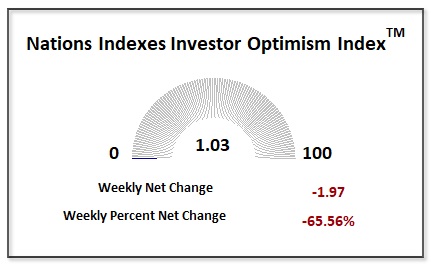
The index takes into account the current levels of S&P VolDex, TailDex, and RiskDex and compares them to their rolling 2-year ranges. It has not closed above 50 since January 24.
Our Optimism Index can be a great contrarian indicator since the best average subsequent 20 trading day returns come when the index closes below 10.00. However, as you can see in the far right-hand column, there are also some sickening additional drawdowns when the index closes below 10.00.

Other Equity Indexes:
The Russell 2000 index of small capitalization stocks rose by just 1.82% this week as investors worry about the ability of smaller companies to respond to supply chain and expense consequences of the remaining tariffs. The index is down 16.59% for the year and 24.58% for the past 52 weeks meaning it remains in bear market territory. It is difficult to see what combination of market dynamics and tariffs would spur the Russell 2000 to outperform.
Option prices for the Russell 2000 index fell by less than the other equity indexes due to this continuing question mark.
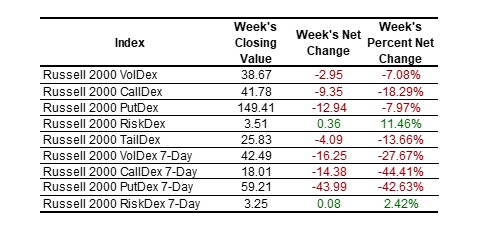
The relative weakness in Russell 2000 CallDex (vs. S&P and Nasdaq-100 CallDex) is striking.

Other Asset Volatility:
Treasury Bonds:
The yield on 10-year treasury notes and 30-year treasury bonds rose this week as note and bond prices fell despite the weakness in the stock market early in the week.
Why It Matters…The decline in note and bond prices was very surprising since they tend to rally in the face of a steep selloff in equity prices. This decline in note and bond prices signaled that other factors were at work. Some observers believe China was selling some of its holding of treasuries but the reason for the decline is not as important as the fracturing of the traditional equity/fixed income relationship.
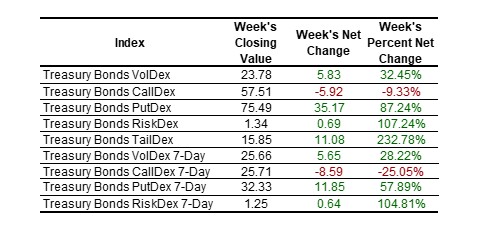
Treasury bond volatility rising for the week is important. We’ll continue to watch this unfold.

The relationship between put prices and call prices as expressed by RiskDex is also worthy of special attention. Treasury bond puts have gotten very expensive relative to call prices.

The changing dynamic means defined-risk trades in the treasury space are appropriate. If the recently announced tariff exemptions for electronics imported from China mean that treasury bond puts will fall back from their very high level then selling cash-secured puts or put vertical spreads in TLT is likely to be profitable.
Last week we said that “Treasury bond RiskDex can be a particularly good indicator of perceptions for risk in the EQUITY market. If traders are reaching to buy treasury bond calls at the expensive of puts that is a sign of significant concern for equities.” This week’s move leads us to discount this indicator for now.
Treasury bond PutDex ended the week at 75.49.

Bitcoin:
VolDex on bitcoin rose 0.99% for the week even as bitcoin prices remained resilient despite the volatility in other asset classes.
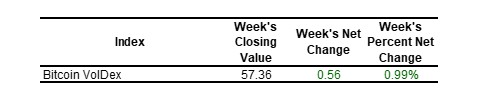
It’s only by using objective and consistently constructed data that it’s possible to use options on bitcoin during the next round of economic turmoil. We’ll continue to monitor our bitcoin volatility metrics for a road map for the future.
Bitcoin VolDex had been drifting lower as you can see until bottoming near 45. It continues to display lower highs and lower lows so it will be interesting to see if volatility sellers rush in once equity prices and volatility stabilize. We’re not generally fans of trying to use traditional technical analysis tools in volatility markets but bitcoin VolDex signals a willingness of traders to continue to sell bitcoin volatility as the price ignores price movement in other asset classes.

Gold:
Gold has rallied strongly as the world searches for a safe haven that is not affiliated with any particular political entity as treasury bonds would be. While this makes one wonder about the future for bitcoin, gold bulls have done well recently.
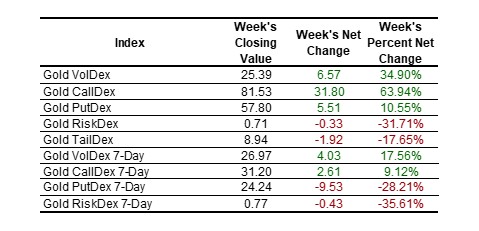
Like treasuries, gold has bucked the trend and has seen option prices head higher. The move in CallDex is particularly noteworthy as it means traders are positioning for even higher prices in gold.
Two weeks ago we said, “Gold VolDex has traded in a narrow range over the past 52-weeks and is in the lower portion of that range. Long volatility trades in gold make sense given cheaper option prices and the possibility of substantial upheaval in all asset prices.”
That certainly worked out, particularly for those who expressed that thesis by buying gold call options.

Last week we pointed out that, “Gold CallDex has generally been trending lower and despite this week’s spike is at just the 44th percentile of its 52-week range so buying call spreads to get upside exposure to gold prices while using the call skew common in gold options is a reasonable speculative trade.”
Again, this certainly worked out.

0DTE and 1DTE Options:
Zero day to expiration (ODTE) options accounted for just 48.68% of all SPY option volume this week as 0DTE traders pulled back during the worst of the selloff. This is the second consecutive week with 0DTE volume being less than half of all SPY volume. On Wednesday, when the S&P 500 staged its huge intraday rally, 0DTE volume was just 44.71% of SPY option volume. Volume does not yet fall off enough for traders to have to account for it but this is an important trend.
Very short-dated volatility measures which use a variance swap methodology, as 1-day VIX does, inject significant error into the resulting measure because of the way out-of-the-money options trade in the hours before expiration. The VolDex at-the-money methodology is particularly suited for these very short-dated tenors.

Equities:
This week’s news was universally good for the single names we cover. Each gained at least 5% for the week with NVDA leading the way higher and gaining 17.62%.
AAPL gained the least but the latest news that electronics are going to be exempt from tariffs levied against China should help AAPL on Monday’s open.

Volatility eased in all these names as you can see.
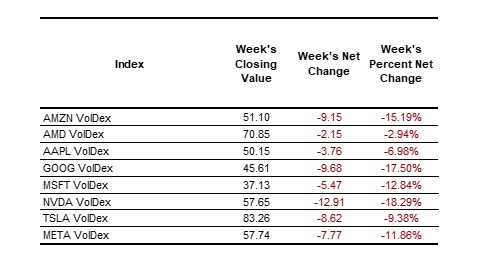
As we pointed out last week, “AAPL VolDex value is at its highest level since we started calculation on January 1, 2022…Selling cash-secured out-of-the-money put options can be one way to potentially add AAPL to a portfolio while taking advantage of high put option prices.”
This was profitable but selling cash-secured puts is an investment strategy and not an trading strategy. It’s possible that simply buying the shares would have been more profitable but we were taking advantage of very high option prices and giving ourselves a margin of error if AAPL shares kept falling in price.
What if you’re interested in this strategy in one of the other names we cover?
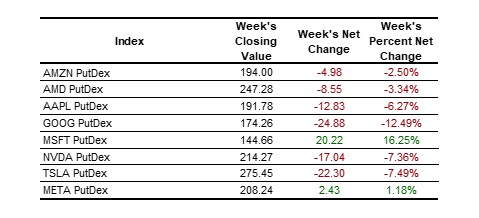
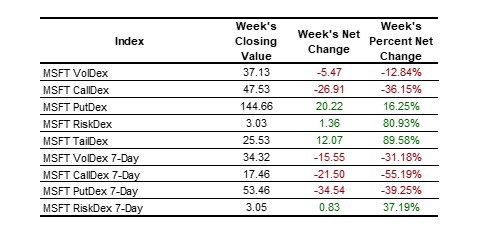
MSFT obviously stands out since its PutDex measure rose on the week despite the rally in the share price. There are two other factors to consider: MSFT reports earnings on April 30 so this 30-day PutDex measure catches that event, and just because PutDex is higher doesn’t mean it should be sold. You’ll note that MSFT’s PutDex is the lowest of the names we cover so it was likely due for a rally.
.

You can see the fuller picture for MSFT volatility below. It’s interesting that both PutDex and TailDex rallied.
We’ll continue to comment during the week via our X account, @Nations_Indexes.
Scott’s Weekly Commentary:
It once again seems that the Trump administration is using tariffs as a negotiating ploy. I have been whipsawed regarding this issue. The lesson for option traders is to not commit yourself to any outcome. If there is only one way your trade can make money, for example, by having the tariffs become draconian, then make certain your option trades are both defined-risk and relatively inexpensive in terms of potential loss. In a situation like that you need to be paid in convexity meaning the amount of money made increases in a nonlinear fashion.
Did the surprising weakness in the bond market force this approach? I think it did. Regardless of how we got here I’ll take it because tariffs are a tax and they’re a regressive tax. Neither is good for the U.S. or its citizens.
Last week I encouraged readers to “First, do no harm. Don’t panic sell just because of the panic. Take the Warren Buffett point of view: you get to buy something you want to own anyway but at a discount to where it was at the start of the year.” That ended up working, as it nearly always does. Yes, it’s tough to put into practice if you’re closing in on retirement but maybe that means you should rethink your equity allocation once the turmoil subsides and fundamental relationships return to a more normal state.
Last week I also said, “One thing to think about, implied volatility for out-of-the-money call options tends to fall very fast once stocks recover from this sort of selloff. It will be entirely possible, even likely, that long out-of-the-money call option positions will lose money even if the underlying rallies.” This is a market reaction that ones learns through experience (sometimes painful experience) so remember it for future corrections.
Since it seems like we’re returning to “normal,” we can focus a bit more on the earnings season. JPM, MS, and WFC reported solid earnings. UNH, NFLX, BAC, and C report next week. I think the guidance NFLX provides, particularly regarding their lower-tier products, will be interesting. Are customers downgrading to the ad-supported tiers in an expression of financial stress? That would be worrying. And C has consistently been the weakling among the big U.S. banks and while I don’t think being the cheapest bank means that’s the place to invest (Citi’s price to book is 0.6 while JPM’s is 1.9) there’s the possibility C will report nice results and rally. Just remember that implied volatility will collapse when the results are released so long volatility structures are to be avoided.
Everyone at Nations Indexes hopes you have a healthy and profitable week.
Scott
