

Your Week’s Volatility Market Commentary — Information Is Your Edge
It’s Never Good When Traders Have to Look at a Map
The Weekly Takeaway:
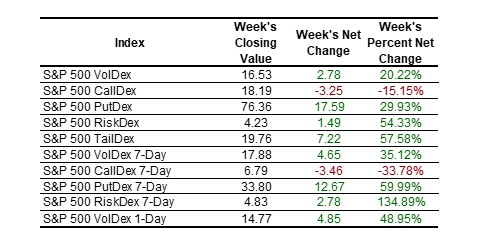
- The S&P 500 fell 0.39% this week due to a decline of 1.13% on Friday. That decline was in response to news of hostilities between Israel and Iran;
- Crude oil rose by 6.27% to close at $73.18 a barrel after trading as high as $77.62 on Friday;
- Gold rose by 3.64% to close at $3452.60 an ounce;
- The yield on 10-year treasury notes fell by 8.6 basis points as “risk off” assets rallied;
- The Nasdaq-100 index fell by 0.60%;
- VolDex (ticker VOLI) rose by 20.22% to close at 16.53;
- TailDex (ticker TDEX) rose by 57.58% in recognition of the fact that a war in the Middle East is a “tail event” that may whipsaw the U.S. stock market. The spike in TailDex began mid-day on Wednesday, June 11, when the U.S. government ordered the departure of non-emergency government personnel in Baghdad and took other measures to protect citizens in other locations in the Middle East;
- S&P 500 PutDex rose by 29.93% and CallDex fell by 15.15%;
- U.S. Treasury Note CallDex rose by 24.54%;
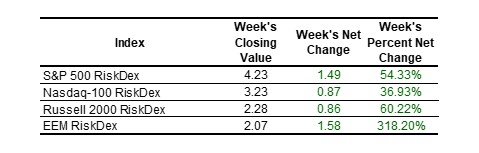
- RiskDex rose on all the equity indexes we cover. It rose by 54.33% for the S&P 500 and by 60.22% for the Russell 2000 which had outperformed the other major indexes last week;
- A reminder: we have expanded the list of asset classes we cover to include high-yield bonds, 7-10 year treasury notes, and emerging market equities;
- We have expanded the list of equities we cover to include BRKB, JPM, LLY, PLTR, and WMT. We now cover not only the names with the most active option markets but the 10 largest names in the S&P;
- The equites we cover were mixed on the week as investors wait for clarity on the impact of the Middle East situation;
- The Nations Investor Optimism Index fell 76.40% to close at just 10.10. It has not closed above 50 since January 24th;

Equity Index Volatility:
Implied volatility and option prices were generally quiet during the week with the exception of the ramp on Friday. However, it is worth noting that while VOLI made its low for the week just before the U.S. announcement on Wednesday, its increase that day was modest. It was TDEX that displayed the most pronounced rally.
Last week we noted that VolDex values for the S&P 500, Nasdaq-100, and Russell 2000 were all below the 15th percentile of their 52-week ranges and that, “We continue to believe directional trades are best approached from a long volatility point of view even though summer tends to be a lower volatility period for stocks.”
VolDex values are still relatively low given the prospect for profound volatility during the remainder of June. VolDex for the S&P, Nasdaq-100, and Russell 2000 are at the 21st, 18th, and 20th percentiles of their 52-week ranges respectively. Long volatility structures will likely not be profitable if the literal shooting stops but that is the way to express any directional thesis until we know if that is the case. We are not suggesting traders endeavor to profit from the misery of others but for those using options the best approach is clear.
TailDex values for these three equity indexes are at the 32nd, 18th, and 27th percentiles of their respective 52-week ranges. Profits on long TailDex trades have been fleeting as traders rush to sell those put options whenever they spike.

S&P 500 RiskDex rose by 54.33%, is back above 4.00 and is at the 34th percentile of its 52-week range.

Why It Matters…Historical data for all our indexes is available to subscribers at the Everything! level and they allow option traders to understand the context of the current option pricing environment. Volatility is mean-reverting and that is a phenomenon traders can take advantage of in both directions. But you have to understand what normal is, what the “mean” is, in order to do so.
This historical data shows that equity index volatility and option prices are low in relation to their recent ranges and, as we said last week, “short volatility trade structures are best avoided. They may work, but the risk/reward when option prices are this low is unattractive.” That is doubly so with the current geopolitical situation.
You can see the week’s volatility results for the S&P 500 below.
The Nasdaq-100 fell by slightly more than the S&P. You can see the week’s results for our indexes on the Nasdaq-100 below.
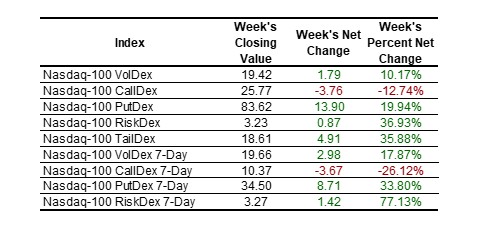
As noted above, Nasdaq-100 VolDex closed at just the 18th percentile of its 52-week range and is still below 20.00.

RiskDex calculates the ratio of out-of-the-money put option prices (PutDex) to out-of-the-money call option prices (CallDex). It is both a measure of skew and a measure of fear.
Nations Investor Optimism Index:
The Investor Optimism Index had been inching its way to 50, a level it hasn’t touched since January 24. That came undone this week.
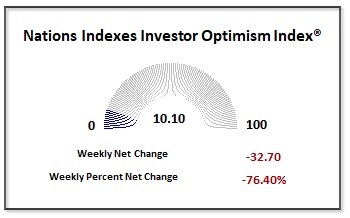
The index takes into account the current levels of S&P VolDex, TailDex, and RiskDex and compares them to their rolling 2-year ranges.
Our Optimism Index is now available in real-time on our home page at NationsIndexes.com.
Other Equity Indexes:
During the previous week the Russell 2000 outgained both the S&P 500 and Nasdaq-100. That reversed this week with the Russell 2000 losing 1.49% thanks to a decline of 1.85% on Friday.
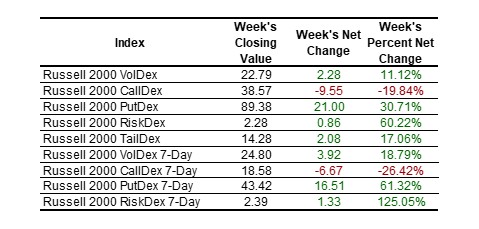
Why It Matters…Russell 2000 CallDex has been very cheap during the past two months and we have suggested using these calls to express any bullish sentiment in small caps. That remains the case.
We’ve added the emerging market equity index to our roster of equity indexes. EEM is the underlying ETF we use. These values are available in real time to subscribers.
Other Asset Volatility:
Treasury Bonds:
The yield on 10-year treasury notes and on longer-term treasury bonds fell as risk-averse investors raced to buy treasuries which are still seen as the “gold standard” among “risk off” trades. PutDex for both fell slightly but CallDex for both was very strong as you would expect.
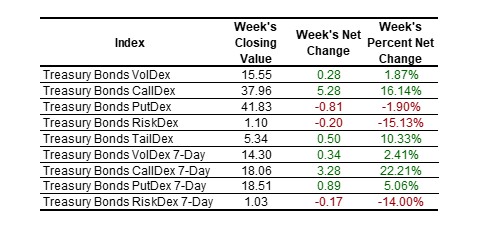
Treasury Bond VolDex remains stuck at the 15 level which is surprising. As we said last week, “This means that structures that are long at-the-money TLT options are unlikely to be hurt by volatility dropping dramatically.” That continues to be the case and Treasury Bond VolDex levels in the low teens are to be bought regardless of directional thesis.
You can see that Treasury Bond VolDex has not been convincingly below 15.00 since March.

We have just begun calculating our metrics on treasury notes with the underlying IEF so we’ll be watching this as well.
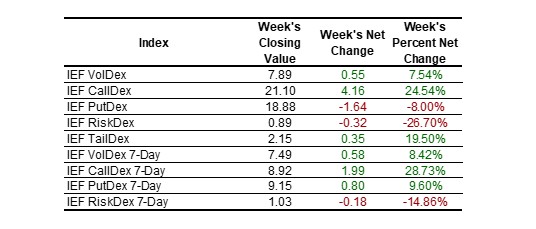
Why It Matters…Last week we observed that “RiskDex remains high in TLT despite a small decline this week so traders who are bullish on treasuries can take advantage with structures which sell puts or put spreads.” That certainly worked. Treasury Bond RiskDex remains above 1.00 meaning PutDex is still above CallDex. That relationship will not be sustained if there is more unfortunately news from the Middle East.

Bitcoin:
Volatility measures for bitcoin were surprisingly statistic this week. VolDex on bitcoin on rose by just 3.20% to close at 41.91. We have been watching Bitcoin VolDex as it continues to fall but we’ll be watching for the response to geopolitical news with an eye on direction rather than absolute levels. However, you’ll note that Bitcoin RiskDex closed at 1.00 indicating that PutDex and CallDex are at nearly equal levels.
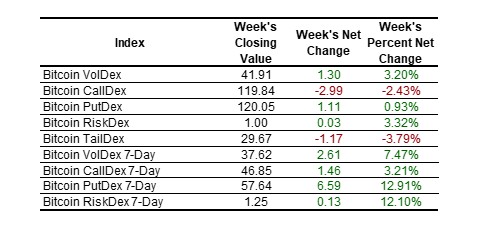
Last week we noted that, “Bitcoin VolDex continues to trend lower and rallies in Bitcoin VolDex should be sold…” We would no longer establish short-term volatility trades in bitcoin that are short volatility without using defined risk structures.

Gold and Silver:
Gold rose by 3.64% this week as you would expect given the news flow. Gold VolDex rose 11.11% and CallDex rose by 25.11%. Interestingly, some traders felt it safe to sell out-of-the-money puts. This is probably the best purely short volatility trade available.
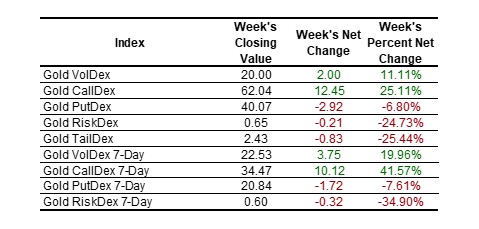
Gold VolDex is back at a level not seen prior to the tariff turmoil which rocked stocks beginning in April.

The same cannot be said for Gold PutDex despite this week’s selling. Gold PutDex closed at the 31st percentile of its 52-week range. Gold CallDex is one of the few broad asset volatility measures above the 50th percentile of its 52-week range.
How To Trade It? The move in Gold CallDex has likely already happened absent substantial deterioration in the geopolitical environment. Since gold tends to show call skew we could suggest any bullish option structure includes long call spreads.

This is not a time to be a hero in “risk off” assets.
0DTE and 1DTE Options:
Zero day to expiration (ODTE) options accounted for 59.17% of all SPY option volume this week and accounted for 61.36% of all SPY option volume on Monday. It is worth noting that 0DTE volume accounted for 58.55% of all SPY option volume on Friday so markets and trading remained robust.
Very short-dated volatility measures which use a variance swap methodology, as 1-day VIX does, inject significant error into the resulting measure because of the way out-of-the-money options trade in the hours before expiration. The VolDex at-the-money methodology is particularly suited for these very short-dated tenors.

Equities:
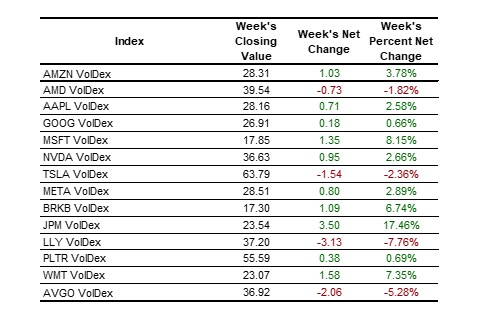
We have expanded the list of single names we cover. Movement among the names we cover was mixed this week. TSLA was the big winner as Elon Musk continues to distance himself from the current administration and as investors wait for the long-anticipated Tesla robotaxi.

VolDex for the names we cover was less mixed.
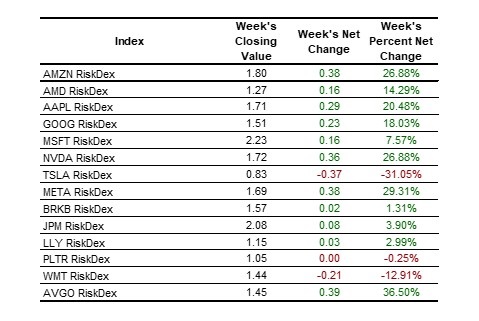
TSLA RiskDex again enjoyed attention on TSLA being focused on the robotaxi rather than the spat between Musk and Trump. RiskDex on TSLA is below 1.00 again while it remains above 1.00 for all the other names we cover. You’ll see much more green than red this week in our RiskDex table.
Last week we pointed out that, “TSLA CallDex remains in the middle of its 52-week range.” TSLA CallDex rallied another 14.08%. It is now at the 65th percentile of its 52-week range. We are unlikely to recommend buying TSLA calls at this level but anyone considering doing so should understand the historical levels.

Some investors believe TSLA is unique but other stocks offer much more enticing call purchasing opportunities.


We’ll continue to comment during the week via our X account, @Nations_Indexes.
Scott’s Weekly Commentary:
It is never a good thing when traders have to look at a world map to understand precisely where the news is coming from.
Last week I commented that, “So the two things that will worry me this summer? Tariffs and the tax bill with its impact on the bond market.” War did not make my list. I was wrong.
But this is why, with option prices low, we have been recommending long volatility structures. The wonderful matrix of variables that move option prices means you could express any directional thesis via long volatility structures and that’s what you should do when option prices are low. Investors who were long volatility, even if they were using it to get long the market, did not have to panic when they woke up on Friday. That’s not the case for those who were ignoring cheap option prices to sell puts for example.
We’ll tell you when option prices are high and when your trade should be expressed by a short volatility position. That’s the reason we created our indexes in the first place: to have objective data so we can make these decisions rationally rather than relying on instinct or a hunch.
What is going on in Ukraine and the Middle East are tragedies. Full stop. But that also impacts our stock market, the same market you’re invested in as a means of funding your retirement or to pay for your kids’ educations. Don’t feel bad about occasionally viewing what is going on through the lens of an investor who has responsibilities. It doesn’t mean you’re callous or uncaring. You can advocate for your political point of view while at the same time legitimately worrying about the impact on your own future.
Everyone at Nations Indexes hopes you have a healthy and profitable week.
Scott
