

Your Week’s Volatility Market Commentary — Information Is Your Edge
Stocks Rally, Earnings Impress…but Inflation
The Weekly Takeaway:
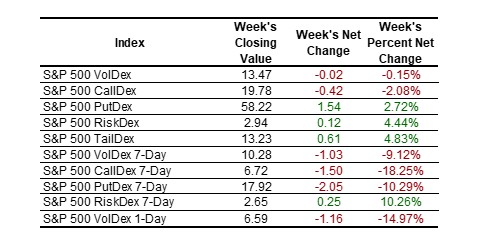
- The S&P 500 rose by 0.59% for the week and closed at 6296.79. It made a new all-time high during the week and is now up 7.06% YTD;
- The Nasdaq-100 rose by 1.25% for the week and is now up 9.77% YTD;
- CPI data was released on Tuesday and showed that YoY inflation had increased by a slightly higher than expected 2.7%;
- The yield on 10-year treasury notes rose by another basis point and closed at 4.432%;
- VolDex (ticker VOLI) fell by 0.15%. It remains at the 12th percentile of its 52-week range;
- TailDex (ticker TDEX) rose by 4.83% to close at 13.23. It closed at the 10th percentile of its 52-week range;
- CallDex fell by 2.08% and PutDex rose by 2.72% indicating a slightly more skeptical approach to the broad market on the part of option traders;
- VolDex on the Nasdaq-100 fell by 2.54% after falling 5.46% last week. It closed at the 9th percentile of its 52-week range;
- U.S. Treasury Bond VolDex rose by 1.63% and fixed income investors continue to worry about fiscal policy and the federal debt;
- Bitcoin VolDex fell by just 0.02% and remains above 40;
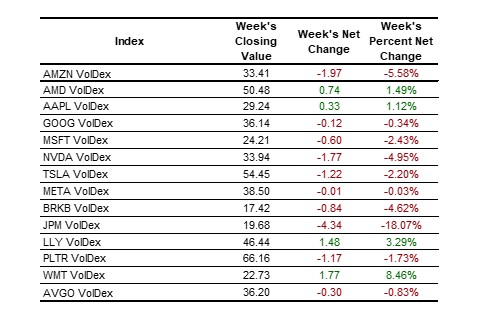
- VolDex fell on 10 of the names we cover. It fell by 18.07% in JPM in a sign of the power of the earnings catalyst for option traders (JPM reported on Tuesday). It rose by 8.46% for WMT as investors continue to worry about the impact of tariffs on China on WMT’s costs;
- The Nations Investor Optimism Index fell by 11.13% to close at 39.78.

Equity Index Volatility:
Implied volatility and option prices in the S&P we mixed this week with VolDex (VOLI) and out-of-the-money call prices falling while out-of-the-money put prices rose. This increase in put skew (RiskDex rose by 4.44% to close at 2.94) signals a bit more skepticism on the part of investors.
Nasdaq-100 volatility measures showed similar price action despite NVDA making a new all-time high on Friday. It is interesting that Nasdaq-100 TailDex rose by 3.19% for the week.
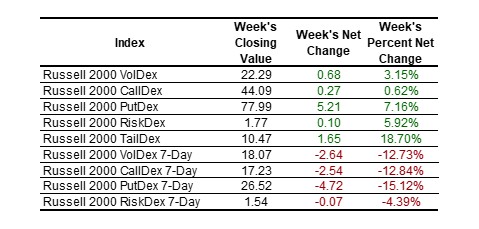
30-day volatility on the Russell 2000 was higher in every measure. Russell 2000 TailDex gained 18.70% for the week.
We have been noting that equity index VolDex values are near the bottoms of their 52-week ranges and that directional option strategies should avoid being short volatility. Volatility tends to be very low in the heart of summer, which is looming, but that doesn’t mean traders should sell volatility and assume significant risk in the hope of a small profit. You don’t have to swing at every pitch nor do you have to trade every day.
We have been watching S&P 500 TailDex closely in hopes that we could buy those deep out-of-the-money puts at the 10.00 level. It now seems the market isn’t going to fall that low.

S&P 500 RiskDex rose by 4.44% after rising 2.39% in the previous week but is still below 3.00.
RiskDex is a measure of fear and option skew and it is interesting that it seems to have bottomed while the S&P makes new highs. That suggests there is a healthy amount of worry even though other vol measures are low.
You can see the 52-week chart of S&P RiskDex.

Why It Matters…Historical data for all our indexes is available to subscribers at the Everything! level and they allow option traders to understand the context of the current option pricing environment. Volatility is mean-reverting and that is a phenomenon traders can take advantage of in both directions. But you have to understand what normal is, what the “mean” is, in order to do so.
You can see the week’s volatility results for the S&P 500 below.
You can see the week’s results for our indexes on the Nasdaq-100 below.
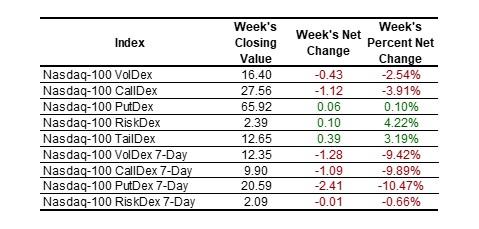
Nasdaq-100 VolDex closed at just the 9th percentile of its 52-week range. 7-day VolDex and CallDex are both below the 4th percentile of their 52-week ranges.


Nations Investor Optimism Index:
The Investor Optimism Index fell by more than 11% this week and is now well below the 50.00 midpoint.

The index takes into account the current levels of S&P VolDex, TailDex, and RiskDex and compares them to their rolling 2-year ranges.
Our Optimism Index is now available in real-time on our home page at NationsIndexes.com.
Other Equity Indexes:
You can see how option prices for the Russell 2000 were strong this week with every 30-day measure higher.
Why It Matters…Traders hate being long volatility during the summer so option prices get cheap. Sometimes it’s just a function of fewer traders paying attention. The lowest average VOLI close by month occurs in July with an average closing price of 15.30; June is second lowest at 16.21 (October has the highest average close with 18.93 and November is second at 18.47). But it is tough to sell volatility when it is already low and expect the trade to be very fulfilling. It may yield a small profit but an exogenous event could make it very expensive.
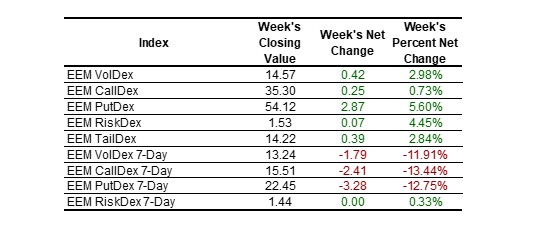
We’ve added the emerging market equity index to our roster of equity indexes. EEM is the underlying ETF we use. These values are available in real time to subscribers so you can put them to use in your trading. EEM option prices showed the same movement as S&P and NDX options with VolDex and CallDex falling while put option prices rose.
Other Asset Volatility:
Treasury Bonds:
The yield on 10-year treasury notes continued to climb higher and closed the week at 4.432% as investors worry about the impact of inflation as well as the new tax and spending bill which, as we’ve said before, seems certain to attract bond vigilantes who will be selling and shorting treasury bonds.
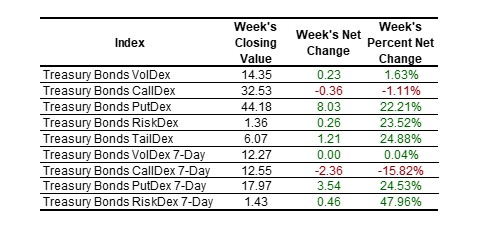
The rally in treasury bond CallDex ended but bond traders were aggressively buying puts during the middle of the week due to fears of inflation. RiskDex rose 23.52% and closed at the 69th percentile of its 52-week range.


Why It Matters…Treasury bond prices move inversely to interest rates and the TLT option market is announcing significant concern about bond prices falling.
Last week we said, “We are watching for renewed interest in owning puts on treasury bonds.” We got it this week.

Bitcoin:
Bitcoin VolDex fell by 0.01 points which is 0.02% but is still above 40.
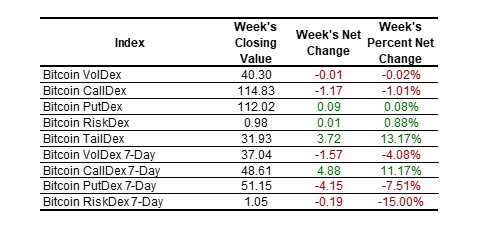
Bitcoin VolDex remains in an easily discernable downtrend though that has paused over the past 2 weeks. We continue to watch for an opportunity to sell volatility in defined-risk structures with VolDex back above 45.

Bitcoin RiskDex ticked up slightly but is still below 1.00. We continue to recommend defined-risk trades which would profit if RiskDex rose meaning out-of-the-money put prices rise versus out-of-the-money call prices. These should be done for no net premium such that without a move beyond the current strikes that are 16 delta calls or puts the trade expires worthless. Our rationale is that bitcoin has been acting more like a “risk on” asset and should have a RiskDex value that recognizes the put skew common among “risk on” assets.
Precious Metals:
Gold fell by 0.24%. Gold VolDex fell by 1.86% to close at 15.92.
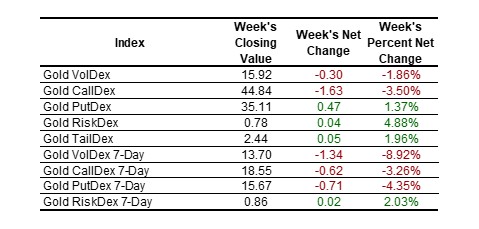
It is time to exit long volatility trades in gold until VolDex is back below 15.00.

VolDex Term Structure:
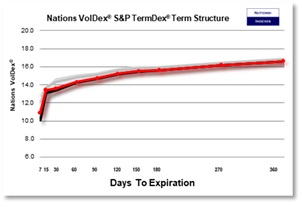
Term structure for S&P VolDex has returned to a relatively normal shape however the discount 7-day VolDex is showing to 15-day suggests selling a calendar spread would be interesting. That entails selling the longer-dated straddle, 15-day in our case, and buying the shorter-dated straddle, 7-day in our case. The trade wants realized volatility during the next 7 days. Traders should close the entire trade when the shorter-dated legs are near or at expiry to avoid being short the remaining legs. This is not a trade recommendation but an example of how we use our indexes to inform our trading.
0DTE and 1DTE Options:
Zero day to expiration (ODTE) options accounted for 61.64% of all SPY option volume this week and that ratio was above 60% on 4 of the 5 trading days.
Very short-dated volatility measures which use a variance swap methodology, as 1-day VIX does, inject significant error into the resulting measure because of the way out-of-the-money options trade in the hours before expiration. The VolDex at-the-money methodology is particularly suited for these very short-dated tenors.

Equities:
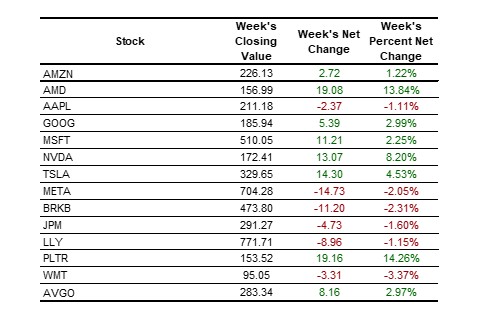
We have expanded the list of single names we cover.
Results were mixed with 8 gainers and 6 losers although the gains again tended to outweigh the losses.
AMD had another big gain, rising 13.84% after leading the way last week with a gain of 6.17%. PLTR gained 14.26% this week as the AI company continues to win government contracts and ink new enterprise deals.
WMT was the biggest loser for the second straight week with a loss of 3.37% following last week’s loss of 4.03% as investors continue to worry about the impact of tariffs on a company that imports 75% of its non-grocery items from China.
VolDex was mixed for the names we cover.
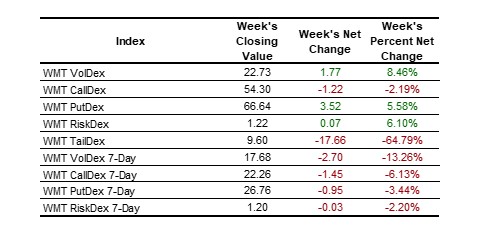
The impact on volatility of WMT’s move and the concerns about tariffs was surprisingly muted last week (we pointed this out in last Saturday’s edition) but that ended this week as WMT VolDex rallied 8.46% to close at 22.73. Traders who recognized the lack of response last week and took advantage of the setup did well this week.
NVDA had another great week and closed with a market cap of $4.2 trillion; it is the only name in the U.S. stock market with a market cap above $4 trillion. But NVDA is now technically overbought with an RSI reading of 78 (anything above 70 is considered overbought).
NVDA CallDex is at just the 18th percentile of its 52-week range so it is a mediocre candidate for selling a covered call but it does not report earnings until August 27 so a 30-day covered call would not catch earnings making it slightly more interesting.

In the August 15 expiry, with shares at 172.41, the 190 strike call which has a 15 delta, meaning it is just over 1 standard deviation out-of-the-money and therefore very analogous to our CallDex index, could be sold at the close on Friday for 1.12. We don’t consider that to be a compelling trade so we would continue to watch NVDA CallDex for a more profitable setup while keeping an eye on the earnings calendar.
We continue to scan for high RSI readings coupled with high CallDex levels because that indicates a compelling covered call candidate.
AMD is one of those candidates. Thanks to its recent rally it has an RSI reading of 72.72 so it is technically overbought and AMD has a CallDex value of 141.67, the 62nd percentile of its 52-week range. RiskDex is 0.90 so AMD is showing call skew. The 185 strike call could be sold at 1.75 on Friday versus the closing price of 156.99. This is not a recommendation but an example of how we use our indexes.

We’ll continue to comment during the week via our X account, @Nations_Indexes.
Scott’s Weekly Commentary:
Stocks continue to rally and the S&P 500 made new all-time highs thanks to earnings strength. The banks kicked off earnings season with better than expected results which put investors in a buying mood.
Retail sales rose by 0.6% so it would seem the consumer is doing just fine but we learned CPI rose more than expected over the past 12 months and posted an increase of 2.7% year over year.
Stocks tend to go up over time, something that “permabears” seem to forget, so you can’t just bail out of the market every time it makes a new high and this week it went up despite political reasons for it not to (tariffs) in a display of significant resilience.
Earnings have been good so far and it is easy to forget that earnings and interest rates account for about 85% of the performance of the stock market over time. Higher interest rates could undo the rally, and there’s substantial risk of that, but they’re not here yet.
What to do now? Enjoy the quiet summer interlude because I think things are going to get spicy come September.
Everyone at Nations Indexes hopes you have a healthy and profitable week.
Scott
