

Your Week’s Volatility Market Commentary — Information Is Your Edge
Stocks Make New Highs Then Give It Back as Jobs Data Disappoints
The Weekly Takeaway:
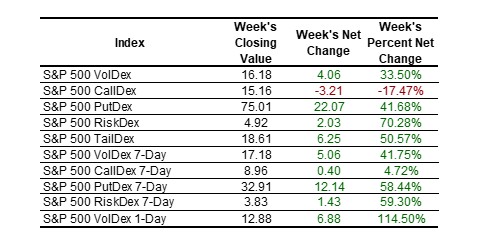
- The S&P 500 fell 2.36% for the week after making new all-time highs early on Thursday. The index lost 1.60% on Friday and ended up losing ground on each of the last 4 days of the week. The index also staged a key reversal on Thursday. The index is up 6.06% YTD;
- The Nasdaq-100 fell by 2.19% this week and is now up 8.33% YTD;
- The market was initially helped by positive earnings reports from several technology and AI names as well as reports of a tariff deal with Japan. But a new tariff announcement hurt stocks before Friday’s employment data which was weaker than expected with downward revisions to previous months’ reports;
- Only 198 of the stocks in the S&P 500 are within 10% of their 52-week highs, illustrating the top-heavy nature of the year’s results to date;
- VolDex (ticker VOLI) rose by 33.50% to close at 16.18. Last week it closed at just the 8th percentile of its 52-week range, this week it closed at the 20th percentile of its 52-week range;
- TailDex (ticker TDEX) rose by 50.57% to close at 18.61. It closed at the 26th percentile of its 52-week range. The week’s price action in TDEX is an example of what happens to deep out-of-the-money put options when the unlikely (horrible jobs data) becomes real;
- CallDex fell by 17.47% as traders sold out-of-the-money calls to get short exposure to the S&P. PutDex rose by 41.68% in an expression of fear. CallDex and PutDex diverge more often than many would expect and it is a signal worth watching;
- VolDex on the Nasdaq-100 rose by 29.06%. It closed the previous week at just the 5th percentile of its 52-week range and closed this week at the 18th percentile of that range;
- U.S. Treasury Bond VolDex fell by 0.43% despite the volatility in equity markets in a display of the power of a big catalyst passing – the monthly jobs report is the most important monthly catalyst for treasuries. CallDex rose by 0.42% as some traders positioned themselves for a potential spike in treasury bond prices;
- Bitcoin VolDex resumed its downtrend after pausing the past 3 weeks. It fell 5.05% and ended the week at 38.54;
- VolDex rose on most of the single names we cover. The exceptions were the names which reported this week and that includes AMZN, MSFT, and META;
- The Nations Investor Optimism Index fell by 52.98% to close at 27.38.

Equity Index Volatility:
Implied volatility and option prices in the S&P were higher with all metrics rising in all tenors with the exception of 30-day CallDex which fell as traders wanted short exposure to the index. They are likely thinking that if the index recovers, implied volatility will fall precipitously, particularly during August.
S&P 500 RiskDex rose 70.28% as PutDex and CallDex diverged. TailDex rose by 50.57% indicating the level of surprise regarding the jobs data.
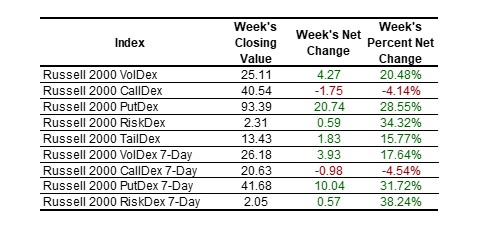
Nasdaq-100 and Russell 2000 volatility measures showed similar price action with CallDex falling and all other metrics rising.
We have been noting that equity index VolDex values are near the bottoms of their 52-week ranges and that directional option strategies should avoid being short volatility. This week showed why that approach is best when implied vol is low.
Last week we pointed out that “S&P 500 RiskDex rose by 1.51% to close at 2.89. Zero-cost trades that take advantage (e.g., a call spread collar) make sense given this setup.” That certainly worked out with RiskDex closing at 4.92 after trading above 5.00 on Friday.
You can see the 52-week chart of S&P RiskDex.

Why It Matters…Historical data for all our indexes is available to subscribers at the Everything! level and they allow option traders to understand the context of the current option pricing environment. Volatility is mean-reverting and that is a phenomenon traders can take advantage of in both directions. But you have to understand what normal is, what the “mean” is, in order to do so.
Last week’s closing level in RiskDex and our suggested trade is an illustration of the power of knowing what is normal and taking advantage of misalignment in option prices caused by complacency.
You can see the week’s volatility results for the S&P 500 below.
You can see the week’s results for our indexes on the Nasdaq-100 below.
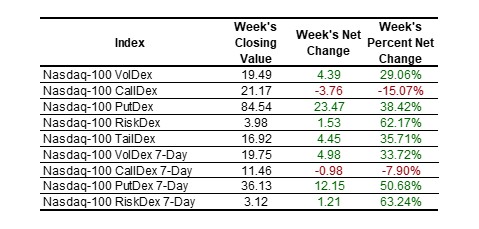

Nasdaq-100 CallDex closed at 21.17 which is the 1st percentile of its 52-week range.

Nations Investor Optimism Index:
The Investor Optimism Index fell by 52.98% to close at 27.38.
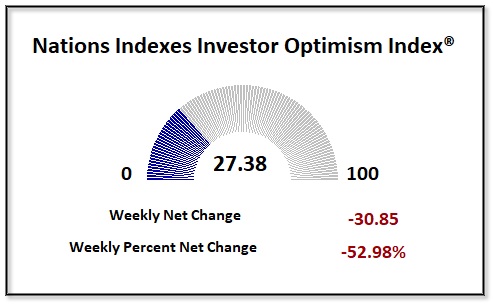
The index takes into account the current levels of S&P VolDex, TailDex, and RiskDex and compares them to their rolling 2-year ranges.
Our Optimism Index is now available in real-time on our home page at NationsIndexes.com.
Other Equity Indexes:
You can see how 30-day option prices for the Russell 2000 were higher with the exceptions of CallDex.
Why It Matters…Volatility remains relatively low despite Friday’s price action because traders do not want to be long volatility during August. This will offer a few opportunities to take smallish long vol positions that will be low probability / high potential return trades.
Other Asset Volatility:
Treasury Bonds:
The yield on 10-year treasury notes fell by 16.6 basis points to end the week at 4.220%. Bond and note prices were helped by buying as a rate cut at the September Federal Reserve meeting is now seen as likely (the Fed Funds futures contracts say the odds of a 25 basis point cut are 80.3%).
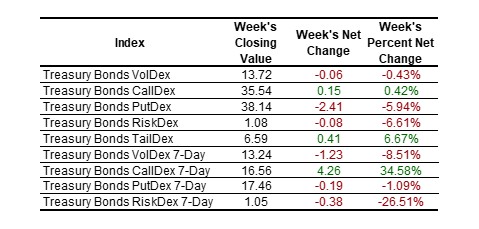
Treasury bond option prices tend to be very weak immediately following the release of monthly jobs data and that was certainly the case this week although the spike in 7-day CallDex is interesting.

Why It Matters…Treasury bond prices move inversely to interest rates and the TLT option market is communicating that traders want to own treasuries and treasury bond calls as they prepare for lower interest rates and the potential for more turmoil in equity markets.
Bitcoin:
Bitcoin VolDex finally resumed it downward trend.
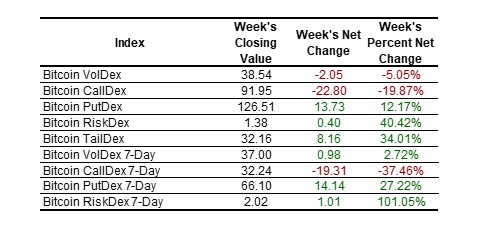
We had been watching for opportunities to short bitcoin volatility with Bitcoin VolDex above 45 and since we never revisited that level we missed this week’s break.

However, we have been emphatic in suggesting longs in bitcoin puts and shorts in bitcoin call spreads with RiskDex hovering around 1.00. Our rationale was that bitcoin has been acting more like a “risk on” asset and should have a RiskDex value that recognizes the put skew common among “risk on” assets. That worked very well as RiskDex rallied by 40.42% to close at 1.38.
Precious Metals:
Gold rose 0.56% this week. Gold VolDex fell 1.03% and vol metrics other than CallDex were all weak in gold.
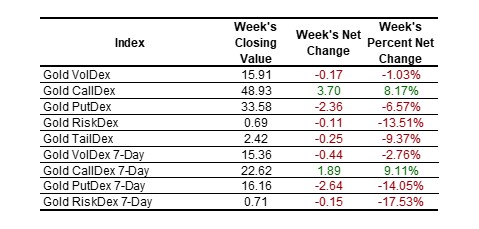
You can see the Gold VolDex chart below.

VolDex Term Structure:
Term structure for S&P VolDex shifted from a very normal, “lower left to upper right” configuration to a much flatter expression. Friday’s closing VolDex term structure is in red while the week’s other closes are in black (Thursday) and gray.
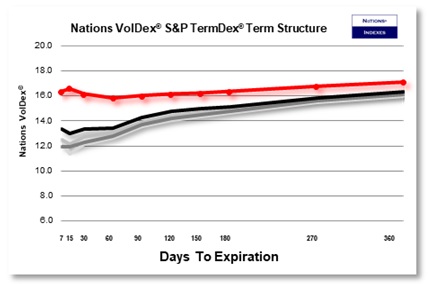
Term structure is not yet inverted. Inversion (meaning the graph is downward sloping) is a sign of distress in the equity market.
Option Window:
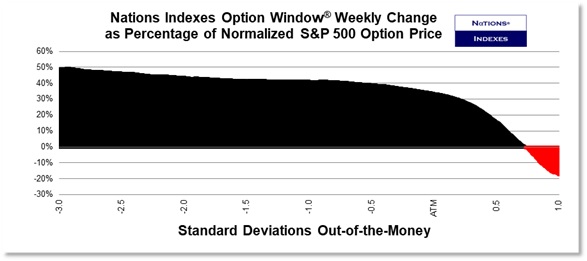
Option Window® is a graphical display of where option flows were concentrated this week. The black areas show where buying drove prices higher at constant points of moneyness (horizontal axis) while red shows that selling drove prices lower. It is easy to see that buying was spread fairly evenly from at-the-money down to 3 standard deviations below at-the-money but that it tailed off above at-the-money and selling took over at 0.65 standard deviations above at-the-money.
0DTE and 1DTE Options:
Zero day to expiration (ODTE) options accounted for 56.72% of all SPY option volume this week. They accounted for 55.82% of all SPY volume on Friday.
Very short-dated volatility measures which use a variance swap methodology, as 1-day VIX does, inject significant error into the resulting measure because of the way out-of-the-money options trade in the hours before expiration. The VolDex at-the-money methodology is particularly suited for these very short-dated tenors.

Equities:
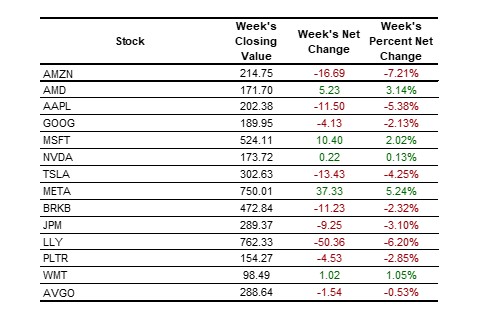
We have expanded the list of single names we cover.
Results this week were mixed with some names that reported earnings gaining ground. Those included MSFT and META. In an interesting turn, WMT gained 1.05% this week despite renewed tariffs.
VolDex was mostly higher for the single names we cover with those that reported earnings this week tending to fall.
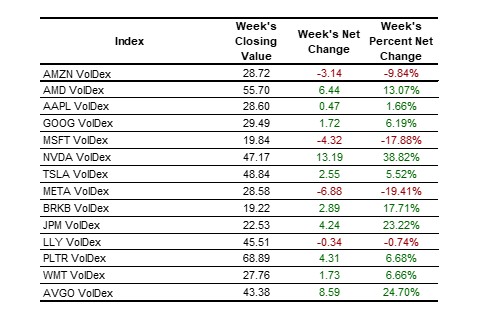
NVDA VolDex rose by 38.82% as the 30-day tenor now catches the company’s August 27 earnings release. NVDA is the only name in the U.S. stock market with a market cap above $4 trillion although MSFT revisited that territory early in the week.
NVDA VolDex closed at the 27th percentile of its 52-week range.

MSFT bulls were disappointed the company couldn’t remain in the $4 trillion market cap club following better than expected earnings but shares were pulled down by the general market decline.
Remaining bulls might consider expressing that sentiment by buying calls as prices have dropped following the catalyst. MSFT CallDex is at the 18th percentile of its 52-week range.
We’ll continue to comment during the week via our X account, @Nations_Indexes.
Scott’s Weekly Commentary:
That got pretty ugly pretty quickly. The announcement of a 10% tariff baseline and tariffs as high as 50% on select trading partners set a negative tone for the market on Friday. July’s nonfarm payroll number of 73,000 new jobs was well below the consensus estimate of 111,000. But it was the downward revisions for May and June totaling 258,000 jobs that were the sucker punch. I don’t believe these revisions were rigged because that would mean the original numbers were rigged higher.
I’m certain owners of MSFT and META are pleased with this week’s results and with good reason. Holders of AMZN are probably dealing with a different emotion as those shares fell 7.21%.
I expect realized volatility to ease as we get into the heart of August but when the market is driven by political headlines we’ll have to buckle up for some surprises.
I’m not certain why the Fed would choose to meet and make a decision regarding interest rates just 2 days before the jobs data comes out…it would seem logical to wait for the most important economic data point of the month to inform your decision. Their symposium in Jackson Hole begins on August 21 and you can bet there will be plenty of discussion of a rate cut between now and then. I’m not sure economic growth or inflation demand a rate cut but the jobs data was anemic enough to make one more likely than not.
What will that mean for stocks? I do not believe it will be enough to overcome the new tariffs and weakness in the job market. I’m not bearish but I’m paying attention to the top-heavy nature of the market. The 10 biggest names in the S&P account for more than 30% of the index. Of all the names in the S&P, less than 40% are within 10% of their 52-week highs and more than 18% are within 10% of their 52-week lows. I’ll be watching those 10-largest names closely because if they weaken then there will be money to be made by option traders.
Everyone at Nations Indexes hopes you have a healthy and profitable week.
Scott
