

Your Week’s Volatility Market Commentary — Information Is Your Edge
Stocks Make New Highs And Manage To Hold That Level This Week
The Weekly Takeaway:
- The S&P 500 gained 2.43% this week to close at 6389.45 thanks to big gains on Monday, Wednesday, and Friday. The index is up 8.63% YTD;
- The Nasdaq-100 gained 3.73% this week and made a new all-time high on Friday. The index is now up 12.37% YTD;
- The market rebounded strongly from last Friday’s steep sell-off with mega-cap technology names leading the way;
- Markets remained volatile as tariffs took effect and new tariffs were announced;
- AAPL gained 13.33% on the week, its best week since June 2020, thanks to being exempted from tariffs;
- VolDex (ticker VOLI) fell by 24.27% after gaining 33.50% in the previous week. It closed at 12.22, the 8th percentile of its 52-week range;
- TailDex (ticker TDEX) fell by 28.32% after gaining 50.57% in the previous week. This week’s close of 13.34 is the 12th percentile of its 52-week range;
- CallDex rose by 8.25% as traders bought calls to get long exposure to the S&P. PutDex fell by 26.74% as fear evaporated. CallDex and PutDex diverge more often than many would expect and it is a signal worth watching;
- VolDex on the Nasdaq-100 fell by 20.92% after gaining 29.06% in the previous week. It closed at the 6th percentile of its 52-week range;
- It is worth noting that while our volatility indexes declined as stocks rallied this week, they did not return completely to the very low levels which existed on July 25;
- U.S. Treasury Bond VolDex fell by another 11.43% and closed at just 12.15, the 3rd percentile of its 52-week range. CallDex and PutDex both fell in the treasury bond space;
- Bitcoin VolDex resumed its collapse, falling another 14.94% and closing at 32.78, another all-time low. Bitcoin RiskDex fell by 15.02% and we believe this is the best opportunity in options on Bitcoin;
- VolDex fell on most of the single names we cover with GOOGL and AVGO the exceptions;
- The Nations Investor Optimism Index rose by 14.54% to close at 31.36.

Equity Index Volatility:
Implied volatility and option prices in the S&P were lower in all measures and tenors with the exception of 30-day CallDex which rose 8.25% as the S&P 500 rallied and as traders who sold calls last week to get short exposure were forced to buy them back.
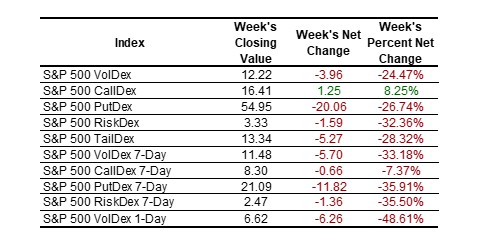
S&P 500 RiskDex fell by 32.36% and is back below its long-term average price telling investors that fear is below average.

7-Day measures in the S&P 500 all fell by more than 33% with the exception of 7-Day CallDex which fell by just 7.37%.
Nasdaq-100 volatility measures showed similar price action however 7-Day CallDex rose by 8.76%.
Implied volatility is once again very low so short volatility option structures are to be avoided.
Why It Matters…Historical data for all our indexes is available to subscribers at the Everything! level and they allow option traders to understand the context of the current option pricing environment. Volatility is mean-reverting and that is a phenomenon traders can take advantage of in both directions. But you have to understand what normal is, what the “mean” is, in order to do so.
You can see the week’s results for our indexes on the Nasdaq-100 below.
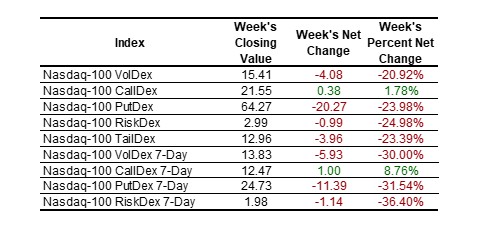

Last week we noted that “Nasdaq-100 CallDex closed at 21.17 which is the 1st percentile of its 52-week range.” Buyers of out-of-the-money calls in QQQ probably lost a little money on those trades this week but this was the right trade because it offered a very attractive risk/reward profile.

Nations Investor Optimism Index:
The Investor Optimism Index rose by 14.54% to close at 31.36.
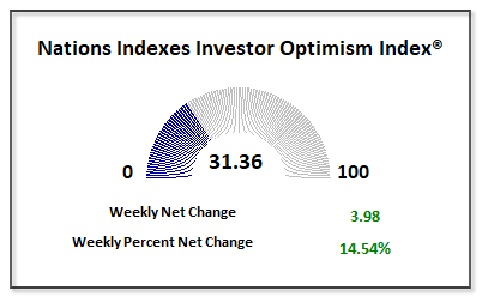
The index takes into account the current levels of S&P VolDex, TailDex, and RiskDex and compares them to their rolling 2-year ranges.
Our Optimism Index is now available in real-time on our home page at NationsIndexes.com.
Other Equity Indexes:
You can see how 30-day option prices for the Russell 2000 were lower with the exception of CallDex.
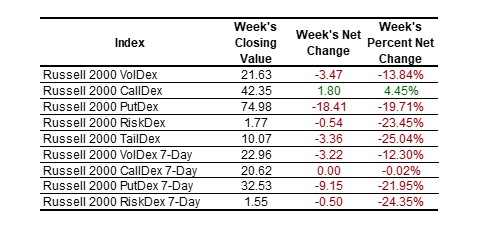
Why It Matters…Volatility remains relatively low thanks to the rally in stock prices and because traders do not want to be long volatility during August. This will offer a few opportunities to take smallish long vol positions that will be low probability / high potential return trades such as last week’s Nasdaq-100 CallDex trade.
Other Asset Volatility:
Treasury Bonds:
The yield on 10-year treasury notes rose by 6.5 basis points to end the week at 4.285%. Bond and note prices were hurt by the rally in equities which took some steam out of last week’s bond buying. Yields dropped despite the likelihood of the Fed cutting rates by 25 basis points at their September meeting climbing from 80.3% to 88.9%.
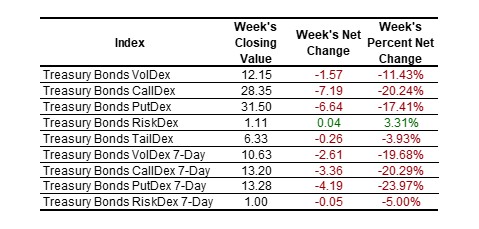
Treasury bond VolDex closed at just the 3rd percentile of its 52-week range.

Traders will be looking for opportunities to buy treasury bond call options as the prospects for a rate cut solidify.

Why It Matters…Treasury bond prices move inversely to interest rates and the TLT option market is also impacted by volatility in equity markets as treasury bonds are seen as a safe haven. Last week’s buying of treasuries was driven by weak jobs data and fears of a sell-off in equities. That buying pressure eased this week although we wonder if the weakness in Treasury Bond CallDex isn’t overdone given the likelihood of a rate cut. We’ll be watching as Treasury Bond CallDex’s 30-day tenor starts to capture the Fed meeting to be held on September 17.
Bitcoin:
Bitcoin VolDex convincingly continued its downward trend.
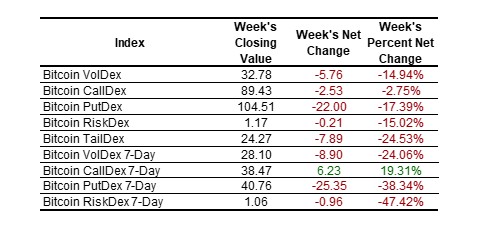
We had been watching for opportunities to short bitcoin volatility at higher levels and missed this renewed break in implied volatility.

We still believe that Bitcoin RiskDex should move to resemble RiskDex values for other “Risk On” assets like equity indexes. Bitcoin RiskDex fell by 15.02% this week to close at 1.17 but we consider this an opportunity for delta-neutral call spread collar strategies.
Precious Metals:
Gold rose 1.27% this week. Gold futures made a new all-time high of 3534.10 on Friday but then closed lower for the day. Technicians call this a “key reversal” and it is a troubling sign for gold prices which have moved mostly sideways between 3300 and 3490 since the middle of April. The decline in CallDex versus the rally in PutDex is noteworthy.
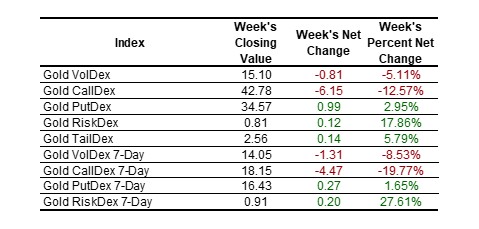
You can see the Gold VolDex and RiskDex charts below.


VolDex Term Structure:
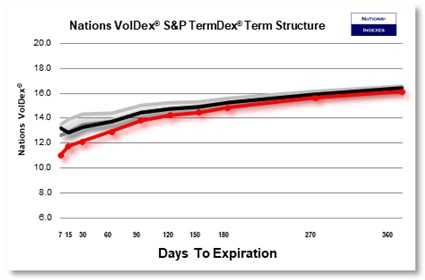
Term structure for S&P VolDex resumed a very normal shape which expresses very little concern in the near-term. Friday’s closing VolDex term structure is in red while the week’s other closes are in black (Thursday) and gray for earlier days in the week.
Option Window:
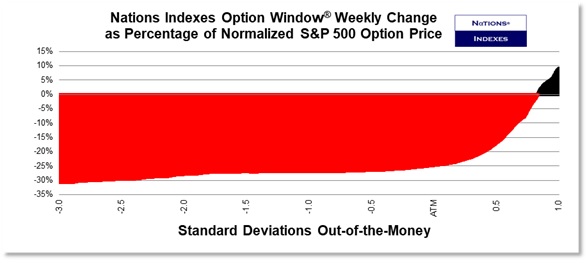
Option Window® is a graphical display of where option flows were concentrated this week. The black areas show where buying drove prices higher at constant points of moneyness (horizontal axis) while red shows where selling drove option prices lower. It is easy to see that selling was robust and spread across the vast majority of the option skew. Buying prevailed above strike prices that are approximately 0.8 standard deviations above at-the-money.
0DTE and 1DTE Options:
Zero day to expiration (ODTE) options accounted for 60.66% of all SPY option volume this week. They accounted for more than 60% of all SPY option volume on 4 of the 5 days of the week (Friday was just 58.98%).
Very short-dated volatility measures which use a variance swap methodology, as 1-day VIX does, inject significant error into the resulting measure because of the way out-of-the-money options trade in the hours before expiration. The VolDex at-the-money methodology is particularly suited for these very short-dated tenors.

Equities:
We have expanded the list of single names we cover to include not only the most dynamic stocks in the S&P 500 and the stocks with the highest option volume, but also the largest names in the S&P 500.
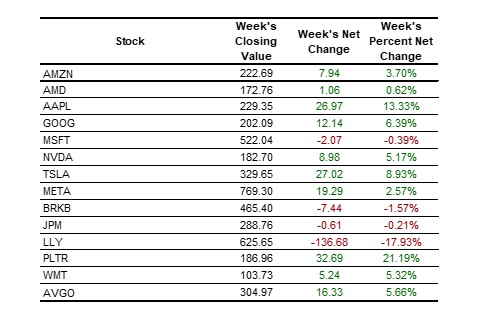
The single names we cover had a good week despite MSFT and JPM falling slightly and BRKB falling 1.57%. Only LLY dropped considerably as the pharma company fell 17.93% on news that their new weight loss pill did not perform as well as hoped.
AAPL and PLTR were the big gainers. AAPL avoided the worst of the new tariffs by committing to investing and manufacturing in the U.S. PLTR gained 21.19% courtesy of a strong quarterly earnings report and improved full-year guidance as quarterly revenue passed the $1 billion threshold for the first time.
VolDex was mostly lower for the single names we cover as several more reported earnings and tariff fears unexpectedly ebbed.
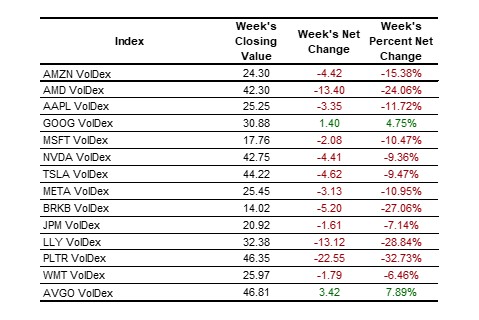
LLY VolDex fell by 28.84% demonstrating the power of a passing catalyst. AAPL VolDex fell by 11.72% as the stock rallied and the company managed to avoid the worst of the new tariffs.
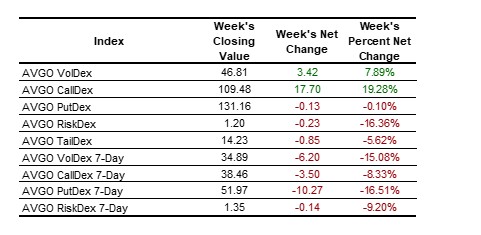
Only VolDex on GOOGL and AVGO rallied. AVGO is due to report earnings on September 4 so the 30-day tenor of VolDex now catches that catalyst, hence the rally in implied volatility.
In our July 19 edition of Volatility Insights we highlighted that AMD was a prime candidate for a covered call with a CallDex value of 141.67 (62nd percentile at the time) and the stock technically overbought with an RSI of 72.72. We used the 185 strike call option expiring on August 15, which could be sold at 1.75 with the stock at 156.99, as an example of the power of our indexes when used in concert with momentum indicators.
Since then this trade was worked very well. Shares have gained another 15.77 while this call closed on Friday at 0.80. This trade has made money on both legs and we can expect the call option to erode very quickly with just 5 trading days remaining before expiration.
If we were to apply this same analysis to the current market, AAPL seems to be the best candidate although not as compelling a candidate as AMD was.
In AAPL, the earnings catalyst has passed, CallDex is at 57.83 which is the 45th percentile of its 52-week range, and RSI is 73.66 meaning the stock is technically overbought. Shares closed at 229.35 on Friday and in the September 5 expiry, the 245 calls could have been sold at 1.50. This is not a recommendation but is rather an illustration of how many traders use our indexes to identify opportunities.
We’ll continue to comment during the week via our X account, @Nations_Indexes.
Scott’s Weekly Commentary:
Last week’s fear evaporated very quickly so the stock market made new highs. Some of this is due to increased expectations for the Fed to cut interest rates at their September 17 meeting. I’m not sure it’s needed. Yes, last week’s jobs data was disappointing but the unemployment rate is just 4.2% and that indicates our economy is at full employment. Inflation above the Fed’s 2% goal and full employment seem to suggest this is an odd time to be cutting rates but the market does a pretty good job of knowing when rate cuts are coming, deserved or not.
What will that mean for stocks? As I said last week, I’m not bearish and the stock market tends to rise over time. But we’re riding on the backs of just a few big names and broader strength would be welcome. That said, the percentage of stocks in the S&P 500 that are within 10% of their 52-week high has increased in the past 2 weeks.
However, the 10 largest names in the S&P 500 now account for more than 1/3rd of the index’s total market cap. And while NVDA has a market cap of $4.46 trillion, the 11th largest name has a market cap of just $828 billion.
What am I doing? You don’t have to swing at every pitch in the option space and while option prices are very low, they’re low for a reason and that is the calendar and accommodative Fed policy. Be long but be watchful.
Everyone at Nations Indexes hopes you have a healthy and profitable week.
Scott
