

Your Week’s Volatility Market Commentary — Information Is Your Edge
Four Down Days, One Big Up Day Thanks to the Fed
The Weekly Takeaway:
- The S&P 500 gained 0.27% this week to close at 6466.91. The index lost ground each of the first four days of the week but closed with a gain thanks to Friday’s rally of 1.52%. The index is now up 9.95% YTD;
- The Nasdaq-100 lost 0.90% this week. The index gained 1.54% on Friday but couldn’t overcome losses from Tuesday, Wednesday, and Thursday. The index is now up 11.83% YTD;
- The market rallied on Friday thanks to Fed Chair Powell’s Friday morning comments that the Fed is open to rate cuts if it continues to see weakness in the job market;
- Expectations for a rate cut from the Fed at its September meeting remain high thanks to Powell’s comments but the market says the current likelihood is 75% and that is LOWER than 85% from Thursday’s close and 85% from a week ago;
- VolDex (ticker VOLI) fell by 2.27%. It closed at 11.60, the 6th percentile of its 52-week range;
- TailDex (ticker TDEX) fell by 8.33%. This week’s close of 12.65 is the 10th percentile of its 52-week range;
- CallDex fell by 8.20% after rising by 5.93% last week and rising 8.25% in the week before that. This week’s decline was due to traders selling out-of-the-money calls early in the week to get short exposure amid a falling S&P 500 and a tepid response on Friday as the passing of the Powell speech catalyst and the looming weekend dampened interest in buying calls;
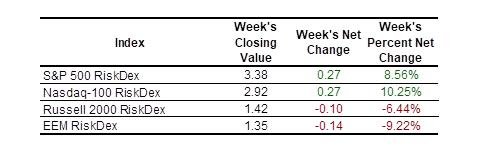
- RiskDex rose by 8.56% because CallDex fell by 8.20% while PutDex fell by just 0.81%;
- VolDex on the Nasdaq-100 rose by 5.80%, fueled by weakness in the Nasdaq-100, particularly the megacap names that have fueled this year’s rally. Regardless, it closed at just the 6th percentile of its 52-week range;
- The Russell 2000 index gained 3.30% on the week thanks to a rally of 3.86% on Friday as small cap names are believed to benefit most from lower interest rates. Russell 2000 VolDex gained 2.77%;
- U.S. Treasury Bond VolDex fell by 1.16% and closed at 12.00, the 2nd percentile of its 52-week range. However, CallDex and PutDex both rose on the week so traders were selling the at-the-money options described by VolDex but buying out-of-the-money calls to position themselves for a move in treasury bond prices;
- Bitcoin volatility was mixed with VolDex falling 7.71% while CallDex rose 13.75% and PutDex falling 13.19%. This suggests traders are very bullish on bitcoin;
- VolDex was mixed on the single names we cover with TSLA VolDex gaining 4.03% as the big winner and WMT VolDex falling by 29.03% thanks to the release of the company’s Q2 earnings results;
- The Nations Investor Optimism Index fell by 5.31% and closed back below 50 at 48.53.

Equity Index Volatility:
Implied volatility and option prices in the S&P fell in all metrics and tenors with the exception of 30-day RiskDex which rose only because CallDex fell by more than PutDex.
This shows the power of the passing of a big catalyst (Powell’s speech) and that traders do not want to be long volatility during the last week in August.
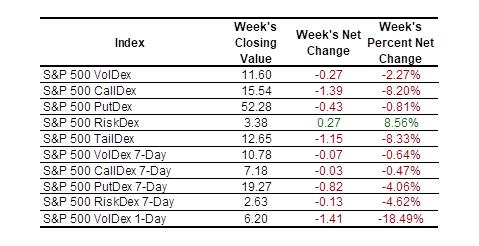
S&P 500 CallDex fell and closed at 15.54 but that is the 12th percentile of its 52-week range.

Implied volatility remains very low so short volatility option structures are to be avoided. 30-day tenors now catch next month’s release of jobs data, CPI, and PPI, and the results of the Fed’s September 16-17 meeting so we expect 30-day volatility metrics to ramp.
Why It Matters…Historical data for all our indexes is available to subscribers at the Everything! level and they allow option traders to understand the context of the current option pricing environment. Volatility is mean-reverting and that is a phenomenon traders can take advantage of in both directions. But you have to understand what normal is, what the “mean” is, in order to do so.
Results for Nasdaq-100 volatility diverged from S&P 500 volatility as the two indexes went in different directions and as concerns rose about the megacap names that have fueled the Nasdaq-100 this year. You can see the week’s results for our indexes on the Nasdaq-100 below.
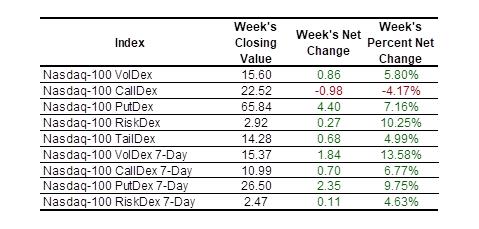

While VolDex, CallDex, and PutDex on the Nasdaq-100 are all still below the 12th percentile of their respective 52-week ranges, RiskDex is at the 53rd percentile signaling a reasonable amount of concern for the fate of the big tech names.

You’ll note the difference in S&P 500 RiskDex and Nasdaq-100 RiskDex. The S&P 500 metric tends to be higher because investors are willing to sell out-of-the-money covered calls in the S&P 500 but are much less willing to do so in the Nasdaq-100. This offers interesting relative value trade opportunities.
Nations Investor Optimism Index:
The Investor Optimism Index fell by 5.31% and is now back below 50.
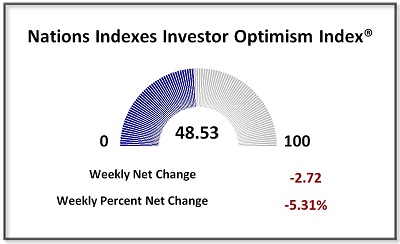
The index takes into account the current levels of S&P VolDex, TailDex, and RiskDex and compares them to their rolling 2-year ranges.
Our Optimism Index is now available in real-time on our home page at NationsIndexes.com.
Other Equity Indexes:
Option prices and implied volatility in the Russell 2000 were mixed as the index led the way in the equity index world.
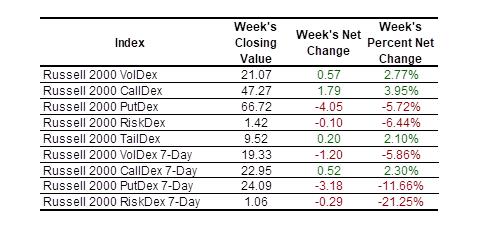
Why It Matters…The RiskDex regimes for the 4 equity indexes we cover are very different. Savvy traders can take advantage.
Other Asset Volatility:
Treasury Bonds and Notes:
The yield on 10-year treasury notes fell by 6.8 basis points this week thanks to hopes for a rate cut in September. The yield ended the week at 4.260%.
In a repeat of the previous week, the price action in treasury bond options was odd with VolDex falling slightly and PutDex and CallDex rising. Traders seem to be expecting little volatility during the next weeks but want protection from out-of-the-money options in an acknowledgement that the 30-day tenor now catches a number of important data releases.
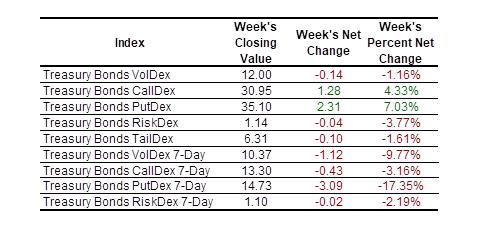
Treasury bond VolDex closed at just the 2nd percentile of its 52-week range while CallDex closed at the 36th percentile and PutDex closed at the 15th percentile.

For the last two weeks we have been pointing out that traders are anxious to be long treasury bond calls and that continued this week.

Why It Matters…Treasury bond prices move inversely to interest rates which are impacted by jobs data, CPI, PPI, and the looming Fed rate decision. We will watch Treasury Bond VolDex as all those catalysts approach because the current level seems very low.
Bitcoin:
Bitcoin volatility was mixed with VolDex and PutDex lower and CallDex higher.
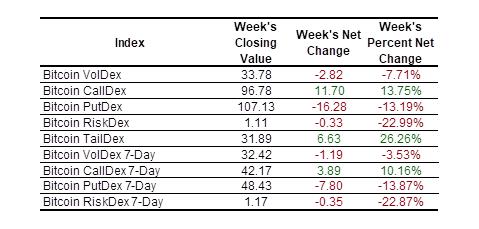
Traders clearly believe the path for bitcoin is to the upside for the next 30 days.

Bitcoin RiskDex fell by 22.99% and we believe this is an opportunity for traders to employ a call-spread collar to take advantage of the expected increase in put prices relative to call prices.
Precious Metals:
Gold rose by 1.05% and gold futures continue to trade in a broad sideways pattern since April although lower interest rates should help gold.
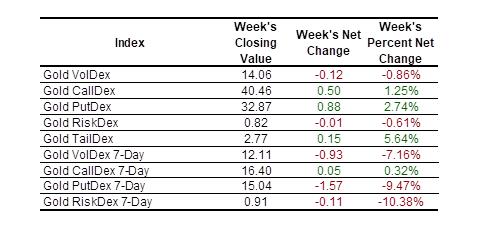
You can see the Gold VolDex chart below.

VolDex Term Structure:
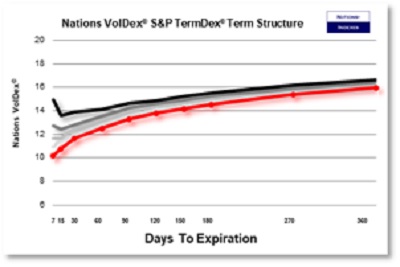
Term structure for S&P 500 VolDex maintains a very normal shape and the upward sloping shape suggests there is little fear in the near term. Friday’s closing VolDex term structure is in red while the week’s other closes are in black (Thursday) and gray for earlier days in the week.
Option Window:
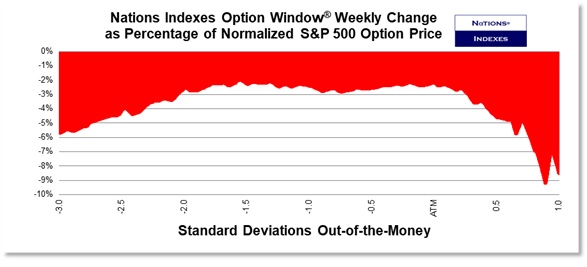
Option Window® is a graphical display of where option flows were concentrated this week. Any black areas (there are none this week) show where buying drove prices higher at constant points of moneyness (horizontal axis) while red, which predominates this week, shows where selling drove option prices lower. Out-of-the-money call option prices were pressured early in the week.
0DTE and 1DTE Options:
Zero day to expiration (ODTE) options accounted for 60.82% of all SPY option volume this week.
Very short-dated volatility measures which use a variance swap methodology, as 1-day VIX does, inject significant error into the resulting measure because of the way out-of-the-money options trade in the hours before expiration. The VolDex at-the-money methodology is particularly suited for these very short-dated tenors.

Equities:
We have expanded the list of single names we cover to include not only the most dynamic stocks in the S&P 500 and the stocks with the highest option volume, but also the largest names in the S&P 500.
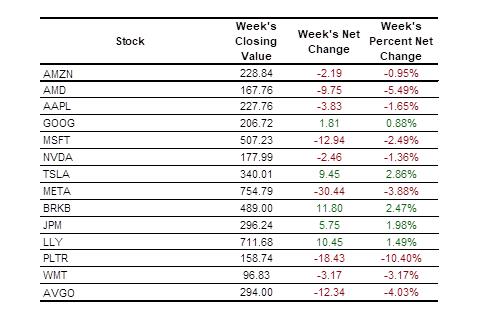
The single names we cover were mixed this week with AI names falling.
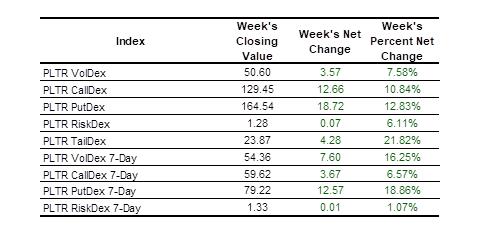
Last week we said, “The decline in PLTR can be dismissed given its YTD gain of 134.26%.” We got that wrong as PLTR fell another 10.40% this week.
Megacap tech all fell as you can see below with AI related names leading the way downward.
VolDex was similarly mixed for the single names we cover. WMT VolDex fell by 29.03% as the company reported Q2 earnings.
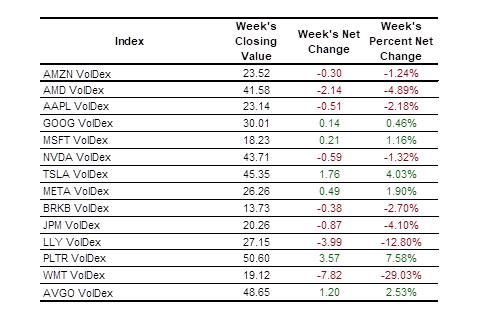
The price action in PLTR options was all to the upside as traders bid up all PLTR option prices including out-of-the-money calls. This is an indication of real concern because traders were reaching to buy volatility at any strike price.
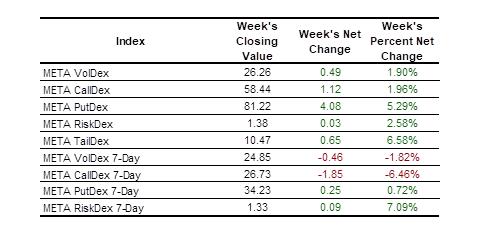
We highlighted META options last week as they were trading at very low levels. META VolDex gained 1.90% and all 30-day metrics were in the green.
Last week we said, “Traders with an opinion as to the next move in META can take advantage using options” and that remains the case as VolDex is at the 2nd percentile of its 52-week range while CallDex is at the 1st percentile and PutDex is at the 9th.
The META VolDex chart below clearly shows seasonality tied to earnings releases but that offers an opportunity for traders with a directional opinion for the next 30 days.

We’ll continue to comment during the week via our X account, @Nations_Indexes.
Scott’s Weekly Commentary:
The market had a terrible start to the week but Jay Powell saved the week by suggesting the Fed would cut rates if job creation data was not everything it might be. I’m not certain that makes much sense as the jobs portion of the Fed’s mandate calls for “full employment” which is generally understood to mean an unemployment rate of not more than 5%. The most recent reading was 4.2% so by any measure our economy is at full employment.
Some might ask, “What would be the problem with the Fed cutting rates even if we’re at full employment?” and it’s a reasonable question because it would reduce borrowing costs. But history has shown that the Fed does the most damage when it reduces rates too much and leaves them there too long. This clearly happened in 1928 and 1929 and it led to an investing bubble which led to the Great Depression. This also happened in the 2000’s when Alan Greenspan left rates too low which led to investors, hungry for yield, flocking to mortgage-backed securities. That led to the housing bubble which led to the second-worst stock market collapse in modern history.
So the Fed pushing rates too low and then leaving them there for too long directly led to the two worst economic episodes since 1900. Lower rates come at a cost.
The wreckage in the AI and megacap space is not yet ugly but it is headed in that direction. Investors, particularly retail investors, have been quick to rush in and buy any dips and that is a good long-term strategy, particularly when compared to what used to happen when retail investors would bail at the bottom. So it will be interesting to see if retail comes in to buy the dip in AI names.
PLTR is still up 6.49% over the past 30 days and up 109.89% YTD so the last two weeks have been ugly but only if you just got into the stock. This one will be fun to watch.
NVDA is up 6.56% over the past 30 days and 32.54% YTD. This puzzle is more nuanced because it relies on tariff policy as the company would like to sell sophisticated computer chips to China. It’s a good company that is well managed with a forward PE of 35.9, but their fate is not entirely in their hands. This will be fun to watch as well.
I expect very little to happen in the coming week as everyone takes the last week in August off and prepares to enjoy the Labor Day weekend. I hope you’re able to do that too.
Everyone at Nations Indexes hopes you have a healthy and profitable week.
Scott
