Your Week’s Volatility Market Commentary — Information Is Your Edge
Jobs Data Disappoints but Stocks Don’t
The Weekly Takeaway:
- The S&P 500 rose by 0.33% during the holiday-shortened week to close at 6481.50. The index is now up 10.20% YTD;
- The Nasdaq-100 gained 1.01% this week as GOOG, TSLA, and AVGO all gained more than 5%. The index is now up 12.57% YTD;
- VolDex (ticker VOLI) fell by 1.31% to close at 12.07. That is the 8th percentile of its 52-week range;
- TailDex (ticker TDEX) fell by 4.25%. This week’s close of 14.18 is the 14th percentile of its 52-week range;
- CallDex and PutDex both rose slightly as investors were willing to sell at-the-money options but bought out-of-the-money options to profit from a big move in either direction;
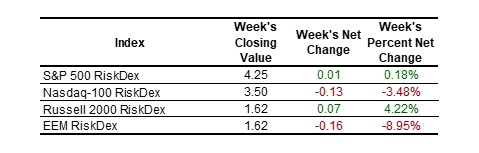
- RiskDex rose slightly – after gaining 25.33% during the previous week – and closed at 4.25. That is the 45th percentile of the 52-week range illustrating that investors are nervous about the potential for downside in a market that is very richly priced;
- The yield on the Treasury notes fell by 14.1 basis points and ended the week at just 4.086%. Most of the decline occurred on Friday after disappointing jobs data was released. The market’s estimate of the likelihood of the Fed cutting the Fed Funds rate at their next meeting is 100%;
- Every volatility measure on Treasury notes rose on the week despite the passing of the jobs data catalyst. Savvy traders will be watching Treasury note and bond volatility;
- Volatility measures on the Nasdaq-100 reacted very differently. Nearly every measure fell (only 7-Day RiskDex rose because 7-Day CallDex fell by more than 7-Day PutDex) with VolDex falling 4.26%. It is at just the 7th percentile of its 52-week range;
- Bitcoin volatility fell across nearly all 30-day measures (TailDex rose 0.64%) and VolDex fell by 5.37%;
- Volatility in gold was again noteworthy with VolDex gaining 3.46% after gaining 16.73% during the previous week. Every volatility measure was higher in gold this week;
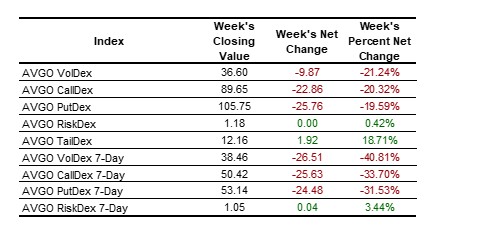
- VolDex on the individual equity names we cover was mostly higher this week. AVGO VolDex fell by 21.24% in the typical post earnings vol crush and GOOG VolDex fell by 18.75% after the company received a favorable judgement in antitrust litigation;
- The Nations Indexes Optimism Index® rose by 4.24% to close at 78.83.

Equity Index Volatility:
The price action in S&P 500 options this week was interesting with RiskDex ticking up to 4.25 but TailDex falling. Investors are bracing for a move but don’t believe it will be a dramatic move to the downside.
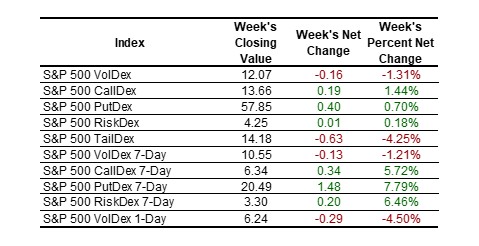
S&P 500 RiskDex is the only 30-day metric in the S&P 500 that is above the 14th percentile of its 52-week range. Its average close since 2005 is 3.75. These historical metrics (Average, median, 10th percentile, 25th percentile, 75th percentile, and 90th percentile) are available to subscribers at NationsIndexes.com.

Why It Matters…Historical data for all our indexes is available to subscribers at the Everything! level and they allow option traders to understand the context of the current option pricing environment. Volatility is mean-reverting and that is a phenomenon traders can take advantage of in both directions. But you have to understand what normal is, what the “mean” is, in order to do so.
Results for Nasdaq-100 volatility were different than those for the S&P with Nasdaq-100 volatility falling across the board.
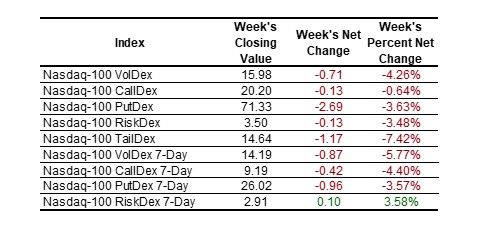

Nasdaq-100 RiskDex remains elevated despite falling 3.48%. It is at the 64th percentile of its 52-week range in a sign investors remain worried about the prospects for ‘big tech’ despite this week’s gains.

Other Equity Indexes:
The Russell 2000 index of small capitalization stocks again led the way higher, gaining 1.04% this week as smaller companies are seen as beneficiaries of lower interest rates. 30-day VolDex, PutDex, and CallDex were all lower but all 7-day volatility measures were higher for the Russell 2000.
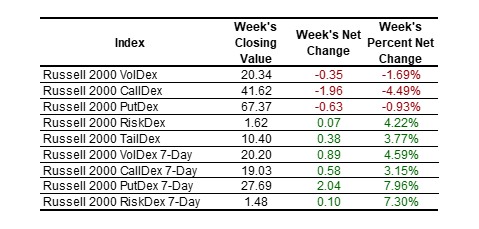
Why It Matters…The RiskDex regimes for the 4 equity indexes we cover performed very differently this week.
Nations Investor Optimism Index:
The Investor Optimism Index rose by 4.24% to close at 78.83.
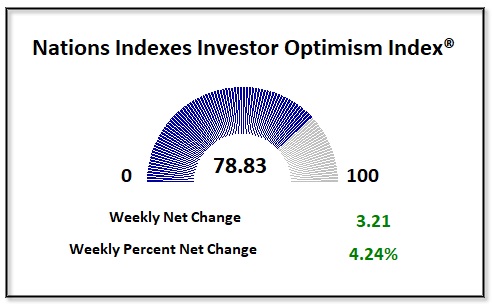
The index takes into account the current levels of S&P VolDex, TailDex, and RiskDex and compares them to their rolling 2-year ranges. It is plotted on a 0 to 100 scale.
Our Optimism Index is now available in real-time on our home page at NationsIndexes.com.
Other Asset Volatility:
Treasury Bonds and Notes:
The yield on 10-year treasury notes fell by 14.1 basis points as mentioned above and closed at 4.086%. That is the lowest level since April when yields fell in response to tariff turmoil.
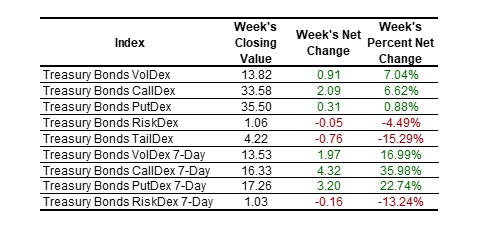
Treasury bond VolDex is still relatively low on an historical basis.

Treasury bond CallDex rose by 6.62% but PutDex rose just 0.88% as traders scooped up out-of-the-money calls in anticipation of a Fed rate cut.

Why It Matters…Treasury bond prices move inversely to interest rates and it is interesting that traders remain more interested in owning puts than calls (albeit barely).
Bitcoin:
Bitcoin volatility fell and bearish sentiment ebbed a bit.
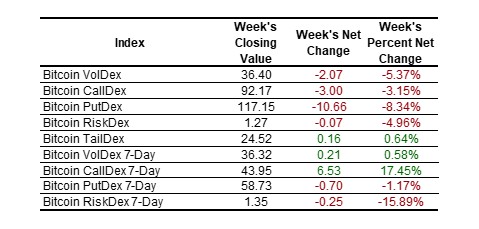
The divergence in 7-day CallDex (up 17.45%) and 30-day CallDex (down 3.15%) is striking and we will continue watching.

Precious Metals:
Gold rose by another 4.08% as lower interest rates helped. Gold futures have broken out of the sideways pattern they were in since April.
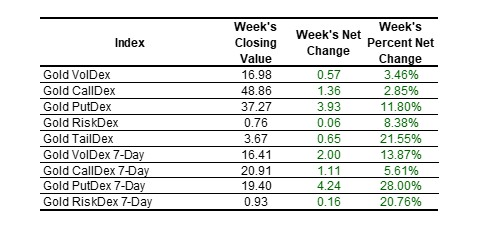

While RiskDex rose slightly it is still displaying a substantial amount of call skew. The average Gold RiskDex value since 1/3/2022 is 0.85. Important percentile metrics for all our indexes are available to subscribers at NationsIndexes.com.

VolDex Term Structure:
Term structure for S&P 500 VolDex maintains a very normal shape and the upward sloping shape suggests there is little fear although the “kink” in the 15-Day VolDex occurs because it catches the Fed meeting. Friday’s closing VolDex term structure is in red while the week’s other closes are in black (Thursday) and gray for earlier days in the week.

Option Window:
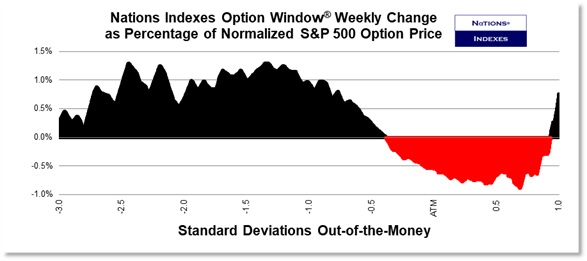
Option Window® is a graphical display of where S&P 500 option flows were concentrated this week. Any black areas show where buying drove prices higher at constant points of moneyness (horizontal axis) and time (constant 30 days to expiration) while red shows where selling drove option prices lower. This week’s action was unusual in that selling was concentrated in a small and specific portion of the skew.
0DTE and 1DTE Options:
Zero day to expiration (ODTE) options accounted for 59.08% of all SPY option volume this week.
Very short-dated volatility measures which use a variance swap methodology, as 1-day VIX does, inject significant error into the resulting measure because of the way out-of-the-money options trade in the hours before expiration. The VolDex at-the-money methodology is particularly suited for these very short-dated tenors.

Equities:
We have expanded the list of single names we cover to include not only the most dynamic stocks in the S&P 500 and the stocks with the highest option volume, but also the largest names in the S&P 500.
The single names we cover were mixed this week. AVGO was the standout in the AI space, gaining 12.61% while NVDA and AMD fell.
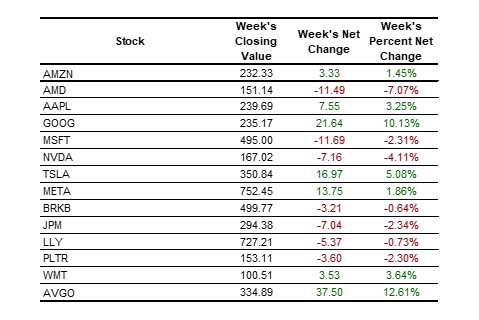
VolDex was higher for nearly all names this week with only those which saw catalysts pass posting lower VolDex values.
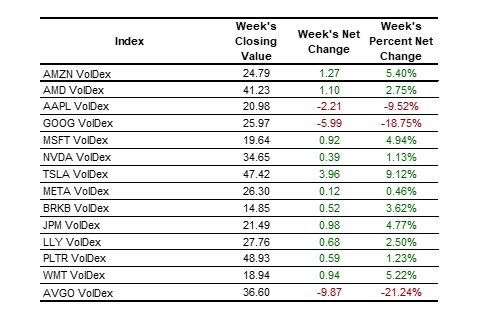
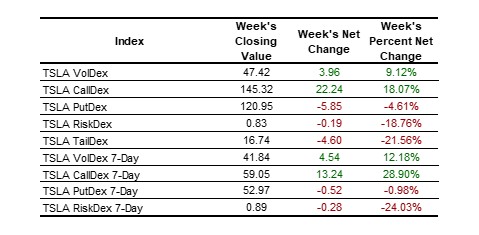
TSLA saw VolDex (at-the-money volatility) and CallDex (out-of-the-money call option volatility) increase while PutDex fell. This played out in both 30-day and 7-day tenors. The action was driven by the company’s compensation plan for founder Elon Musk which is intended to keep him focused on TSLA. The plan is very generous but requires him to meet very aggressive milestones.
The shares remain in a sideways pattern that began in May. Since then the top has been approximately 365 and the bottom approximately 287. CallDex is at the 21st percentile of its 52-week range but PutDex is at just the 5th percentile.
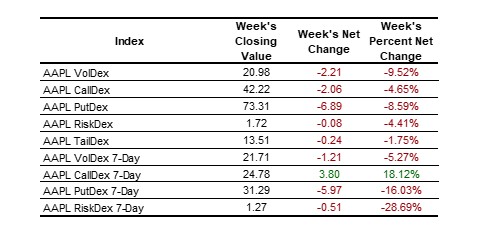
AAPL volatility measures fell on the week with the exception of 7-day CallDex. VolDex fell by 9.52% to close at 20.98, the 10th percentile of its 52-week range. PutDex fell by 8.59% to close at 73.31, the 16th percentile of its 52-week range.
AAPL is slightly overbought with an RSI on Friday’s close of 70.86.
Given cheap option prices and the fact that AAPL is slightly overbought, small positions that are long puts or put spreads seem interesting as a speculation. For example, in the October 3 expiry, buying the 225/235 put spread (buying the 235 put and selling the 225 put) could have been executed on Friday’s close at 2.00 with AAPL at 239.69.
The spread costs just 20% of its width which is an attractive relationship for a spread so close to at-the-money in a stock that is slightly overbought. This is not a trade recommenation but is instead an example of how many traders use our indexes to generate specific trade ideas. We’ll continue to follow this spread to see how the trade works.

We’ll continue to comment during the week via our X account, @Nations_Indexes.
Scott’s Weekly Commentary:
Following Friday’s disappointing jobs report (22k new jobs were created in August when 77k were expected) the market is now certain the Fed is going to cut interest rates at the next meeting which ends on September 17. The only question that remains is how much they’re going to cut – the market says the likelihood of a 25 basis point cut is 89% and the odds of a 50 basis point cut are 11%.
Yes, inflation is still well above the Fed’s 2% target and the unemployment rate of 4.3% is still below the 5% unemployment level that is generally considered to mark full employment but the market wants what it wants.
The jobs news helped bonds and gold but stocks to only a lesser degree. If you want to trade on the interest rate paradigm then I’d focus on gold and fixed-income because there’s no telling what is next for tariffs and AI doesn’t care about interest rates.
The stock market tends to go up over time. That is something permabears forget (or ignore). Valuations are EXTREMELY high and that is worrisome; being concerned from time to time doesn’t make you a permabear so the occasional bearish or protective trade, particularly when options are cheap like they are now, makes sense.
I’m starting a new tradition here…from now on I’ll be posting additional graphics that are interesting but don’t make the regular content. You’ll see them below.
Everyone at Nations Indexes hopes you have a healthy and profitable week.
Scott