

Your Week’s Volatility Market Commentary — Make Information Your Edge
Stocks Bounce Back In An “Everything” Rally – What Do Options Say
The Weekly Takeaway:
- The S&P 500 gained 1.70% for the week and experienced substantial volatility. The S&P 500 is now up 13.30% for the year;
- The Nasdaq-100 gained 2.46% for the week. The index is now up 18.11% YTD;
- S&P 500 VolDex (ticker VOLI) closed at 16.66, a decline of 7.70% for the week. VolDex’s closing value is the 22nd percentile of its 52-week range;
- S&P 500 TailDex (ticker TDEX) closed at 21.23, a gain of 12.27% for the week. This week’s close is the 30th percentile of its 52-week range;
- S&P 500 CallDex fell by 12.80% after falling 5.97% in the previous week as traders continue to sell out-of-the-money call options, signaling their belief that extended upside is unlikely for the S&P 500. It closed at just the 3rd percentile of its 52-week range;
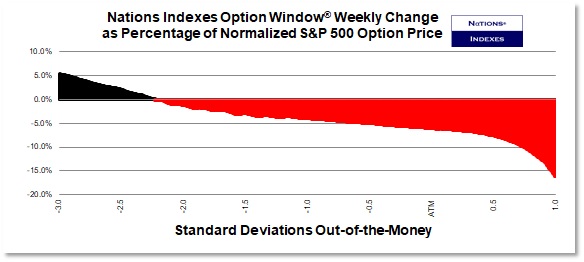
- The takeaway is that at-the-money and above at-the-money option prices fell while deep out-of-the-money put prices rose:
- VolDex on the Nasdaq-100 fell by 4.59% this week. It closed at the 25th percentile of its 52-week range;
- TailDex on the Nasdaq-100 rose by 7.60% to close at 19.61;
- The yield on the Treasury notes fell by another 4.4 basis points and ended the week at 4.007% after falling as low as 3.971% on Thursday;
- Every volatility measure on Treasury bonds fell on the week in sympathy with the decline seen in equity index volatility. Treasury Bond VolDex closed at just 11.60, the 4th percentile of its 52-week range;
- Every measure of bitcoin volatility rose again this week with Bitcoin VolDex gaining 12.25% to close at 50.04. That is the fourth straight weekly gain for Bitcoin VolDex;
- Silver gained 6.55% for the week despite losing 5.25% on Friday. Silver VolDex gained 14.32% on the week to close at the 89th percentile of its 52-week range:
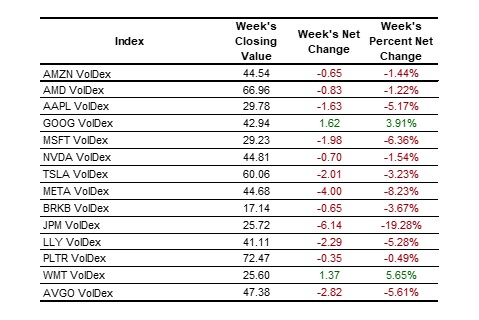
- VolDex was generally lower for the equity names we cover. JPM VolDex led the way lower after the company reported earnings. VolDex on GOOGL and WMT were the only ones to finish higher on the week;
- The Nations Indexes Optimism Index® fell by 4.08% to close at 61.58.
- You can always learn more about all of our indexes at Learn More About Our Indexes
- We have added an interesting segment to our weekly Volatility Insights. Trade Spotlight will describe an interesting trade opportunity based on our index values and other metrics like readily available momentum measures. These are not trade recommendations but illustrate another way to use our volatility indexes. Be certain to check it out.

Equity Index Volatility:
The S&P 500 managed to gain 1.70% this week despite significant volatility including an intraday gain of more than 60 points from its low on Friday.
S&P 500 volatility displayed a pronounced bias for puts and away from calls as you can see below in our Option Window®.
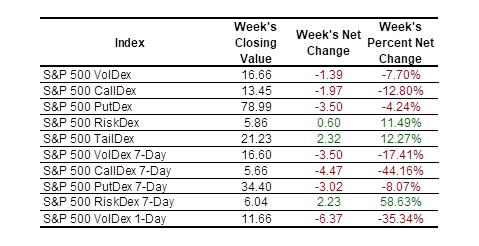
TailDex rose by 12.27% to close at 21.23, its highest level since June.
RiskDex rose by 11.49% after last week’s gain of 43.87%. This week’s close of 5.86 is the 78th percentile of its 52-week range and RiskDex has gained 87.9% over the past 30 days.
Historical metrics (Average, median, 10th percentile, 25th percentile, 75th percentile, and 90th percentile) for all out indexes are available to subscribers at NationsIndexes.com.

Why It Matters…Historical data for all our indexes is available to subscribers at the Everything! level and they allow option traders to understand the context of the current option pricing environment – the current environment, while not unique, is unusual. Volatility is mean-reverting and that is a phenomenon traders can take advantage of in both directions. But you have to understand what normal is, what the “mean” is, in order to do so.
Nasdaq-100 VolDex fell by 4.59% to close at 21.94, the 25th percentile of its 52-week range.
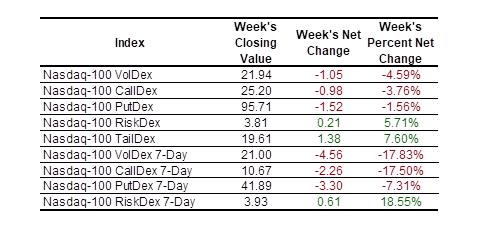

Nasdaq-100 TailDex rose by 7.60% to close at 19.61 after closing at 21.88 on Thursday. Thursday’s close was the highest since April 15 when the market was swooning over fears of a trade war.

Why It Matters…Traders have to have the objective data provided by our indexes to trade in a way that doesn’t rely on hunches or guesses.
Nations Option Window®:
Our Option Window® graphic shows the impact of buying and selling of S&P 500 options at each point on the skew. Moneyness as defined by standard deviations from at-the-money is constant as is the precisely 30-day time to expiration.
You can see that option activity was heavily skewed toward buying of deep out-of-the-money puts and selling every strike price above the point that is 2 standard deviations below at-the-money. That 2 standard deviation below at-the-money level translates to approximately 5400.
Nations Investor Optimism Index®:
The Investor Optimism Index fell by 4.08% to close at 61.58 so optimism, as measured by implied volatility, continues to fall but remains above the midline of 50.
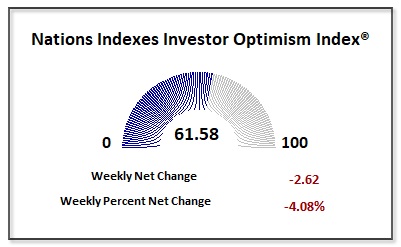
The index takes into account the current levels of S&P VolDex, TailDex, and RiskDex and compares them to their rolling 2-year ranges. It is plotted on a 0 to 100 scale.
Our Optimism Index is now available in real-time on our home page at NationsIndexes.com.
1DTE Options:
S&P 500 1-Day VolDex fell by 35.34% after gaining 178.15% during the previous week.
Very short-dated volatility measures which use a variance swap methodology, as 1-day VIX does, inject significant error into the resulting measure because of the way out-of-the-money options trade in the hours before expiration. The VolDex at-the-money methodology is particularly suited for these very short-dated tenors.

Other Asset Volatility:
Treasury Bonds and Notes:
The yield on 10-year Treasury notes fell despite stocks rallying as some investors seek the safety of Treasury notes rather than ride out the volatility we’ve seen in our equity markets.
Despite this, every volatility measure for Treasury bonds fell on the week with VolDex falling to 11.60, just the 4th percentile of its 52-week range.
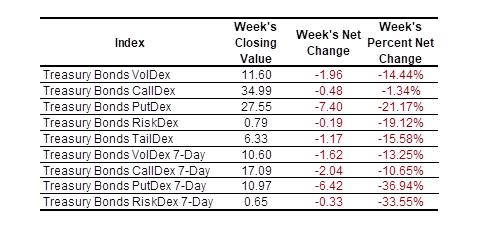
Directional trades in Treasury bonds should take advantage of very low at-the-money implied volatility as measured by VolDex.

Why It Matters…We still believe the ability to buy at-the-money Treasury bond options at historically low prices is a unique opportunity given the risks currently present. Long volatility structures are the correct approach. Short volatility structures should be avoided.
Bitcoin:
Bitcoin fell again this week, losing another 6.71%, and Bitcoin volatility rose again this week with VolDex gaining 12.25% after gaining 9.72% and 6.70% in the previous two weeks.
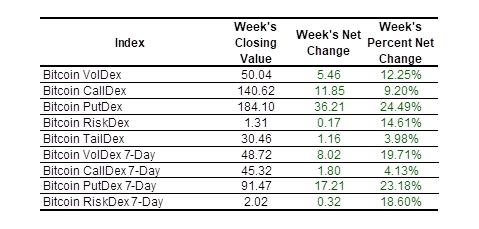
Last week we noted that “Traders will be watching for opportunities to short bitcoin options if Bitcoin VolDex recaptures the 50 level.” We are there with Bitcoin VolDex closing at 50.04 although traders will be cautious until the realized volatility in Bitcoin subsides.

Precious Metals:
Gold futures gained another 5.23% this week despite a loss of 2.05% on Friday. Buyers are clearly driven by lower interest rates, concerns about an economic slowdown, and potential geopolitical tensions.
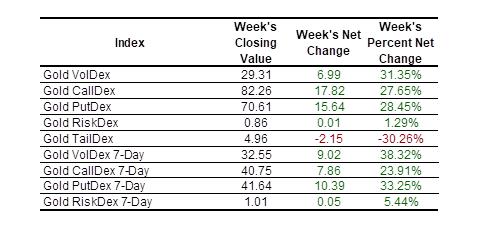
Gold VolDex gained 31.35% to close at 29.31, its highest close March 8, 2022. Friday’s close was the 94th percentile of its 52-week range.

Gold CallDex gained 44.34% to close at 64.44, its highest level since June.

Interestingly, Gold PutDex gained 28.45% last week to close at 70.61, the 99th percentile of its 52-week range.
Silver was the standout performer of the week with a gain of 6.55% despite losing 5.25% on Friday.
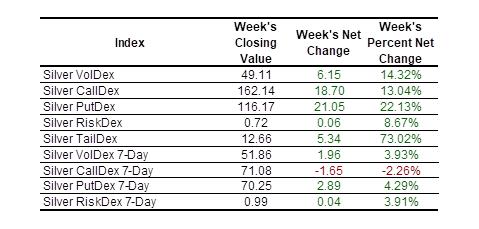
The action in Silver CallDex was particularly frantic this week with Silver CallDex gaining 13.04% for the week but gaining 91% over the past 30 days.

Equities:
We have expanded the list of single names we cover to include not only the most dynamic stocks in the S&P 500 and the stocks with the highest option volume, but also the largest names in the S&P 500.
Nearly every equity we cover gained ground on the week with the exceptions of AMZN, JPM, and LLY. AMD was once again the big winner with a gain of 8.46% following last week’s gain of 30.50% on news of a partnership with OpenAI which will deploy AMD GPUs as it builds out its next-generation AI infrastructure.
LLY was the big loser with a decline of 3.68% following President Trump’s comments that prices for GLP-1 weight-loss drugs, including LLY’s Mounjaro, should be “much lower” and suggested a $150 monthly out-of-pocket cost which is approximately 65% below current out-of-the-pocket costs.
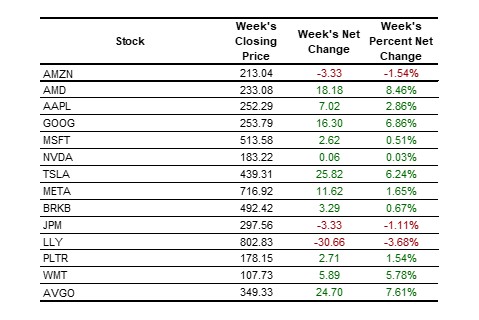
VolDex was generally lower on the equity’s we cover. JPM VolDex fell following the quarterly earnings release, again demonstrating the power of the volatility crush after earnings.
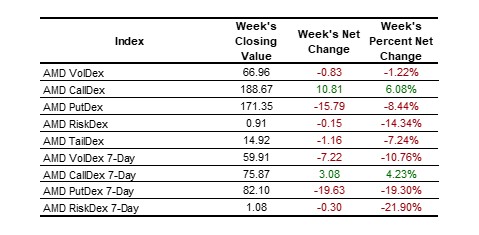
Volatility metrics in AMD were mixed this week after being higher across the board last week. AMD VolDex fell 1.22% and AMD PutDex fell 8.44% but AMD CallDex rose 6.08% as traders clearly expect more upside for AMD. We discuss AMD in our Trade Spotlight section below.
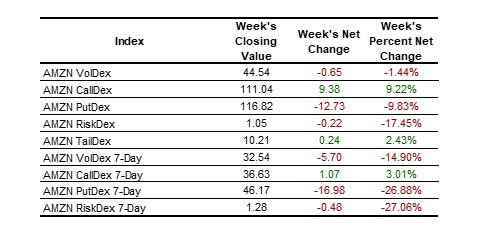
AMZN lost 1.54% this week due to a variety of concerns including tariff worries, insider selling and the resulting supply overhang, and sluggish growth in AWS.
Despite those concerns, AMZN CallDex rose by 9.22% and AMZN PutDex fell by 9.83%. AMZN CallDex ended the week at the 99th percentile of its 52-week range while AMZN PutDex ended the week at just the 47th percentile of its 52-week range. The result is that collar strategies are interesting for owners of the shares who are worried about losses. Call spread collar strategies are interesting for those who don’t own shares.
Trade Spotlight:
These are not trade recommendations.
More extensive Trade Spotlight material will be available at NationsIndexes.com very shortly but Trade Spotlight provides illustrations of how many traders use our indexes.
This week’s Trade Spotlight focuses on AMD. Shares are up 46.4% over the past 30 days on news of expansion in the AI GPU market and new AI partnerships. But ORCL hasn’t been able to sustain its recent AI-related gains and some are concerned about AMD’s ability to execute and gain share from competitors.
AMD’s relative strength index (RSI) is 71.5 as of Friday’s close so it is technically overbought. But PutDex at 171.35 while high, is at just the 38th percentile of its 52-week range. That means some traders will be looking to buy 30-day put spreads to get bearish exposure to AMD shares and potentially benefit if put option prices advance.
Also, AMD RiskDex closed at 0.91 meaning that out-of-the-money calls are more expensive than out-of-the-money puts. Given that AMD is technically overbought, this means that some traders will be looking at a call spread collar strategy (selling a call spread and using the proceeds to buy a put option).
Again, the setups we describe in Trade Spotlight are never trade recommendations but are rather illustrations of how many traders use our indexes to identify trade opportunities and to craft superior trade structures.
We’ll continue to comment during the week via our X account, @Nations_Indexes.
Scott’s Weekly Commentary:
The market bounced back strongly on Monday, reversing the negative sentiment from the end of the previous week and everything is rallying (equities, precious metals, fixed income) as interest rates fall.
But why are rates falling? Is it because the market expects the Federal reserve to continue cutting rates? It seems so as the market believes the odds of a 25 bps cut at the October meeting are 99%. If the government shutdown continues then the Fed will be in a corner. They won’t have any inflation or unemployment data that might justify that rate cut although the shutdown itself might deserve a cut. That would be one hell of a press conference.
Rates might also be falling because traders expect the economy to slow.
But equity prices continue to rally albeit with substantial volatility. I think that is telling as is the fact that deep OTM puts gained ground on the week while calls lost ground. It seems the option market is expressing skepticism regarding the rally. I’m still a nervous bull but I have reason to worry.
Everyone at Nations Indexes hopes you have a healthy and profitable week.
Scott


