Your Week’s Volatility Market Commentary — Make Information Your Edge
The Market Has Stabilized – But Traders Have Opportunities!
The Weekly Takeaway:
- The S&P 500 gained 0.31% this week. It is now up 16.81% for the year;
- The Nasdaq-100 gained 1.01% this week as AI-related names continued to do well. The index is now up 22.27% for the year;
- S&P 500 VolDex (ticker VOLI) closed at 12.65, a decline of 6.99% for the week and it is at just the 9th percentile of its 52-week range;
- S&P 500 TailDex (ticker TDEX) closed at 12.35, a decline of 7.07% for the week. It is now at just the 9th percentile of its 52-week range. Important historical metrics for all our indexes including average, median, and critical percentile closes are available to subscribers at NationsIndexes.com;
- In the S&P 500, 30-Day VolDex, PutDex, and TailDex are all below the 10th percentile of their 52-week ranges;
- All of our volatility indexes on the S&P 500 closed lower on the week with the exception of 7-Day CallDex which rose as traders resumed bullish positioning;
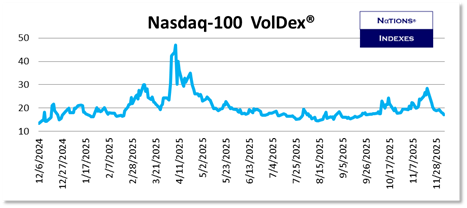
- VolDex on the Nasdaq-100 fell by 8.75% to close at 17.24. That is the 11th percentile of its 52-week range;
- TailDex on the Nasdaq-100 fell by 10.22% to close at 11.99. You can learn more about TailDex at Learn More About TailDex;
- The yield on Treasury notes rose by 12 basis points to close at 4.139%;
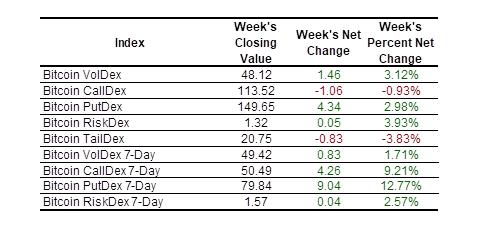
- Bitcoin lost ground this week, falling 1.86%. Bitcoin VolDex gained 3.12% to close at 48.12. Traders are again watching the 50 level;
- VolDex was lower for nearly every equity we cover in sympathy with the broad indexes. Only VolDex on MSFT (+0.04%) and WMT (+4.60%) rose on the week;
- The Nations Indexes Optimism Index® rose by 3.44% to end the week at 84.83. Our Optimism Index is always available in real-time on our home page at NationsIndexes.com;
- You can always learn more about all our indexes at Learn More About Our Indexes;
- We have added an interesting segment to our weekly Volatility Insight. Trade Spotlight will describe an interesting trade opportunity based on our index values and other metrics like readily available momentum measures. Be certain to check it out. This week we revisit an unusual setup in LLY and illustrate how some traders might take a profit in the trade.
Equity Index Volatility:
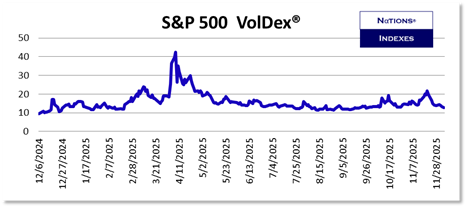
The S&P 500 gained 0.31% this week and closed in the green on each day with the exception of Monday (-0.53%). The extraordinary volatility of previous weeks has ebbed; other than Monday, no day this week posted a closing move of more than 0.30%.
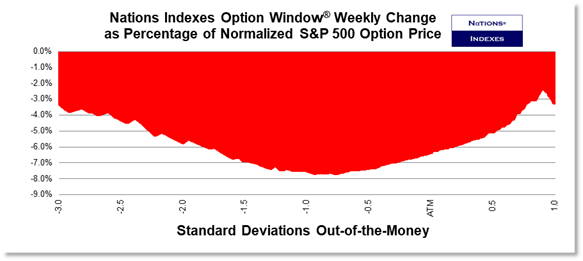
Every one of our S&P 500 volatility metrics was lower on the week with the exceptions of 7-Day CallDex as traders took advantage of the reduced realized volatility and growing certainty about the Fed cutting rates to sell volatility. You can see details for the entire S&P 500 option skew below in our Option Window®.
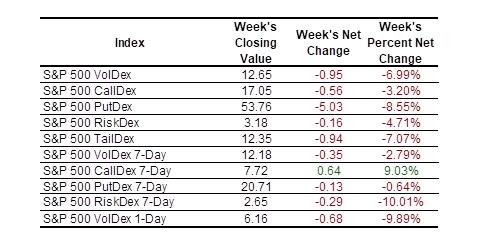
7-Day VolDex fell by 2.79% to close at just 12.18, the 5th percentile of its 52-week range. Traders can take advantage of low implied volatility in front of the coming week’s Fed meeting. While the market says the likelihood of a 25 basis point cut is 86%, future guidance may generate substantial volatility.
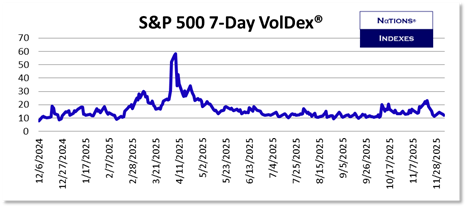
You can learn more about VolDex here.
Historical metrics (Average, median, 10th percentile, 25th percentile, 75th percentile, and 90th percentile) for all out indexes are available to subscribers at NationsIndexes.com.
Why It Matters…Historical data for all our indexes is available to subscribers at the Everything! level and they allow option traders to understand the context of the current option pricing environment – the current environment, while not unique, is unusual. Volatility is mean-reverting and that is a phenomenon traders can take advantage of in both directions. But you have to understand what normal is, what the “mean” is, in order to do so.
Nasdaq-100 VolDex fell by 8.75% to close at 17.24.
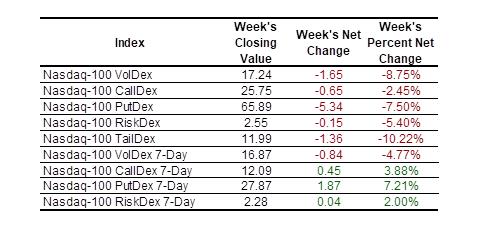
It is interesting that in the Nasdaq-100 7-Day metrics, CallDex, PutDex, and RiskDex all gained on the week. These bear watching.
Why It Matters…Traders have to have the objective data provided by our indexes to trade in a way that doesn’t rely on hunches or guesses.
Nations Option Window®:
Our Option Window® graphic shows the impact of buying and selling of S&P 500 options at each point on the skew. Moneyness as defined by standard deviations from at-the-money is constant. Each tenor is always precisely 30-days to expiration.
You can see that option selling predominated at every point on the skew with the most robust selling taking place in strike prices from at-the-money to 1.5 standard deviations below at-the-money which is approximately 6450 in the S&P 500.
Nations Investor Optimism Index®:
The Investor Optimism Index® rose by another 3.44% this week to close at 84.83.
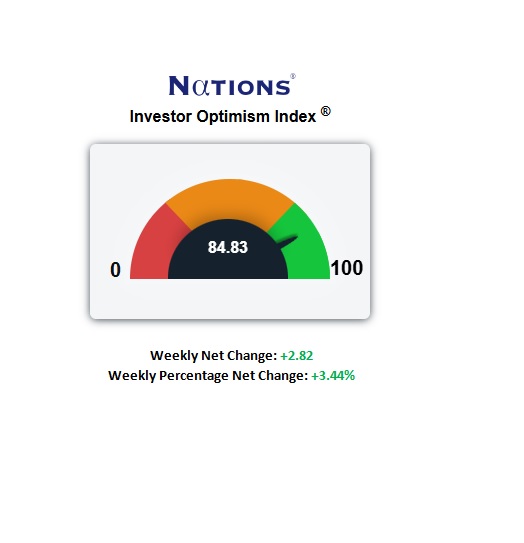
The index takes into account the current levels of S&P 500 VolDex, TailDex, and RiskDex and compares them to their rolling 2-year ranges. It is plotted on a 0 to 100 scale.
Our Optimism Index is now available in real-time on our home page at Nations Optimism Index.
VolDex Term Structure:
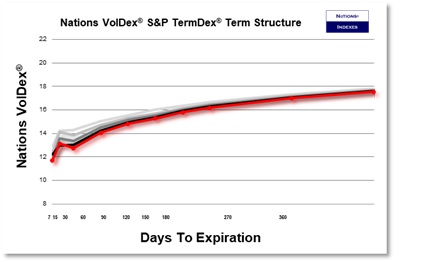
The Nations TermDex® measure of VolDex term structure illustrates S&P 500 VolDex for various tenors. It provides insight into both near-term and longer-term expectations for volatility in the S&P 500.
1DTE Options:
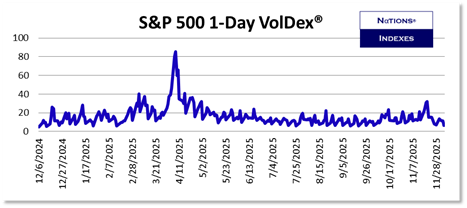
S&P 500 1-Day VolDex fell by 9.89% to close at 6.16. That is the 2nd percentile of its 52-week range.
Very short-dated volatility measures which use a variance swap methodology, as 1-day VIX does, inject significant error into the resulting measure because of the way out-of-the-money options trade in the hours before expiration. The VolDex at-the-money methodology is particularly suited for these very short-dated tenors.
Other Asset Volatility:
Treasury Bonds and Notes:
The yield on 10-year Treasury notes rose to 4.139% this week as note prices fell.
Volatility metrics for Treasury bonds were mixed this week as you can see below with CallDex rising as PutDex and TailDex fell.
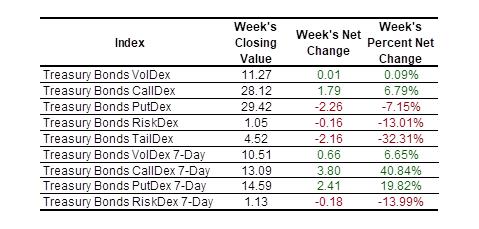
Treasury Bond implied volatility remains VERY low. While we have not witnessed a big move in Treasury Bond prices that would make long volatility structures profitable, short volatility structures are to be avoided.
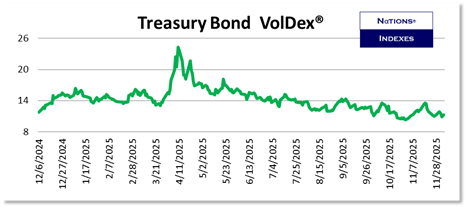
Why It Matters…We still believe the ability to buy at-the-money Treasury bond options at historically low prices is a unique opportunity given the risks currently present. CallDex is at just the 6th percentile of its 52-week range while VolDex and PutDex are both at the 7th percentile. Long Treasury bond volatility structures are available at attractive prices for a range of directional ideas.
Bitcoin:
The pain for holders of Bitcoin tapered this week despite a weekly decline of 1.86% thanks to Tuesday’s gain of 6.49%.
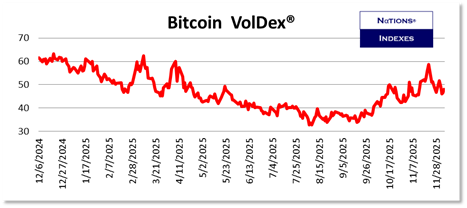
Traders continue to be willing to sell Bitcoin volatility at round-number levels. They sold aggressively with VolDex at 60 two weeks ago and again more recently when VolDex approached 50.
Equities:
We have expanded the list of single names we cover to include not only the most dynamic stocks in the S&P 500 and the stocks with the highest option volume, but also the largest names in the S&P 500.
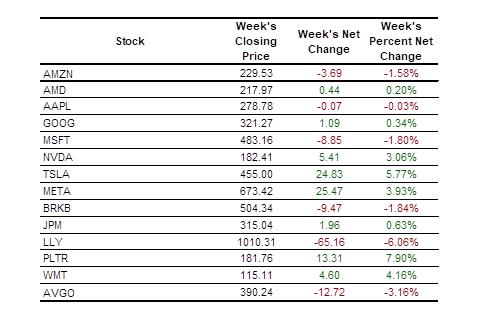
Performance of the equities we cover was mixed this week with 8 names gaining ground and 6 losing ground.
We have begun illustrating how many traders use our indexes to create smarter trades. We post the trade setups below on our Trade Spotlight section and, more importantly, we post them in real time on “X”. None of the trades we mention on “X” at @Nations_Indexes are trade recommendations.
VolDex was less ambivalent with nearly all names showing lower implied volatility.
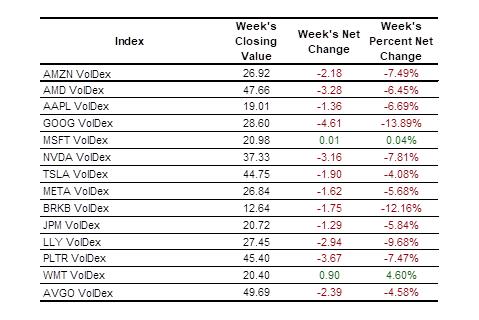
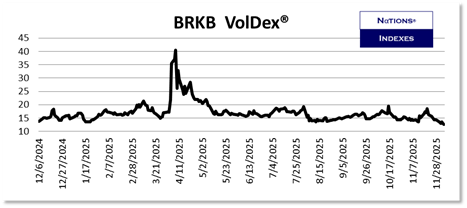
Not only did VolDex fall for most names, if fell to extremely low levels for some of them. VolDex for META fell to 26.84, the 4th percentile of its 52-week range. AAPL VolDex fell to the 6th percentile. TSLA VolDex fell below 45 and to just the 2nd percentile of its 52-week range. BRKB VolDex closed on Friday at its 52-week low.
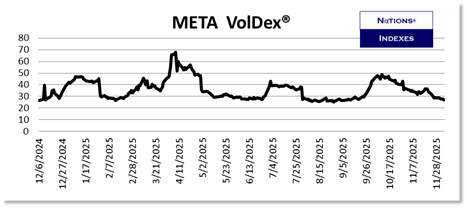
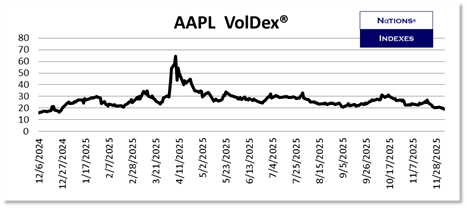
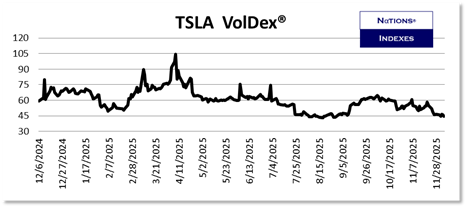
You can learn more about VolDex here.
While the looming holiday is depressing implied volatility, there are still two full weeks of trading until the market is likely to really slow and even then, outsized price moves are possible. Traders with a directional thesis should be using long option structures in these names.
We’ll continue to comment during the week via our X account, @Nations_Indexes.
Trade Spotlight:
This week’s Trade Spotlight revisits our option collar on LLY which has been in the news regarding its Zepbound anti-obesity drug and potential changes in pricing. This is not a trade recommendation but is instead an illustration of how many traders use our metrics to identify trade opportunities.
At 1:57 p.m. on November 14, LLY was trading at 1031.57 and its Relative Strength Index (RSI) was above 80 signifying that the stock was strongly overbought following a furious rally. At the same time, LLY RiskDex was at 0.98, the 18th percentile of its recent range. Since RiskDex was below 1.00 it was displaying call skew rather than the put skew which is typical for equities.
We illustrated how one might use this information to protect gains in LLY; in the December 19 expiration, the 1160 covered call could have been sold at 10.40 while the 930 put could have been bought at 10.55. The trade would have cost a net of 0.15. While the owner’s shares would be called away if LLY is above 1160 at that expiration, they would be protected if LLY was below 930 then. LLY was last below 930 as recently as November 7.
Earlier this week we posted on “X” that the trade was working but that erosion would start to hurt the price of the put option this illustration bought, and that our hypothetical trader might take a profit. We highlighted the opportunity to unwind the trade near 2.80 for a 2.65 profit. Another reason to consider taking a profit is that LLY is no longer overbought. It ended the week with an RSI reading of just 54.
Again, this is not a trade recommendation but an illustration of how many traders use our indexes in concert with momentum measures like RSI to identify trade opportunities.
We’ll continue to watch the trade and look for other interesting trade setups.
Scott’s Weekly Commentary:
The market got very boring very quickly and that’s generally a good thing although the most active traders will likely disagree with that.
Confidence that the Federal Reserve is going to cut rates by 25 basis points during this week’s meeting is high and with good reason; it is likely Fed Open Market Committee members would be speaking out if the market had it egregiously wrong and a cut was not in the offing. The Fed seems to be fine with being wrong but not with being surprising.
GOOGL managed to jump back into the AI conversation after seeming to be trailing for so long. And AI names did well this week.
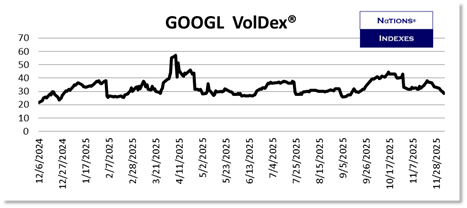
The weakness in option volatility is notable and there are very few names for which short vol structures make sense. AVGO might be one of the few (VolDex at the 51st percentile and CallDex at the 81st percentile) but that’s largely because it reports earnings on Thursday, December 11.
Guidance regarding future rate cuts will be what I’m paying attention to this week but Jay Powell’s term as Chair ends in May and guidance will likely be tempered by his lame duck status.
Everyone at Nations Indexes hopes you have a healthy and profitable week.
Scott