Your Week’s Volatility Market Commentary — Make Information Your Edge
S&P Rallies Slightly But Precious Metals Grab The Spotlight!
The Weekly Takeaway:
- The S&P 500 gained 0.34% this week thanks to a combined rally of 0.91% on Monday and Tuesday. It is now up 1.37% for the year;
- The Nasdaq-100 lost 0.21% this week. It is now up 1.20% for the year;
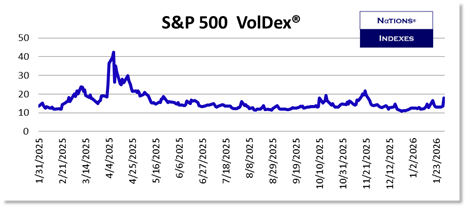
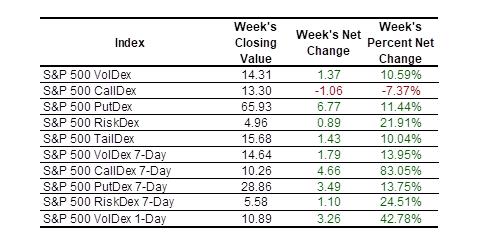
- S&P 500 VolDex (ticker VOLI) gained 10.59% this week and closed at 14.31. That is still just the 22nd percentile of its 52-week range signifying relatively little fear;
- S&P 500 TailDex (ticker TDEX) gained 10.04% this week and closed at 15.68. That is the 18th percentile of its 52-week range;
- S&P 500 CallDex fell by 7.37% to close at just 13.30, the 3rd percentile of the 52-week range. Traders were selling the out-of-the-money calls represented by CallDex to get short exposure to the S&P 500. You can learn more about CallDex at Learn More About CallDex;
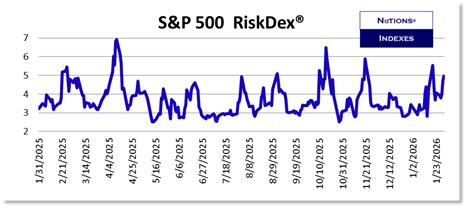
- S&P 500 RiskDex gained 21.91% this week and closed at 4.96, the 56th percentile of its 52-week range. RiskDex is signaling that while investors have relatively little fear (per VolDex), when it comes to direction there is much more concern about potential downside than hope for potential upside. You can learn more about RiskDex at Learn More About RiskDex;
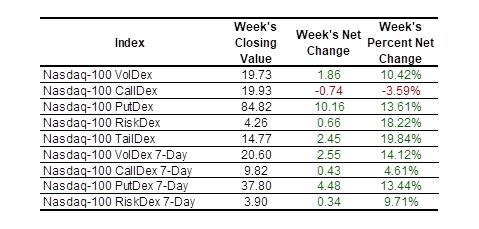
- VolDex on the Nasdaq-100 rose by 10.42% this week to close at 19.73;
- Nasdaq-100 RiskDex gained 18.22% and closed at 4.26 which is the 75th percentile of its 52-week range;
- The yield on Treasury Notes rose by another 0.2 basis points on the week to close at 4.241%;
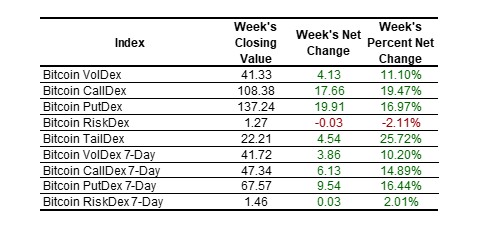
- Bitcoin fell 6.06% this week after falling 6.24% in the previous week. Bitcoin VolDex rose 11.10% to close at 41.33;
- The shocking action on Friday was in the precious metals with gold futures losing 10.28% and silver futures dropping as much as 36.09% on the day before closing at 82.940, a loss of 28.43% for the day. Nonetheless, they both still show strong gains for the year;
- VolDex for individual names was generally higher. The exceptions were the companies which reported earnings and experienced the typical post-earnings “volatility crush”. These included AAPL, MSFT, TSLA, and META;
- The Nations Indexes Optimism Index® fell by 13.85% to close at 68.13. Our Optimism Index is always available in real-time on our home page at NationsIndexes.com;
- You can learn more about all our indexes at Learn More About Our Indexes;
Equity Index Volatility:
The S&P 500 gained 0.34% for the week thanks to gains on Monday and Tuesday.
Nonetheless, every S&P 500 volatility metric with the exception of 30-Day CallDex rose by at least 10% this week. Shorter-dated metrics were particularly strong as traders brace for substantial swings next week. The fact that 7-Day CallDex rose by 83.05% should be construed not as optimism for the week ahead but a sign that option traders were reaching to buy volatility exposure in the cheapest strike prices.
RiskDex gained 21.91% for the week and closed just below the critical 5.00 level. That is the 56th percentile of the 52-week range.
Historical metrics (Average, median, 10th percentile, 25th percentile, 75th percentile, and 90th percentile) for all out indexes are available to subscribers at NationsIndexes.com.
Why It Matters…Historical data for all our indexes is available to subscribers at the Everything! level and they allow option traders to understand the context of the current option pricing environment – the current environment, while not unique, is unusual. Volatility is mean-reverting and that is a phenomenon traders can take advantage of in both directions. But you have to understand what normal is, what the “mean” is, in order to do so.
The Nasdaq-100 lost 0.21% this week and Nasdaq-100 VolDex gained 10.42%. Nasdaq-100 volatility mimicked that for the S&P 500 this week with every metric gaining ground with the exception of 30-Day CallDex. Again, this signals little hope for a significant rally over the next 30 days.
Last week we pointed out that, “The loss in CallDex is striking because it likely means traders are discounting the possibility of a rally in the Nasdaq-100 over the next 30 days. The gain in RiskDex signals that traders would rather buy Nasdaq-100 puts than Nasdaq-100 calls.”
That was prescient this week as the index lost ground. At the low of the day on Thursday it was down 2.32% for the day and at the low of the day on Friday it was down 1.65% for the day.
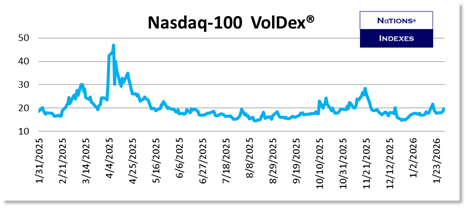
Nasdaq-100 VolDex is still at just the 16th percentile of its 52-week range.
You can learn more about VolDex at Learn More About VolDex;
Nasdaq-100 RiskDex is now at the 75th percentile of its 52-week range. We have been saying for the past two weeks that “The implication is that while option prices are low, traders are more pessimistic than optimistic for the Nasdaq-100 over the next 30 days.” This remains the case.
Why It Matters…Traders need to have the objective data provided by our indexes to trade in a way that doesn’t rely on hunches or guesses.
Nations Investor Optimism Index:
The Investor Optimism Index® fell by 13.85% to close at 68.13. We’ll be watching if the index tests the critical “50” level.
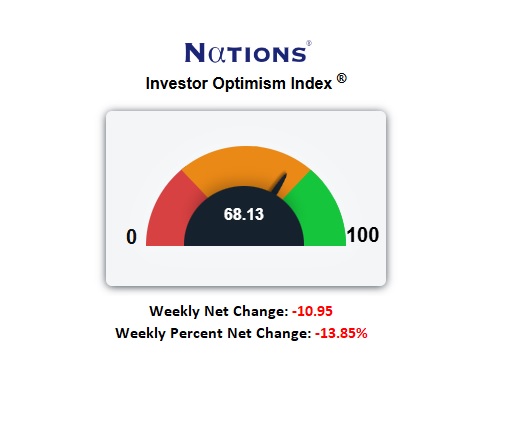
The index takes into account the current levels of S&P 500 VolDex, TailDex, and RiskDex and compares them to their rolling 2-year ranges. It is plotted on a 0 to 100 scale.
Our Optimism Index is now available in real-time on our home page at Nations Optimism Index.
Nations Option Window:
Option Window fills in the blanks between TailDex, PutDex, VolDex, and CallDex and reveals how trade flows were driving option prices. This week you can see strong and steady buying of all strike prices from at-the-money and below while traders were selling out-of-the-money calls.
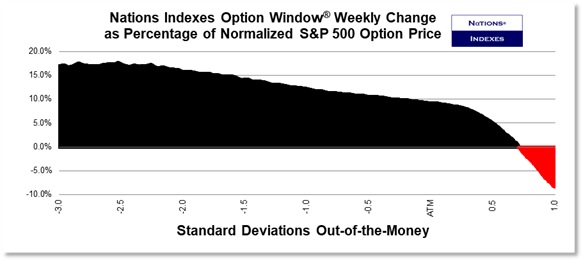
While the S&P 500 gained ground this week, S&P 500 option flows had a decidedly pessimistic tone.
1DTE Options:
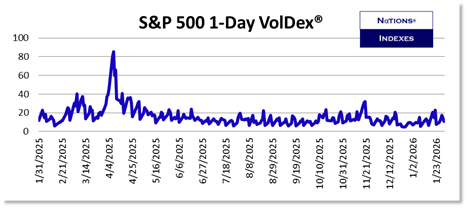
S&P 500 1-Day VolDex rose by 42.78%.
Very short-dated volatility measures which use a variance swap methodology, as 1-day VIX does, inject significant error into the resulting measure because of the way out-of-the-money options trade in the hours before expiration. The VolDex at-the-money methodology is particularly suited for these very short-dated tenors.
Other Asset Volatility:
Treasury Bonds and Notes:
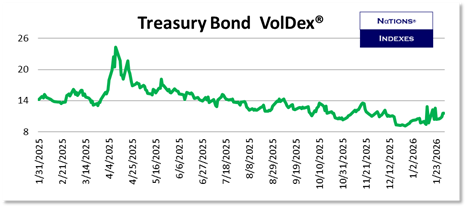
Treasury Bond volatility metrics were mixed this week with most metrics gaining ground although RiskDex fell 10.30% as CallDex rose more than PutDex. However, TailDex fell for the second consecutive week.
Treasury notes and bonds are considered “Flight to Quality” assets so concerns about equity prices will tend to buoy note and bond prices. This also means that concern about equity prices will buoy Treasury bond CallDex (traders want to own these out-of-the-money call options for Treasury bonds due to the possibility of a substantial rally if investors flee equities) and depress Treasury bond TailDex (traders consider the likelihood of a steep drop in Treasury bond prices small due to this potential “flight to quality” demand).
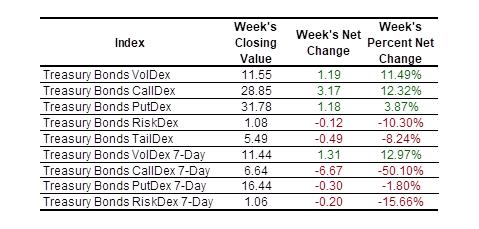
Treasury Bond VolDex rallied by 11.49% but still remains relatively low.
Bitcoin:
Bitcoin fell by 6.06% this week following last week’s decline of 6.24%. Bitcoin volatility rose in response.
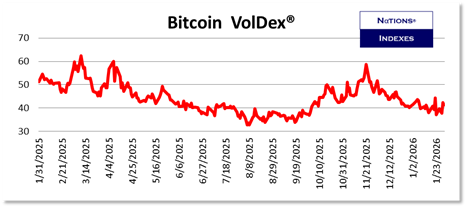
Bitcoin VolDex continues to hover around the 40 area. Traders have shown a tendency to want to short Bitcoin volatility when VolDex is near 50. We’ll be watching to see if Bitcoin VolDex can stage a rally.
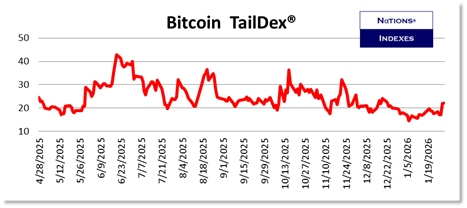
The rally in Bitcoin TailDex is interesting as it is back above 20.00.
You can learn more about TailDex at Learn More About TailDex;
The strike price represented by Bitcoin TailDex is approximately 59,000.
Precious Metals:
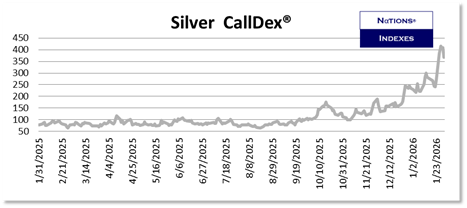
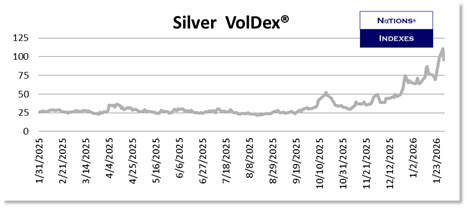
Silver fell by 19.47% this week after gaining 15.47%, 11.78%, and 10.41% in the previous 3 weeks respectively. Volatility metrics for silver were strong, as we would expect given that sort of realized volatility.
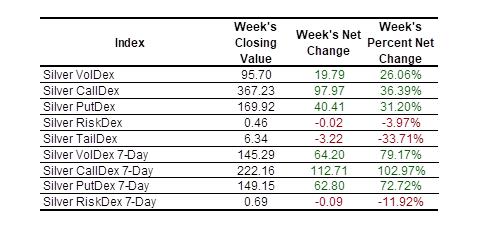
The highest intraday print for Silver VolDex was 117.30 yesterday. A Silver VolDex reading of 117.30 signals that traders expect daily moves in silver of 7.33% (Divide VolDex by 16 to turn the annual value to a daily value).
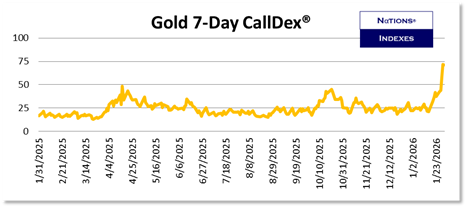
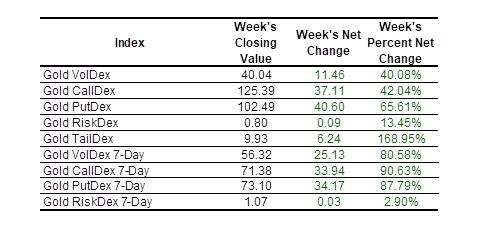
Gold futures fell by 10.28% on Friday and closed at 4,859.20, down 2.50% for the week after topping 5,000 on Monday.
Equities:
We have expanded the list of single names we cover to include not only the most dynamic stocks in the S&P 500 and the stocks with the highest option volume, but also the largest names in the S&P 500.
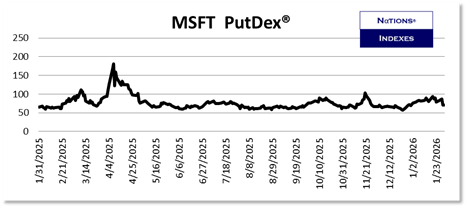
Equities were mixed this week with MSFT losing 7.65% as investors were disappointed by earnings and META gaining 8.76% as investors applauded the company’s earnings report and outlook for AI.
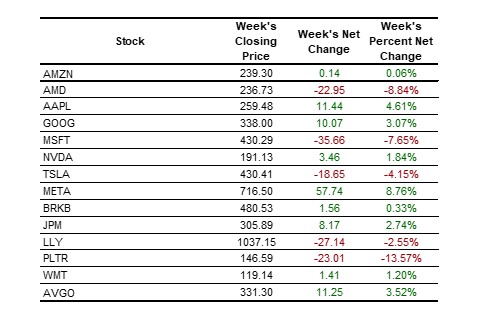
VolDex was less mixed with gains predominating for a fourth straight week except in those names that reported earnings and experienced the typical volatility crush.
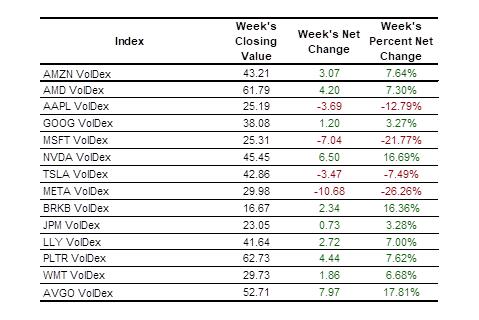
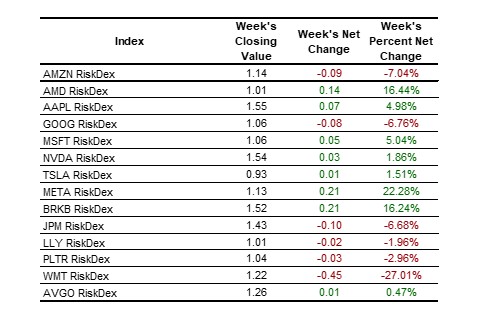
Last week we wrote, “We note that MSFT VolDex gained 4.45% after gaining 5.69% for the previous week. It is now at the 49th percentile of its 52-week range.” The market did a good job of signaling disappointment in MSFT’s earnings.
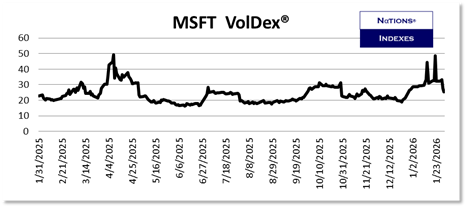
Our RiskDex index compares the normalized price of out-of-the-money put options to that of out-of-the-money call options. The higher the RiskDex reading, the more expensive those puts are relative to those calls. We consider it a measure of the tension between pessimism (put prices) and optimism (call prices). Many traders also use it as a measure of option skew which is the tendency for different strike prices in a single expiry to display different implied volatilities.
A RiskDex reading above 1.00 means put prices are higher than call prices. A RiskDex reading below 1.00 means the opposite, put prices are lower than call prices. An equity index like the S&P 500 should never display a RiskDex reading below 1.00 because of the tendency for really large moves to be negative.
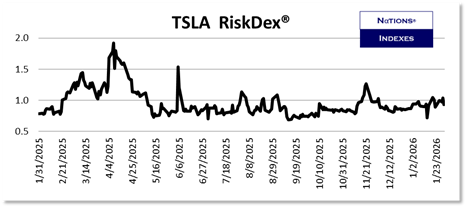
But RiskDex readings below 1.00, signaling that call options are more expensive than put options, does occur in some equities. TSLA is displaying this sort of call skew with a RiskDex value of 0.93 at Friday’s close. It is the only equity we cover which is displaying call skew. We use S&P 500 RiskDex as a measure of fear vs. greed and it is displaying much more fear than greed right now. Similarly, the number of equities displaying call skew (RiskDex below 1.00) is an important signal. When several of these names are displaying call skew it is time to worry that the market is euphoric.
We’ll continue to comment during the week via our X account, @Nations_Indexes.
Scott’s Weekly Commentary:
The carnage – that’s the only word for it – in the precious metals on Friday grabbed the interest of every trader and overshadowed the S&P 500’s gain of 0.34% on the week.
Both gold and silver are still higher on the year but everyone should be careful if they’re trading either. I believe short volatility structures make sense but only if they are defined-risk structures like vertical spreads. And you have to really tend to your execution in a sloppy market like the one we saw on Friday.
The equity market is picking winners and losers in the AI race and MSFT was a loser this week with META a winner. I think AI is transformative but I also know I don’t understand the dynamic well enough to confidently pick winners and losers. Not that long ago many investors thought GOOGL was going to be an “AI loser” and look how quickly that perception reversed.
So you have to pick a basket of these names if you want to overweight AI in your portfolio. A risk reversal (short an out-of-the-money cash-secured put option and long an out-of-the-money call option) can be a good way to approach some of these names and that’s where RiskDex can help as an objective measure of the net cost of that trade. I’m not making a recommendation, just offering a tool for objectively measuring the cost of these trades.
Everyone at Nations Indexes hopes you have a healthy and profitable week.
Scott