
Your Week’s Volatility Market Commentary — Information Is Your Edge
DeepSeek and Trump Tariffs Deep Six the Stock Market
Jump Directly To:
Equity Index |Investor Optimism |NDX | TLT | GLD | IBIT | Commentary
Equity Index Volatility
Weekly Takeaway:
-
The S&P 500 lost 1.00% this week as the DeepSeek AI news hurt early in the week and news regarding punitive tariffs against Canada, Mexico, and China hurt on Friday
-
VolDex (ticker VOLI) rose 16.42% to close at 13.49 breaking a string of 2 weekly declines. But it closed at just the 20th percentile of the 52-week range despite this week’s news
-
TailDex (ticker TDEX) rose by just 1.29% to close at 12.04 but this follows last week’s increase during a week when other S&P volatility measures fell. TailDex signaled that tail hedges were very cheap and those who put them on in the previous week were rewarded. TailDex remains cheap, closing at just the 15th percentile of its 52-week range
-
Beliefs that punitive tariffs will be more benign than initially feared seem to be wrong
VolDex on Nasdaq-100 rose by just 14.86% for the week despite turmoil in AI names following the DeepSeek news and Nasdaq-100 TailDex fell by 0.77%. This is despite NVDA, which ended the previous week as the biggest name in the S&P 500, falling by 15.81%
-
The yield on the 10-year Treasury note fell slightly on the week to close at 4.569%. All of the decline came on Monday as a mini “flight to quality” shaved 10 basis points off the yield
-
CallDex on the S&P eased for the second week, falling another 6.17%
-
VolDex on the individual names we cover was mixed. However, VolDex on NVDA rose 79.86% to close at 74.90, the highest reading among any single name we cover
-
The Investor Optimism Index fell back below 50 to close at 35.63, a decline of 31.68%

Figure 1
Equity Index Volatility:
The S&P 500 lost 1.46% on Monday following the news that DeepSeek’s AI capability had been achieved with a dramatically lower capital expenditure than other AI platforms have required. The news tanked those companies, like NVDA, that supply computer chips to AI platforms. The Nasdaq-100 lost 2.97% on the day and NVDA lost 16.97% while falling from the biggest name in the S&P (in terms of market cap) to third.
CallDex, a measure of the normalized price of 30-day, 1 standard deviation out-of-the-money call options in SPY, fell by 6.17% on the week as traders finally threw in the towel on levered bets to the upside. CallDex on the Nasdaq-100 rose by 4.71% but this is likely a function of op-tion traders wanting to own gamma or wanting defined-risk structures for a rebound. PutDex on Nasdaq-100 rose by 15.44% as traders wanted to protect last year’s sizeable gains.
VolDex on the Nasdaq-100 closed at the 23rd percentile of its 52-week range while PutDex closed at the same 23rd percentile and CallDex closed at the 18th percentile. Options on the Nasdaq-100 remain relatively cheap meaning long option positions are a reasonable way to express a thesis.

Figure 2
RiskDex (the ratio of PutDex to CallDex) on the Nasdaq-100 closed the week at a moderate lev-el of 2.43 which is the 35th percentile of its 52-week range. That means that a risk reversal structure (short the out-of-the-money put and long the out-of-the-money call) can be a replace-ment for owning shares of QQQ although one is faced with the prospect of buying the shares at the strike price of the put option if QQQ continues to fall.

Implied volatility and option prices for the major equity indexes became more expensive this week but not onerously so.

FIgure 4
Why It Matters…The two big news items that pushed stocks lower, Monday’s DeepSeek news and Friday’s tariff news, were surprises. But while implied volatility increased, there was no panic buying and the very muted rally in TailDex signals a lack of fear; it would be more ap-propriate to say the moves in option prices signaled concern.
The rampant buying of out-of-the-money calls as seen via CallDex has eased (CallDex closed at 19.77 on 1/22/2025) which suggests the most bullish sentiment is easing. It is interesting to note that CallDex started falling late the previous week, before the DeepSeek news broke.

Figure 3
Nations Investor Optimism Index

Figure 4
Investor optimism fell by 31.68% for the week to close at a fairly pessimistic reading of 35.63.
The Optimism Index is calculated using the 2-year range for VolDex, RiskDex, and TailDex and signals more optimism when those measures, and option prices, are low and less optimism, as it is signaling now, when those measures are relatively high.
Why It Matters…Our Optimism Index can be used as a contrarian indicator for BOTH equity prices and option prices. Any level below 20 can be considered a contrarian “Buy” signal in the S&P 500 and any level above 80 should serve as a warning of complacency or unreasonably bullish hopes on the part of investors.
Deconstructing S&P Skew: We deconstruct S&P option skew to understand what the option market is really saying. Since VIX includes nearly all strike prices listed in the relevant expira-tions it is impossible to know what is driving changes in VIX – is VIX higher because traders are reaching for call options or is it higher because they’re afraid and are buying puts?
This week saw uniform buying of nearly all strikes below the level that is approximately 0.8 standard deviations above at-the-money (approximately $623 in SPY). Note that buying was concentrated in the just out-of-the-money puts. This reinforces “concern” but not “fear.”

Figure 5
Other Equity Indexes
As we have discussed, the Nasdaq-100 lost 2.97% on Monday but implied volatility and option prices generally rose by less than they did for the S&P 500.

Table 2
WHY IT MATTERS…This week’s relatively muted response in options on the Nasdaq-100 is a little puzzling given that DeepSeek appears to be aimed at the indexes highest flier (NVDA). But to the degree it is good news for other big tech names like AAPL, GOOG, and META (which rose 5.93%, 1.83%, and 6.44% respectively), further damage will be name-specific.
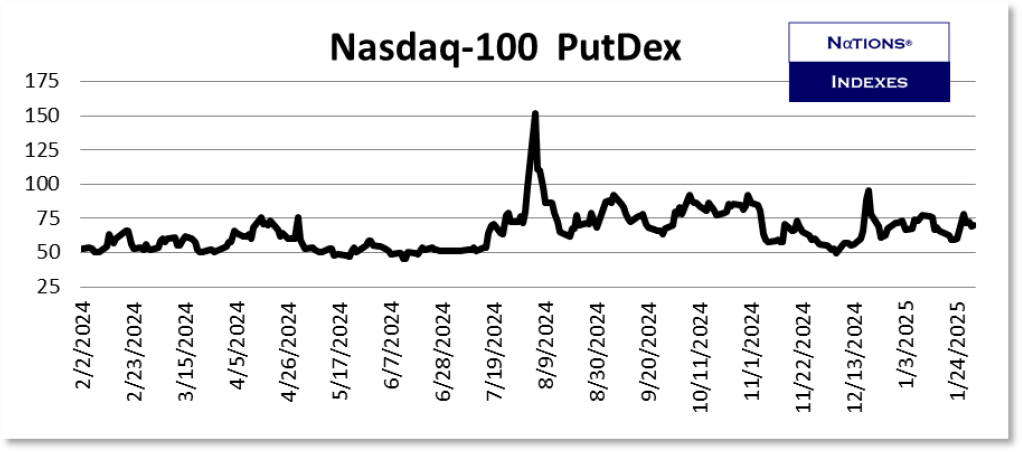
Figure 6
Buying outright puts can be very expensive but owning protective put spreads can be a much cheaper way of getting protection. For example, in the QQQ February 21 expiration, the 525/500 put spread could have been purchased for 4.95 on Friday’s close with QQQ at 529.63.

Table 3
Other Asset Volatility
Treasury Bonds
VolDex on treasury bonds
Our 30-day Dexes on treasury bonds rose across the board this week as traders worried about the equity markets and braced for “flight to quality’ buying in treasuries. But VolDex is at just the 35th percentile and CallDex closed at its 28th percentile. Out-of-the-money treasury bond call options would be the ones that benefit most from a “flight to quality” rally in price and implied volatility. Buying call spreads can take advantage of reasonably priced options AND the call skew common in treasury bond options.
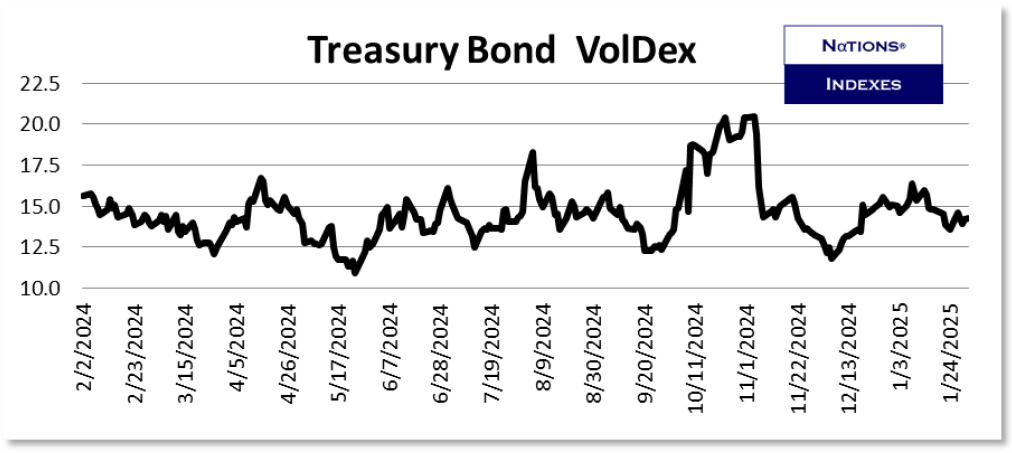
Figure 7
7-day VolDex on treasury bonds fell due to Wednesday’s Federal Reserve meeting passing and resulting in no changes to the outlook for rates in the near-term. However, 7-day CallDex and 7-day PutDex both rallied as traders were buying short-dated, out-of-the-money options for poten-tial moves next week. These options tend to be “dollar cheap” meaning purchasing them for speculation or as a hedge for an equity portfolio can be done economically. For example, the basket of out-of-the-money TLT call options used in 7-day CallDex can be acquired at an aver-age price of just $0.15.
WHY IT MATTERS…RiskDex of 0.98 means traders see risks to treasury bond prices as bal-anced between upside and downside. However, the decline of 5.48% describes more call buy-ing than put buying (CallDex and PutDex confirm this). The move seen in 7-day RiskDex offers an opportunity for traders who expect more upside than downside for treasuries in the coming week.
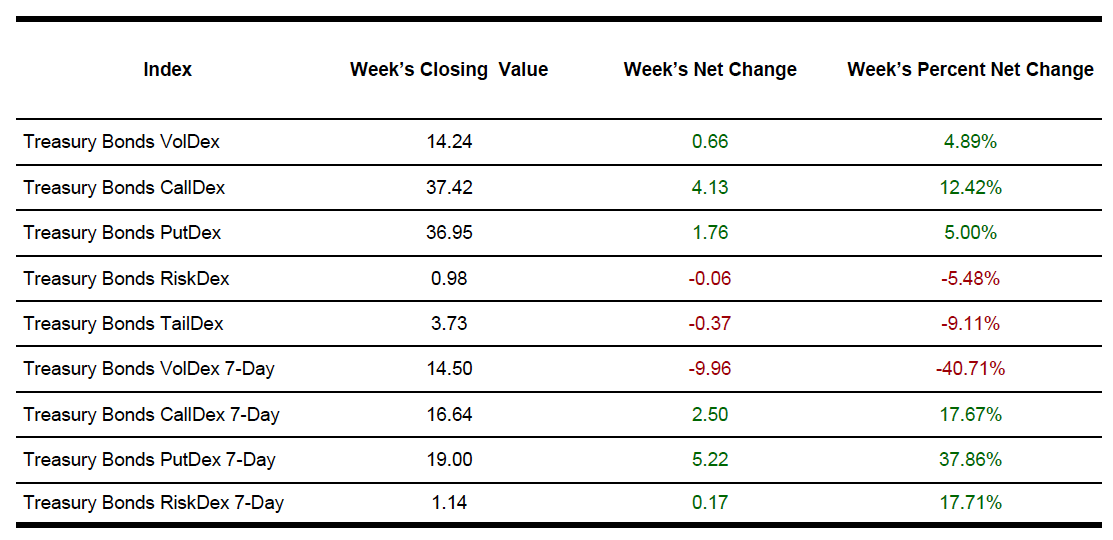
Table 4
We have found that comparing VolDex on the S&P 500 and VolDex on treasury bonds can be instructive. VolDex on the S&P 500 is more volatile than VolDex on treasury bonds but their rel-ative levels can lead to innovative trade structures.
The relative parity in at-the-money volatility as described by VolDex does not yet merit a trade but we will continue to watch this for a trade opportunity.

Bitcoin
VolDex on Bitcoin
VolDex on bitcoin continues to fall. It closed at 51.22 down from 55.83 for the previous week (-4.61 or 8.25%) following the previous week’s decline of 8.73%. VolDex on bitcoin has fallen out of its initial range which was above the 60.00 level. Defined-risk positions which are short volatility in bitcoin continue to make sense.

Table 5
0DTE and 1DTE Options
Zero day to expiration (ODTE) options continued to account for the majority of SPY option volume, with 55.99% of this week’s SPY option trading being 0DTE. Tuesday saw 60.65% of all SPY volume being 0DTE. Monday’s 0DTE volume was 52.07% of the total which is impressive; 0DTE volume is no longer tailing off on particularly volatile days as it has in the past.
Very short-dated volatility measures which use a variance swap methodology, as 1-day VIX does, inject significant error into the resulting measure because of the way out-of-the-money op-tions trade in the hours before expiration. The VolDex at-the-money methodology is particularly suited for these very short-dated tenors.
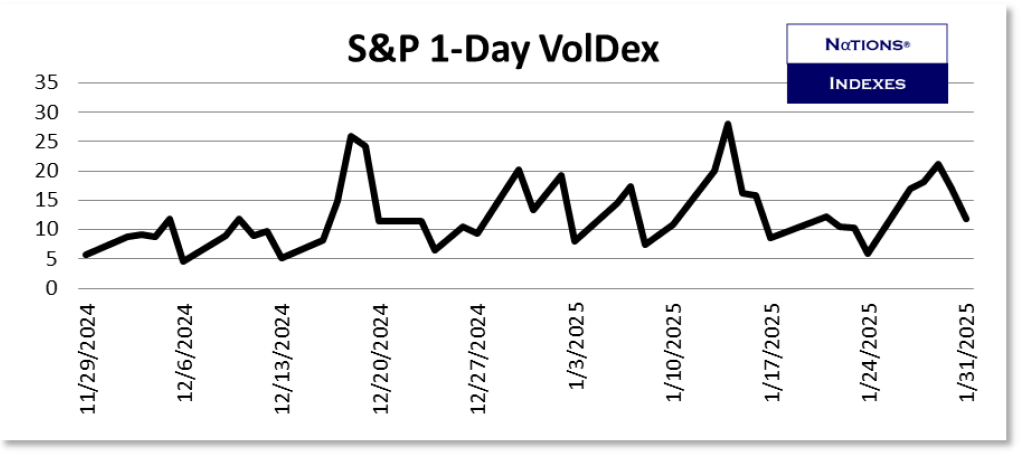
Figure 8
Equities
This week’s news was bad for NVDA although other names, particularly those who were believed to be behind AI leaders such as OpenAI, benefited from the new thinking that pro-gress in creating AI products can be done without buying tens of thousands of NVDA chips, and without spending a billion dollars on programming and training an AI model.
So while NVDA got clobbered, AAPL, GOOG, and META bucked the broader Nasdaq-100 trend and gained ground on the week.

Figure 9
WHY IT MATTERS…NVDA has been one of the highest fliers over the past year with a gain of 95.15% during that period even after accounting for its 1-month loss of 10.59%.
AI will eventually do wonderful things but getting to that point will generate volatility among the most noteworthy names. That provides and opportunity for option traders with objective data.

VolDex on NVDA closed the week at the 75th percentile of its 52-week range.


However, PutDex on NVDA is at just the 57th percentile of its 52-week range meaning out-of-the-money put options or option spreads are expensive but not outrageously so.
Looking at another name that might be helped by the DeepSeek news is instructive. GOOG saw little change in volatility during the week meaning bullish structures can be used.
You will note that 7-day measures in GOOG did rise dramatically during the week but we can put that down to GOOG’s earnings release on 2/4/2025. This means the 7-day values now capture that catalyst.

Scott’s Weekly Commentary
Bulls did well in the previous 2 weeks but things changed sud-denly, as they often do, this week starting with the surprise news regarding DeepSeek and then the latest tariff news which came out Friday afternoon.
I have thought that this administration’s talk regarding tariffs was more of a bargaining position than a final policy, and while I still believe Friday’s announcement will be tweaked and walked back, investors and traders should prepare for an alternate, and volatile, outcome. Our stock market tends to go up over time and that remains the case but the dips can be sickening and the worst damage can be done to investors who shy away from investing because of the tur-moil. Please don’t do that as it has historically done the most damage to investor portfolios.
Continue to use options to create the unique, superior, payoff profiles that can only be con-structed using options.
To the degree that breadth improves from a small handful of names accounting for the bulk of the gains in the S&P, our market will be healthier, or at least less vulnerable to the swooning stock price of NVDA.
GOOG, AMZN, LLY, and AMD all release earnings from Q4 next week.
Everyone at Nations Indexes hopes you have a great and profitable week!
Scott
