

Your Week’s Volatility Market Commentary — Information Is Your Edge
Inflation is Tame and the Fed Is on Hold. What’s Next For Iran?
The Weekly Takeaway:
- The S&P 500 fell 0.15% this week due to a decline of 0.22% on Friday. The week had plenty of news but never had a day with a gain or loss of more than 1%;
- The Nasdaq-100 fell by 0.02% although big chipmaking names had a difficult week due to reports the U.S. government may withdraw waivers which allow certain technologies to be used in China;
- The Federal Reserve left short-term interest rates unchanged. This was as expected:
- Inflation data was tame with the Consumer Price Index rising 0.1% in May. Annual inflation was 2.4%;
- Geopolitical tensions remain high as the world waits to learn if the U.S. will join in military action against Iran but the delay eased the market’s worst fears;
- Crude oil rose another 1.20% this week after gaining 6.27% last week. The close was $74.04;
- The yield on 10-year treasury notes fell by another 8 basis points as “risk off” assets rallied.
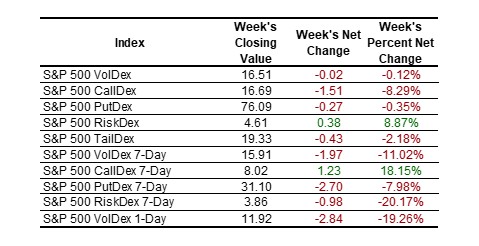
- VolDex (ticker VOLI) fell by 0.12% to close at 16.51;
- TailDex (ticker TDEX) fell by just 2.18% after rising 57.58% last week. It ended the week at 19.33 after trading above 20 on Tuesday;
- S&P 500 CallDex fell by 8.29% after falling 15.15% in the previous week. It closed the week at just 16.69 which is the 17th percentile of its 52-week range. No other 30-day measure is that low in percentile terms;
- U.S. Treasury Note volatility fell with the exception of CallDex which rose by 9.15% after gaining 24.54% during the previous week;
- VolDex was mixed on the equities we cover;
- A reminder: we have expanded the list of asset classes we cover to include high-yield bonds, 7-10 year treasury notes, and emerging market equities;
- The Nations Investor Optimism Index rose slightly to close at 10.56. It stayed above the critical 10.00 level but just barely. It has not closed above 50 since January 24th;
We have expanded the list of equities we cover to include BRKB, JPM, LLY, PLTR, and WMT. We now cover not only the names with the most active option markets but the 10 largest names in the S&P;

Equity Index Volatility:
Implied volatility and option prices were generally mixed this week and did not display much net movement despite news regarding Iran, inflation, and the Federal Reserve.
We have been noting that equity index VolDex values are near the bottoms of their 52-week ranges and that directional option strategies should be long volatility. That did not work this week. Summer tends to see depressed volatility values so, absent news, it is difficult to see volatility increasing from here. That said, we are not fans of selling volatility at low levels in the hope that it will go lower.
TailDex fell slightly as mentioned above. Traders have been very quick to sell TailDex down from elevated levels but we will likely have to see TailDex above 30 before those “Volatility Vigilantes” become interested.

S&P 500 RiskDex rose by 8.87% after rising 54.33% in the previous week. Most of this week’s move was due to the decline in CallDex. RiskDex closed at 4.61 and is at the 40th percentile of its 52-week range. Some of that is deceiving because of the big rally in RiskDex in August of last year. But any trading above the 5.00 level deserves our attention.

Why It Matters…Historical data for all our indexes is available to subscribers at the Everything! level and they allow option traders to understand the context of the current option pricing environment. Volatility is mean-reverting and that is a phenomenon traders can take advantage of in both directions. But you have to understand what normal is, what the “mean” is, in order to do so.
You can see the week’s volatility results for the S&P 500 below.
You can see the week’s results for our indexes on the Nasdaq-100 below.
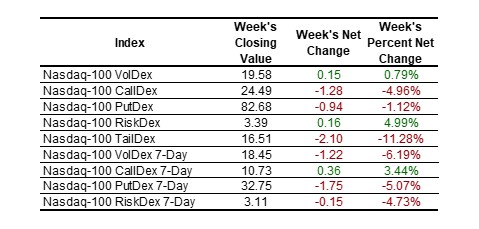
As noted above, Nasdaq-100 VolDex closed at just the 18th percentile of its 52-week range and is still below 20.00 despite gaining slightly on the week.

RiskDex calculates the ratio of out-of-the-money put option prices (PutDex) to out-of-the-money call option prices (CallDex). It is both a measure of skew and a measure of fear.
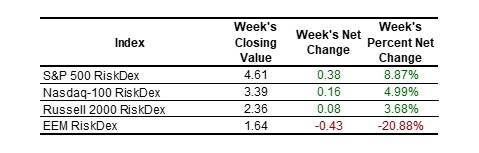
The big decline in EEM RiskDex is driven by a 20% rally in EEM CallDex. As we have noted in the past, savvy traders use these different RiskDex regimes among the biggest equity indexes for relative value trades.
Nations Investor Optimism Index:
The Investor Optimism Index managed to remain above 10 but just barely.

The index takes into account the current levels of S&P VolDex, TailDex, and RiskDex and compares them to their rolling 2-year ranges.
Our Optimism Index is now available in real-time on our home page at NationsIndexes.com.
Other Equity Indexes:
Option prices for the Russell 2000 eased this week.
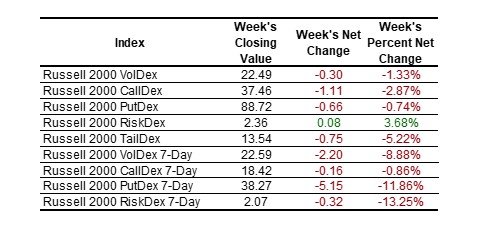
Why It Matters…Russell 2000 CallDex has been very cheap during the past two months and we have suggested using these calls to express any bullish sentiment in small caps. While this has worked to some degree, particularly in the week after Russell 2000 CallDex first fell below 40, our time and focus is now best spent elsewhere.
We’ve added the emerging market equity index to our roster of equity indexes. EEM is the underlying ETF we use. These values are available in real time to subscribers.
Other Asset Volatility:
Treasury Bonds:
The yield on 10-year treasury notes continued to fall as traders continued to buy U.S. treasuries as a reflex trade and in response to very tame inflation data.
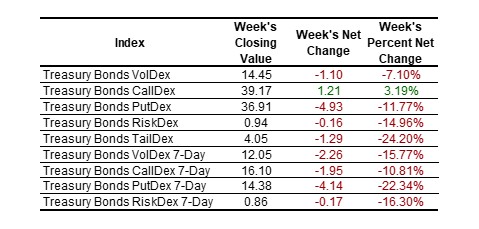
Treasury Bond VolDex finally fell convincingly below the 15.00 level that we’ve been watching. You’ll note that all indexes fell with the exception of CallDex as speculators continue to buy those out-of-the-money call options. Since treasury bonds tend to spike higher in response to exogenous events this trade activity is not unexpected. Despite this week’s rally, Treasury Bond CallDex is still at just the 29th percentile of its 52-week range so this speculative buying is being done at reasonable levels.


We have just begun calculating our metrics on treasury notes with the underlying IEF so we’ll be watching this as well.
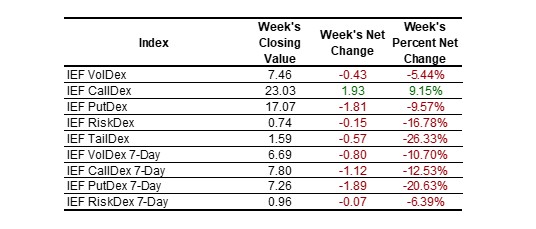
Why It Matters…Two weeks ago we observed that “RiskDex remains high in TLT despite a small decline this week so traders who are bullish on treasuries can take advantage with structures which sell puts or put spreads.” That certainly worked and continues to work. Treasury Bond RiskDex finally fell below 1.00 meaning CallDex is now above PutDex. This is the appropriate relationship given what is going on in the Middle East. Traders who took advantage of this relationship should take profits.

Bitcoin:
Volatility measures for bitcoin have displayed an interesting dynamic during the last two weeks. Bitcoin is acting more like equity markets than “digital gold”.
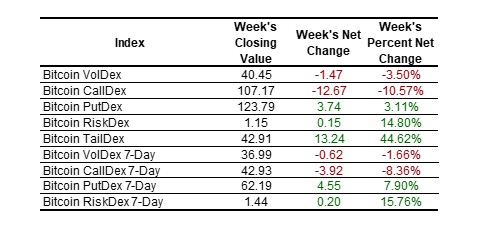
Bitcoin VolDex fell slightly on the week but remains above 40. We have noted that it is seeking its equilibrium level since initially trading at 60.

If Bitcoin continues to resemble the equity indexes more than gold then Bitcoin RiskDex will rally from the week’s close of 1.15. Trade structures that are long out-of-the-money puts and short out-of-the-money call spreads (we would never suggest being naked short bitcoin call options) and which are done delta neutral, will take advantage of this and we suggest them.
Gold and Silver:
Gold fell by 1.95%, giving back half of last week’s gain. All our core volatility measures on gold fell this week although calls falling by so much more than puts is interesting and worthy of our attention. This may be just another example of traders rushing in to sell any pop in volatility.
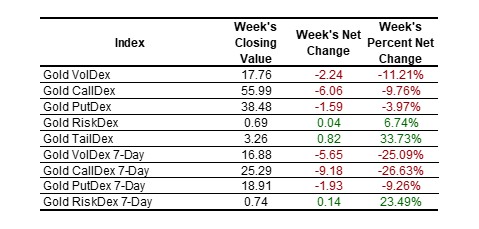
Gold VolDex is back at a level not seen prior to the tariff turmoil which rocked stocks beginning in April. VolDex at 15.00 deserves to be bought.

Silver gained 7.24% over the last 30 days but option prices remain low. Silver VolDex ended the week at just 24.89 which is the 11th percentile of its 52-week range. Given the potential for a geopolitical shock, small positions which are long at-the-money silver options with VolDex below 24 are logical. For example, in the July 18th expiration in SLV options, the 32.5/33 strangle is an interesting long opportunity at 1.40 (account for erosion vs. Friday’s closing values).

We are not generally fans of buying straddles or strangles because erosion is punishing and the move required for the trade to be profitable is significant but this trade is a rare exception if put on in smallish size.
0DTE and 1DTE Options:
Zero day to expiration (ODTE) options accounted for 55.65% of all SPY option volume this week. That is slightly lower than the recent trend. 0DTE accounted for just 45.88% of all SPY option volume on Wednesday. We wonder if this was a function of markets being closed the next day.
Very short-dated volatility measures which use a variance swap methodology, as 1-day VIX does, inject significant error into the resulting measure because of the way out-of-the-money options trade in the hours before expiration. The VolDex at-the-money methodology is particularly suited for these very short-dated tenors.

Equities:
We have expanded the list of single names we cover. Movement among the names we cover was mixed this week. AMD was the big winner with a gain of 10.40%. LLY was the big loser with a loss of 6.91% following news that Novo Nordisk has secured a preferred listing deal with CVS for its obesity drug, Wegovy. This would exclude Lilly’s Zepbound from CVS’s formulary.

VolDex for the names we cover was similarly mixed with VolDex increasing in 8 names and falling in 6.
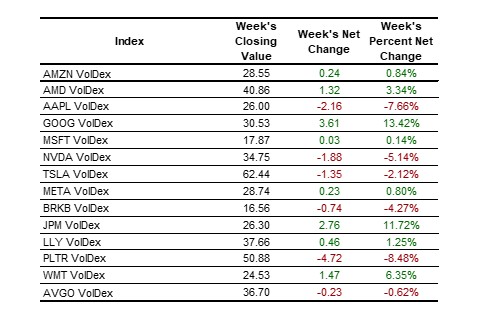
Recently we have been highlighting how expensive TSLA CallDex has become and warned traders away from buying out-of-the-money calls that many have been stocking up on in advance of the expected roll-out of the TSLA robotaxi. This was right as shares fell 0.97% this week and CallDex fell 5.18%. It closed the week at the 57th percentile of its 52-week range.

Option prices in META have gotten very cheap.
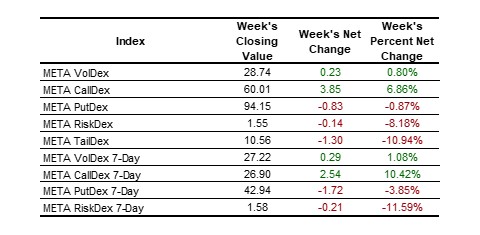
META VolDex closed at 28.74, the 8th percentile of its 52-week range while CallDex closed at 60.01, the 5th percentile of its range.


NVDA options are even cheaper. NVDA VolDex is at its 2nd percentile and CallDex is at the 1st percentile


Traders should be using long option positions to express any directional opinion in META and NVDA.
We’ll continue to comment during the week via our X account, @Nations_Indexes.
Scott’s Weekly Commentary:
This week’s news was generally good albeit the news from the Middle East is good only in the context of the previous week’s horrible news.
But inflation is tame and we have temporary reprieves from tariff turmoil and worries about the spending bill making its way through Congress. The market needs a little break after so much recent concern about these issues. It is tough to see the market sprinting higher this summer but I think most investors would be happy to get to September with the S&P up slightly on the year (it closed on Friday up 1.47% YTD). Fingers crossed because there seems to be more risk to the downside than the upside and RiskDex agrees.
We have heard about bond vigilantes since the 1980s. They are fixed income investors who sell Treasury bond holdings when faced with fiscal or monetary policy (mostly fiscal) that they consider fiscally irresponsible or likely to fuel inflation. Their response is perfectly rational; policy that is irresponsible or inflationary is likely to drive down the price of the bonds the vigilantes hold. But their selling, which in turn drives up interest rates, is seen not as a purely market driven decision but is instead seen as a protest against the policies themselves.
We now see volatility vigilantes in our equity market. We know volatility is mean reverting. If it gets high because of fear, like we saw in April, we know it will come down, back toward its average historical value. The only question is how long it will take. In September and October 2008, as Lehman Brothers was declaring bankruptcy and the financial world was unraveling, VOLI was in the 70s. It didn’t close back below 25, still a pretty high level, until June 19, 2009.
But now we see volatility sellers rushing in to take advantage of any spike in option prices. VOLI traded as high as 46.01 on April 8 of this year. It was back below 25 just 2 days later and closed below 25 just 15 days later. Volatility vigilantes, who couldn’t be certain how the geoeconomic response to the tariff battles would play out, nonetheless rushed in to sell volatility. The period between volatility spike and reversion to the mean continues to decrease.
This works. At some point it won’t work and volatility will spike, the worst will seem to have passed, sellers will sell volatility aggressively, and the market will continue to dive and the spike in volatility will continue higher. The volatility vigilantes will be facing a horrible predicament because they sold options meaning they have limited profit potential but essentially unlimited loss potential and those losses will grow as the volatility spike continues. They’ll be on the wrong side of convexity; as markets continue to swoon and volatility continues to rise the vigilantes will go from losing “X” with every 1 percentage point decline in the S&P to losing “2X” with each percentage point loss before they’re eventually losing “5X” or “10X”. At some point they’ll be out of money and will be forced to throw in the towel. A strategy that had “always” worked will have failed them with dramatic consequences.
It won’t be a new story. In fact, it will be depressingly common. But we learn lessons and pay the market tuition to do so. Some forget those lessons and have to pay up all over again. That’s the real danger here. An investor can withstand a setback in the market but no investor can stand many of them if they are self-inflicted.
Everyone at Nations Indexes hopes you have a healthy and profitable week.
Scott
