

Your Week’s Volatility Market Commentary — Information Is Your Edge
“Old Economy”? Yes! AI? Not so much.
The Weekly Takeaway:
- The S&P 500 fell 0.10% this week to close at 6460.26. The index lost 0.64% on Friday thanks to continuing inflation fears. The index is now up 9.84% YTD;
- The Nasdaq-100 lost 0.35% this week as NVDA, MSFT, META, and TSLA all fell. The index is now up 11.44% YTD;
- Expectations for a rate cut from the Fed at its September meeting remain high as the market says the current likelihood is 86.4%;
- VolDex (ticker VOLI) rose by 5.43%. It closed at 12.23, the 8th percentile of its 52-week range;
- TailDex (ticker TDEX) rose by 17.08%. This week’s close of 14.81 is the 15th percentile of its 52-week range;
- CallDex fell by 13.39% as traders sold out-of-the-money calls to get short exposure to the S&P 500 and as declines in big tech names led to worry about the market’s ability to rally;
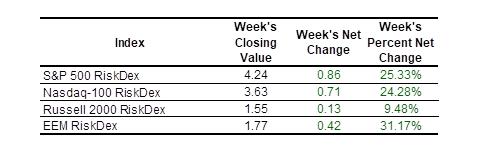
- RiskDex rose by 25.33% and closed above 4 at 4.24;
- VolDex on the Nasdaq-100 rose by 6.95% after rising 5.80% during the previous week. It is still at just the 10th percentile of its 52-week range;
- RiskDex on the Nasdaq-100 gained 24.28% as traders bought puts and sold calls. Nasdaq-100 RiskDex is now at the 66th percentile of its 52-week range;
- The Russell 2000 index continued to buck the trend and gained 0.19% on the week. Russell 2000 VolDex fell 1.79%;
- U.S. Treasury Bond VolDex rose by 7.60% after ending the previous week at just the 2nd percentile of its 52-week range. This week’s close of 12.92 is a still-anemic 9th percentile of its 52-week range. Both CallDex and PutDex rose on the week;
- Bitcoin volatility rose with VolDex gaining 13.88% and PutDex gaining 19.31%. Last week’s bullishness for bitcoin gave way as it fell 7.26% on the week. It is now 12.09% below its recent high;
- Volatility in gold was noteworthy with VolDex gaining 16.73% and CallDex gaining 17.43%;
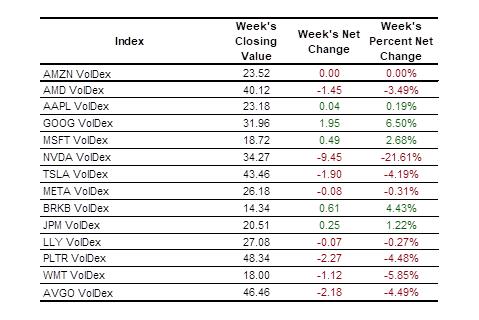
- VolDex was mixed on the single names we cover with VolDex on AAPL, GOOG, MSFT, BRKB, and JPM rising. VolDex on NVDA fell by 21.61% following its most recent earnings release.

Equity Index Volatility:
Implied volatility and option prices in the 30-day tenor for S&P rose with the exception of CallDex. Measures in the 7-day tenor were lower due to the 3-day weekend but 7-Day VolDex and 7-Day PutDex were barely lower illustrating the market’s concern.
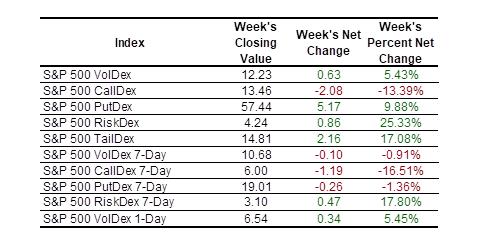
S&P 500 RiskDex gained 25.33% and closed at 4.24.

Implied volatility remains very low so short volatility option structures are to be avoided. RiskDex is showing a subtle tilt to bearishness.
Why It Matters…Historical data for all our indexes is available to subscribers at the Everything! level and they allow option traders to understand the context of the current option pricing environment. Volatility is mean-reverting and that is a phenomenon traders can take advantage of in both directions. But you have to understand what normal is, what the “mean” is, in order to do so.
Results for Nasdaq-100 volatility were similar to those for the S&P as concerns about the ability of the biggest tech names to rally – or maintain the year’s gains – become more common.
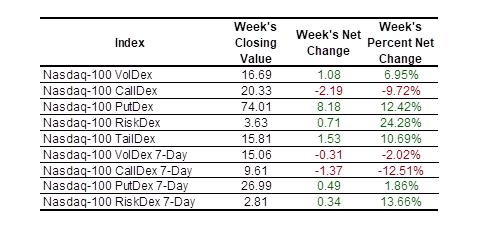

Last week we noted “[Nasdaq-100] RiskDex is at the 53rd percentile signaling a reasonable amount of concern for the fate of the big tech names”.
That signal was prescient and the concern only increased this week as Nasdaq-100 RiskDex rose another 24.28% to close at the 66th percentile of its 52-week range.

Other Equity Indexes:
Option prices and implied volatility in the Russell 2000 were mixed as the index led the way in the equity index world.
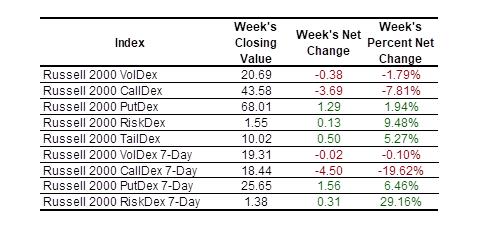
Why It Matters…The RiskDex regimes for the 4 equity indexes we cover are very different. Savvy traders can take advantage.
Other Asset Volatility:
Treasury Bonds and Notes:
The yield on 10-year treasury notes fell by 3.3 basis points after falling 6.8 basis points last week thanks to increased hopes for a rate cut in September. The yield ended the week at 4.227%.
All volatility measures in treasury bonds rose (with the exception of RiskDex which fell only because CallDex rose more than PutDex).
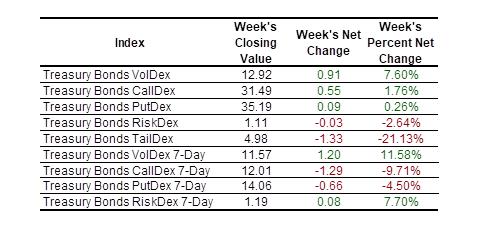
Treasury bond VolDex is still very low on an historical basis. Trades that are short volatility are to be avoided.

Treasury bond RiskDex continues to show put skew (i.e., RiskDex is above 1.00) but the amount of put skew is decreasing.

Why It Matters…Treasury bond prices move inversely to interest rates and it is interesting that traders are more interested in owning puts than calls despite the market saying a rate cut in September is nearly certain.
Bitcoin:
Bitcoin volatility gained while showing bearish sentiment.
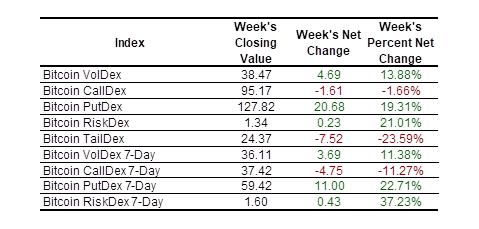
Traders are worried by the decline in bitcoin prices.

Last week we noted “Bitcoin RiskDex fell by 22.99% and we believe this is an opportunity for traders to employ a call-spread collar to take advantage of the expected increase in put prices relative to call prices.”
That certainly worked out as Bitcoin RiskDex rose by 21.01% and bitcoin fell by 7.26%
Precious Metals:
Gold rose by 2.89% after gaining 1.05% during the previous week. Gold futures continue to trade in a broad sideways pattern since April although they are at the very top of that range as expectations for lower interest rates boost demand.
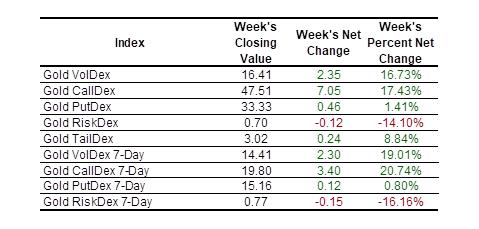
You can see the Gold VolDex chart below.

VolDex Term Structure:
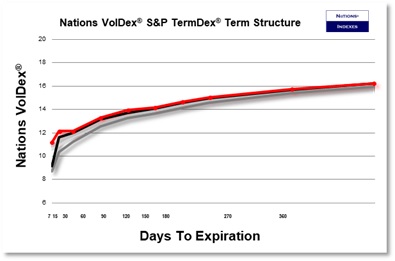
Term structure for S&P VolDex maintains a very normal shape and the upward sloping shape suggests there is little fear although the “kink” in the shortest terms suggests some concern for short-term price movements. Friday’s closing VolDex term structure is in red while the week’s other closes are in black (Thursday) and gray for earlier days in the week.
Option Window:
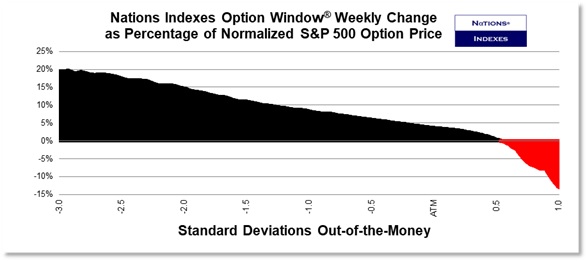
Option Window® is a graphical display of where S&P 500 option flows were concentrated this week. Any black areas (this week that was all strike prices below 0.5 standard deviations above at-the-money or about 6375) show where buying drove prices higher at constant points of moneyness (horizontal axis) while red shows where selling drove option prices lower. Out-of-the-money call option prices show the only red this week as traders sold those calls to get short exposure to the S&P.
0DTE and 1DTE Options:
Zero day to expiration (ODTE) options accounted for 60.73% of all SPY option volume this week.
Very short-dated volatility measures which use a variance swap methodology, as 1-day VIX does, inject significant error into the resulting measure because of the way out-of-the-money options trade in the hours before expiration. The VolDex at-the-money methodology is particularly suited for these very short-dated tenors.

Equities:
We have expanded the list of single names we cover to include not only the most dynamic stocks in the S&P 500 and the stocks with the highest option volume, but also the largest names in the S&P 500.
The single names we cover were mixed this week with AI names falling again and “old economy” names generally rallying.
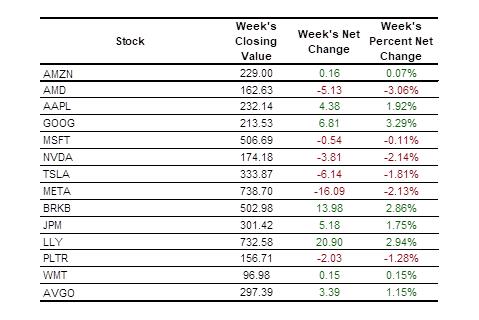
VolDex was similarly mixed for the single names we cover. NVDA VolDex fell by 21.61% following the release of earnings and guidance.
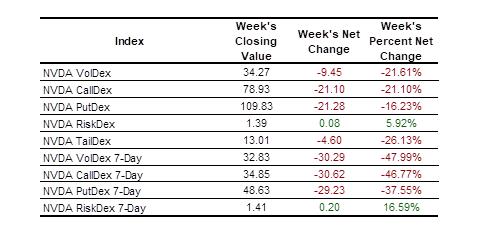
The price action in NVDA options was all red as would be expected following earnings but RiskDex was higher in both the 7-day and 30-day tenors indicating some concern about the short-term path for the share price.
GOOG options all gained on the week (with the exception of 7-day RiskDex which fell only because 7-Day CallDex rose by more than 7-Day PutDex).
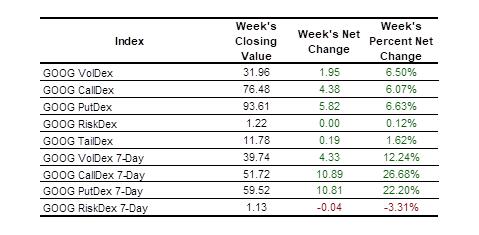
This is interesting because GOOG made a new 52-week high this week and is now up more than 51% from its April low. The stock is now overbought with a Relative Strength Index reading of 74.19. CallDex is at just the 31st percentile of its 52-week range but 7-Day CallDex closed on Friday at the 64th percentile of its 52-week range. We’ll continue to watch for opportunites in GOOG as covered calls may be interesting.
We’ll continue to comment during the week via our X account, @Nations_Indexes.
Scott’s Weekly Commentary:
Friday’s inflation data came in as expected but that shouldn’t provide any comfort as the headline inflation number showed a monthly increase of 0.4% and a year-over-year increase of 2.6%. That the odds for a September rate cut increased is surprising. I’m not certain if the Fed is on autopilot regarding the September meeting or if intervening jobs or inflation data could change the outcome. This is something to consider before making any trades that hinge on the Fed meeting.
NVDA’s earnings and guidance were interesting because the company’s biggest questions have to do with tariff policy, not operations. The company announced that, despite receiving a waiver to sell certain chips into China, the company did not ship any during the previous quarter. Tariff risk is likely a risk for which investors are not compensated. Shares are up 25% for the past 3 months but are now down 1% for the past 30 days.
Last week I pointed out that “The wreckage in the AI and megacap space is not yet ugly but it is headed in that direction.” This week’s price action didn’t disabuse me of that notion. Some investors are going to make tons of money in some AI names. The unique payoff profiles offered by options will be particularly valuable in the AI space through the end of next year.
Things may change quickly as everyone gets back from the Labor Day holiday. It will be fun for traders.
Everyone at Nations Indexes hopes you have a healthy and profitable week.
Scott
