

Your Week’s Volatility Market Commentary — Information Is Your Edge
Stocks Bounce Back as Tariff Talk Fades
The Weekly Takeaway:
- The S&P 500 gained 0.51% for the week despite a 1.07% loss on Tuesday. The S&P gained 1.08% on Wednesday after Fed Chair Jay Powell opined that any tariff-driven inflation would be “transitory”;
- The Nasdaq-100 gained 0.25% for the week as the biggest names in the index were mixed with AAPL and MSFT gaining ground as NVDA, META, and TSLA fell;
- VolDex (ticker VOLI) fell by 12.95% to close at 16.80. It fell by 9.25% on Wednesday as the Fed meeting passed. It closed at the 38th percentile of its 52-week range;
- TailDex (ticker TDEX) fell by just 3.66% for the week after falling 25.07% during the previous week. We have noted an unwillingness on the part of traders to buy deep out-of-the-money puts during the “tariff” selloff. TailDex is now at just the 13th percentile of its 52-week range;
- PutDex on the S&P 500 fell by 13.56% as traders took advantage of the bullish tone and elevated volatility to sell out-of-the-money puts;
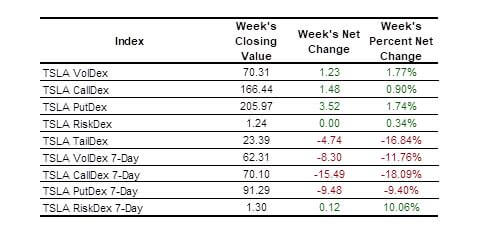
- VolDex fell for all the single names we cover with the exception of TSLA. TSLA VolDex rose by 1.77% to close at 70.31. The next highest VolDex level is NVDA VolDex at 42.12. AAPL VolDex fell by 14.03% on the week as the stock rebounded from the previous week’s loss;
- The Nations Investor Optimism Index rose by 23.30% to close at 29.63. It has rallied from its closing low of 4.90 on March 10.

Equity Index Volatility:
The S&P gained ground on three days this week and bounced back nicely if not convincingly, from recent tariff-induced weakness. Importantly, it started the week well, gaining 0.64% on Monday to continue the momentum that surfaced on Friday, March 14. The index closed 7.81% below its 52-week high so it is no longer in “Correction” territory.
The Nasdaq-100 gained just 0.25% for the week as the largest names were mixed. AAPL gained 2.24% but NVDA lost 3.26% and META lost 1.87%. Volatility fell across the board in the Nasdaq-100 with VolDex falling 11.87%, CallDex falling 17.49%, and PutDex falling 10.72%. Nasdaq-100 PutDex is now at just the 29th percentile of its 52-week range.
Investors have shunned buying out-of-the-money protective puts during the recent decline. Deep out-of-the-money puts have notably lacked any buying interest from hedgers. We have discussed this frequently and while this week’s bounce is comforting, hedger’s unwillingness to buy “crash” protection remains a little surprising. Nasdaq-100 TailDex closed on Friday at just the 18th percentile of its 52-week range.
As we noted last week: “Traders and hedgers raced to buy protective puts in August when the S&P fell due to the Bank of Japan increasing interest rates and traders and hedgers bought puts again in December when inflation and interest rate policy troubled investors. TailDex spiked on both occasions but traders and investors are now refusing to buy deep out-of-the-money put options at nearly any price and were waiting for the opportunity to sell them…” This remains the case.

S&P 500 CallDex finally stopped rallying, losing 11.81% for the week despite closing as high as 22.03 on Tuesday. CallDex fell to very cheap levels in February and has gained more than 41% since February 21. It is now at the 44th percentile of its 52-week range.
Why It Matters…Buying out-of-the-money calls delta neutral as a volatility trade was very profitable if executed at the lows of CallDex in February. The best use of our indexes may be to highlight the most advantageous options without regard to market direction. Just because CallDex was very cheap doesn’t necessarily mean a trader should just buy calls and hope the market will go up. They should instead fold that information into their overall view of the market and use it to craft superior trade structures.

You can find the CallDex fact sheet here:
Below you’ll see the week’s results for our indexes on the S&P 500.
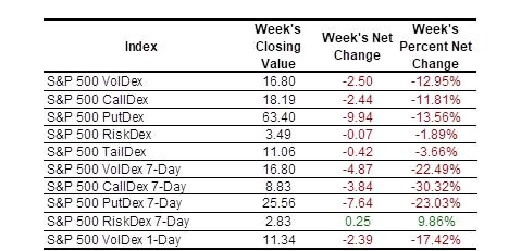
You will note that RiskDex has returned to a more normal level after rallying above 5.00 in February. That rally was driven by weakness in call prices more so that strength in put prices.
Why It Matters…Our index values are most useful when used in concert with each other. Simply knowing CallDex had gotten very cheap is less helpful than looking at it in the context of PutDex and RiskDex, which is the simple ratio of PutDex to CallDex.

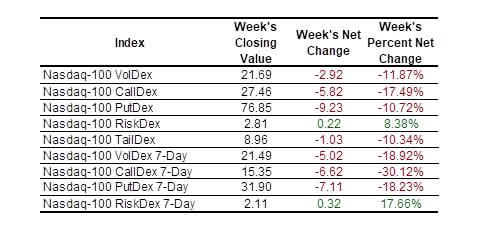
The volatility picture in the Nasdaq-100 was similar to that in the S&P with every metric with the exception of RiskDex falling. Nasdaq-100 RiskDex rose by 8.38% as call prices fell by more than put prices. RiskDex in the Nasdaq-100 is consistently lower than in the S&P 500 as investors have refused to sell out-of-the-money call options in the Nasdaq-100 because they fear truncating upside. This week’s price action, and weakness in some of these share prices, seems to indicate this refusal is tapering off and more traders are now willing to sell calls in the Nasdaq-100.
Why It Matters…Delta neutral structures in QQQ options that buy puts and sell call spreads would take advantage of this trend.

Below you can see Nasdaq-100 RiskDex.

Nations Investor Optimism Index:
The Investor Optimism Index rose by 23.30% but closed at a still-anemic level of 29.63.
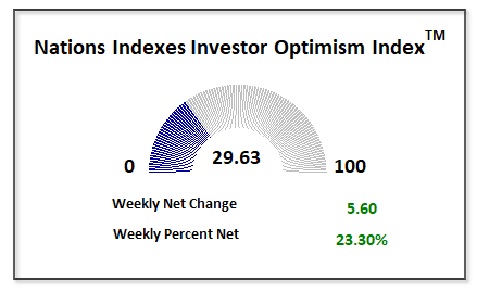
The index takes into account the current levels of S&P VolDex, TailDex, and RiskDex and compares them to their rolling 2-year ranges. It has not closed above 50 since January 24.
Historically, the S&P has averaged a 0.74% gain in the 20 trading days subsequent to the Optimism Index closing between 20 and 30. Interestingly, the best subsequent 20-day performance occurs when the Optimism Index closes below 10.00. That average gain is 2.04%.
Deconstructing Skew:
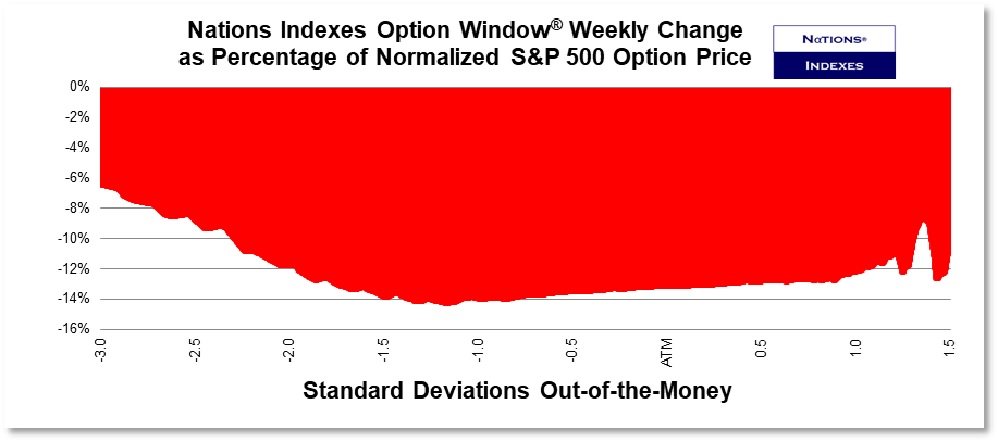
We deconstruct S&P option skew to understand what the option market is really saying. Since VIX includes nearly all strike prices listed in the relevant expirations, it is impossible to know what is driving changes in VIX – is VIX higher because traders are optimistically reaching for call options or is it higher because they’re afraid and are buying puts?
Why It Matters…We can see that traders sold out-of-the-money options across the entire skew and did not target particular strike prices. This indicates a general sense that volatility is headed lower without a consensus regarding direction.
Other Equity Indexes:
The Russell 2000 index of small capitalization stocks rose by 0.63%, outpacing the other major indexes by a small margin. The Russell 2000 remains the worst performer on the year (down 7.77%) and is 16.60% below its 52-week high.
All the option metrics for the Russell 2000 fell on the week with the exception of TailDex which inexplicably rose by 23.36%.
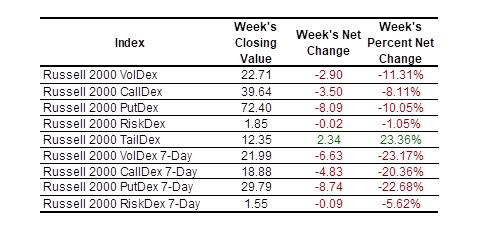
It is interesting that Russell 2000 RiskDex is so much lower than RiskDex for the other major indexes. That has historically been the case but savvy traders can monitor that relationship and use it to create more effective hedges.

Other Asset Volatility:
Treasury Bonds:
The yield on 10-year treasury notes fell again, ending the week at 4.252%. The year-to-date high is 4.803% was made on January 13 but since then concerns have shifted from inflation to slowing growth. The Atlanta Federal Reserve’s current estimate of GDP for the first quarter shows a contraction of 1.8%.
Accordingly, Treasury Bond CallDex bucked the general trend and rose by 1.77% for the week.
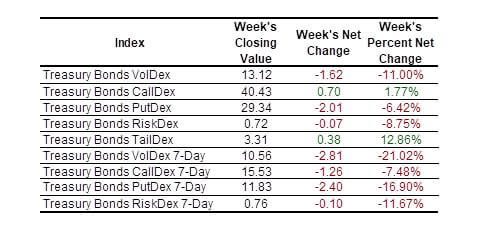
The general decline in Treasury Bond volatility continues to signal that traders believe the worst is over for equity markets. As we said last week, “The fact that ALL our option metrics on treasury bonds fell on the week is likely to be the best evidence that traders believe the worst is over for EQUITY markets.”
Why It Matters…Treasury bond option volatility can be a good signal of directionality for equities since fear of substantial declines in equity prices will be transmitted to treasury bond option prices.
Bitcoin:
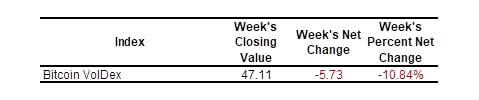
VolDex on bitcoin fell by 10.84% to close at 47.11. This comes on the heels of last week’s decline of 5.16%.
Traders continue to be willing to sell options in bitcoin to take advantage of elevated volatility levels.
0DTE and 1DTE Options:
Zero day to expiration (ODTE) options continued to account for the majority of SPY option volume, with 58.13% of this week’s SPY option trading being 0DTE. It is worth noting that 0DTE volume in SPY accounted for 60.22% of all SPY option volume on Tuesday when the S&P 500 lost 1.07%. Very short-dated volatility measures which use a variance swap methodology, as 1-day VIX does, inject significant error into the resulting measure because of the way out-of-the-money options trade in the hours before expiration. The VolDex at-the-money methodology is particularly suited for these very short-dated tenors.
Equities:
This week’s news was mixed for the individual names we cover with four gaining ground and four losing ground. AAPL bounced back from last week’s loss of 10.70% and NVDA gave back nearly half of last week’s gain of 7.97%.

VolDex declined in all the names we cover with the exception of TSLA. TSLA VolDex remains substantially higher than for all other names. TSLA is 49.09% below its 52-week high and that accounts for some of this, but CEO Elon Musk’s visibility generates concerns for shareholders.
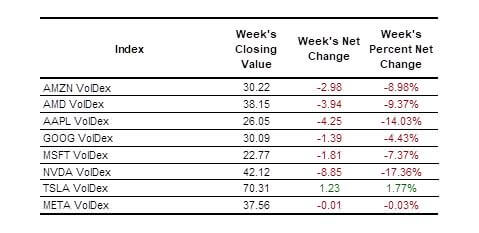
TSLA is now further below its 52-week high than any of the names we cover. We’ll continue to comment during the week via our X account, @Nations_Indexes.

Scott’s Weekly Commentary:
Well, this week worked out better than most expected. Some will be disappointed that the Nasdaq-100 underperformed the S&P 500 but that is probably healthy if it means traders and investors are paying more attention to the broad market and less attention to a handful of the highest flyers. Sometimes boring is good and that’s usually the case when it comes to investing.
I’m struck by how effective treasury bond volatility was in flagging the bottom of the market in equities. We’ve been discussing how treasury bond volatility can be an early indicator of movement in equity prices. If Treasury Bond CallDex climbs that can mean some traders are positioning for higher bond prices and lower bond yields. But when CallDex spikes, that can mean some traders are preparing for a plunge in equity prices and flight to quality buying in treasuries.
It was also comforting to see AAPL rebound from last week’s loss of more than 10%. I believe AAPL is more of a consumer products company now and less of the tech company many think of it as. Growth is tough to come by when you’re the only name in our entire stock market with a market capitalization of more than $3 trillion. And those who always expect great things from AAPL will likely be disappointed by their offerings in AI, at least in comparison to other companies. That may lead to some volatility in AAPL shares and with a forward PE of 29 it is difficult to call the shares “cheap”. We’ll continue to pay attention.
Everyone at Nations Indexes hopes you have a healthy and profitable week.
Scott
