

Your Week’s Volatility Market Commentary — Information Is Your Edge
Stocks Make New Highs, More New Jobs Than Expected – Corrected
The Weekly Takeaway:
- The S&P 500 rose by 1.72% during this holiday shortened week and made a new all-time high. This comes after gaining 3.44% last week. It is now up 6.76% YTD;
- The Nasdaq-100 rose 1.48% this week. It is now up 8.83% YTD;
- The monthly jobs report was released on Thursday and showed stronger job growth than anticipated. The market expected 110,000 new jobs in June and the actual number was 147,000;
- President Trump signed the One Big Beautiful Bill on Friday;
- The yield on 10-year treasury notes rose by 6.5 basis points and closed at 4.348%;
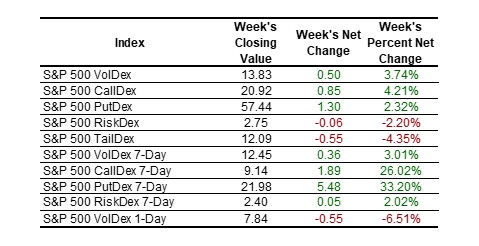
- VolDex (ticker VOLI) rose by 3.74% to close at 13.83. It is at the 13th percentile of its 52-week range;
- TailDex (ticker TDEX) fell by 4.35% to close at 12.09;
- Both CallDex and PutDex on the S&P 500 rose on the week as volatility generally climbed despite the rally in stocks;
- VolDex on both the Nasdaq-100 and Russell 2000 rose on the week;
- U.S. Treasury Bond VolDex fell by 1.98% as the jobs data catalyst passed;
- VolDex was higher on every equity name we cover with the exception of TSLA;
- A reminder: we have expanded the list of asset classes we cover to include high-yield bonds, 7-10 year treasury notes, and emerging market equities;
- We have expanded the list of equities we cover to include BRKB, JPM, LLY, PLTR, and WMT. We now cover not only the names with the most active option markets but the 10 largest names in the S&P;
- The Nations Investor Optimism Index rose 5.58% to close at 45.58. It has not closed above 50 since January 24th;

Equity Index Volatility:
Implied volatility and option prices in the S&P rose this week with the exception of deep out-of-the-money puts as measured by TailDex. RiskDex fell because CallDex rose more than PutDex.
All 30-day volatility measures for the Nasdaq-100 rose with the exception of RiskDex which fell by 3.59% because CallDex rose more than PutDex.
Every volatility measure rose for the Russell 2000.
We have been noting that equity index VolDex values are near the bottoms of their 52-week ranges and that directional option strategies should be long volatility. It seems as if the market has put in a bottom in broad volatility measures as we prepare for earnings season. Very short-term trades should be long volatility.
TailDex continued it collapse from April highs and S&P TailDex closed on Thursday at the 11th percentile of its 52-week range. These deep out-of-the-money puts are dollar-cheap but constantly owning them is a big drag on returns. Trading them from the long side can be profitable if done tactically when they’re cheap, as they are now, and if traders take profits when the options appreciate rather than waiting for expiration or waiting for a complete collapse in the market that would leave these options in-the-money at expiration

S&P 500 RiskDex fell by another 2.20% and closed at 2.75. RiskDex is the ratio of PutDex (1 standard deviation out-of-the-money put prices) to CallDex (1 standard deviation out-of-the-money call prices).
RiskDex is a great measure of sentiment and option skew. You can see the 52-week chart of S&P RiskDex.

Why It Matters…Historical data for all our indexes is available to subscribers at the Everything! level and they allow option traders to understand the context of the current option pricing environment. Volatility is mean-reverting and that is a phenomenon traders can take advantage of in both directions. But you have to understand what normal is, what the “mean” is, in order to do so.
You can see the week’s volatility results for the S&P 500 below.
You can see the week’s results for our indexes on the Nasdaq-100 below.
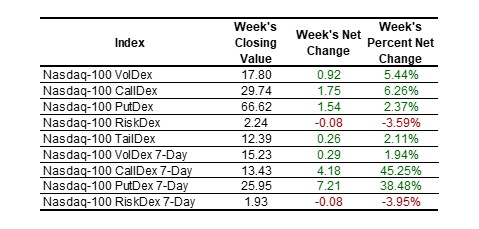
Nasdaq-100 VolDex closed at just the 13th percentile of its 52-week range. 7-day VolDex and CallDex are both below the 10th percentile of their 52-week ranges but this is a time when options are cheap for a reason. The 7-day tenor does not catch earnings so it is difficult to see a good rationale for buying these.


Nations Investor Optimism Index:
The Investor Optimism Index rallied slightly as equity markets made new all-time highs but it could not climb above 50.
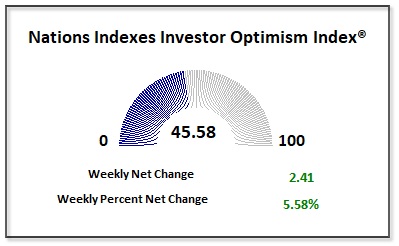
The index takes into account the current levels of S&P VolDex, TailDex, and RiskDex and compares them to their rolling 2-year ranges.
Our Optimism Index is now available in real-time on our home page at NationsIndexes.com.
Other Equity Indexes:
Option prices for the Russell 2000 rose across the board. Even TailDex rose.
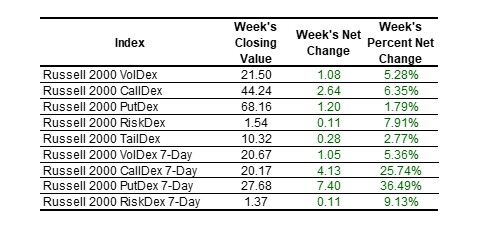
Why It Matters…Russell 2000 CallDex has been very cheap during the past two months and we have suggested using these calls to express any bullish sentiment in small caps. This has worked and Russell 2000 CallDex closed at the 32nd percentile of its 52-week range which seems fairly priced.
We’ve added the emerging market equity index to our roster of equity indexes. EEM is the underlying ETF we use. These values are available in real time to subscribers.
Other Asset Volatility:
Treasury Bonds:
The yield on 10-year treasury notes broke its downward trend. The new One Big Beautiful Bill seems certain to attract bond vigilantes who will be selling and shorting treasury bonds.
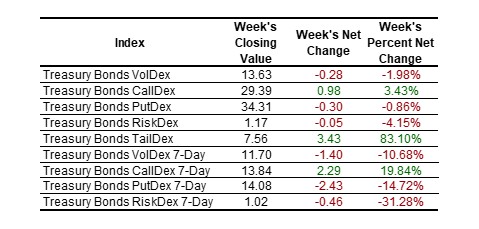
When Treasury Bond VolDex broke through the 15 level that we were highlighting it and it dropped again this week, falling another 1.98% to close at 13.63. That is just the 15th percentile of its 52-week range and we strongly believe this is a buy.

We have just begun calculating our metrics on treasury notes with the underlying IEF so we’ll be watching this as well.
Why It Matters…Treasury bonds tend to spike higher when markets or geopolitics turn chaotic. While it’s usually too late to buy these out-of-the-money calls after the news has hit, it is a dynamic traders should be aware of.
We are watching for renewed interest in owning puts on treasury bonds.
Bitcoin:
Bitcoin VolDex has been interesting since it was unveiled in December. It opened then at 61.66 and has fallen steadily giving option sellers a great opportunity. It closed this week at 39.92, up 4.67% but still below 40.
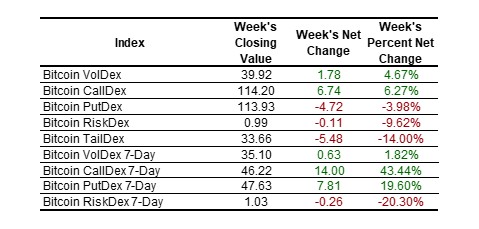
Bitcoin CallDex rose again this week as bitcoin volatility continues to mimic equity index volatility rather than that of something more like “Digital Gold”.

Note that Bitcoin RiskDex fell below 1.00 indicating a slight amount of call skew. If bitcoin continues to resemble the equity indexes more than gold then Bitcoin RiskDex will rally from this level. Trade structures that are long out-of-the-money puts and short out-of-the-money call spreads (we would never suggest being naked short bitcoin call options) and which are done delta neutral, will take advantage of this and we suggest them.
Precious Metals:
Gold rose by 1.97% this week as gold seems to be the first asset moving on concerns about the government’s fiscal situation. Gold VolDex rose slightly but TailDex collapsed as traders are understandably unconcerned about a collapse in gold prices.
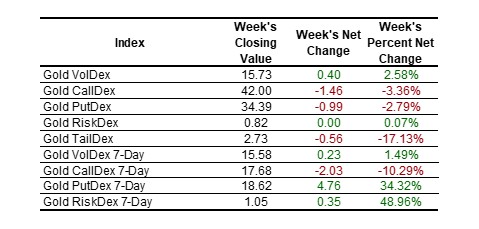
For several weeks we have been saying that Gold VolDex below 15.00 would likely draw some buying interest but we now believe buying lightly even above 15.00 is likely to be profitable.

VolDex Term Structure:
Term structure for S&P VolDex has returned to a very normal shape although the very front end kicked up as you can see. If the term structure continues to flatten watch for opportunities to implement calendar spreads that are short the front and long the back.

0DTE and 1DTE Options:
Zero day to expiration (ODTE) options accounted for 56.81% of all SPY option volume this week.
Very short-dated volatility measures which use a variance swap methodology, as 1-day VIX does, inject significant error into the resulting measure because of the way out-of-the-money options trade in the hours before expiration. The VolDex at-the-money methodology is particularly suited for these very short-dated tenors.

Equities:
We have expanded the list of single names we cover.
Most of the equities we cover gained on the week. AAPL was the big winner with a gain of 6.20% thanks to news that the company is rethinking its approach to AI where it was seen as lagging. Rather than going it alone AAPL is now likely to pursue strategic partnerships in the space.
AMD was the big loser with a loss of 4.10% as its data center segment seems to be disappointing relative to rivals like NVDA.

VolDex for all the names we cover rallied with the exception of TSLA.
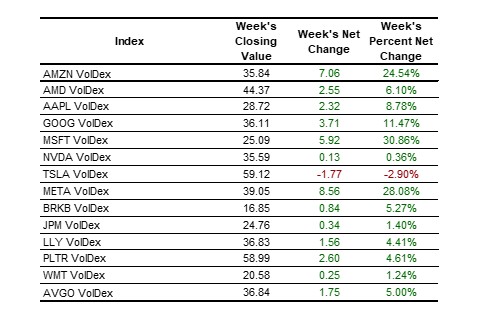
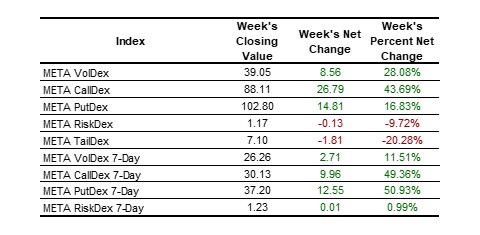
Last week we pointed out that option prices in META were very low and long volatility positions were attractive. Option prices for META rallied strongly this week so those long volatility positions were profitable. META VolDex closed the week at the 32nd percentile of its 52-week range so these options are much more fairly priced. We would suggest taking profits in long volatility positions in META.
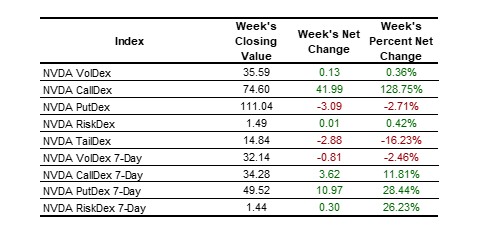
While many equities have volatility regimes that are consistent with their recent histories, NVDA, the largest stock in the S&P 500, has option prices which are historically low. VolDex is at the 7th percentile of its 52-week range. Any directional thesis in NVDA should be expressed with long option structures.
Option prices in the other names we discussed last week have rallied so long option positions in those names were profitable.
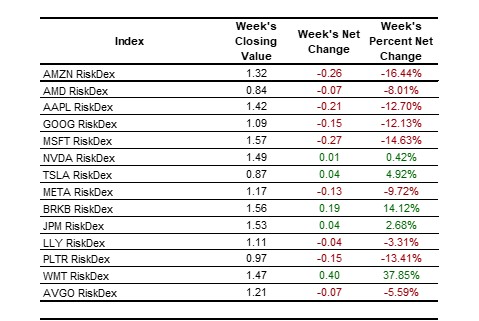
RiskDex fell for several names and is now below 1.00 for 3 names. This call skew offers interesting opportunities for anyone considering bearish structures in these names.
Traders should be using long option positions to express any directional opinion in META and NVDA.
We’ll continue to comment during the week via our X account, @Nations_Indexes.
Scott’s Weekly Commentary:
The news remained good this week although the better than expected jobs data means it is less likely the Federal Reserve will cut interest rates soon.
The 90-day pause on new U.S. tariffs is due to end on July 9. I remain convinced that China will say what we want to hear but will refuse to be pushed around and is likely to stand its ground. They’re a huge exporter but their political leadership wants to increase domestic consumption so they may not need to export as much as they have in the past. Our stock market has convinced itself that the administration will be more conciliatory during this cycle but there is the real possibility for an unpleasant surprise and significant volatility during a period which is usually quiet for our markets.
Earnings season kicks off on July 10 and will shift into high gear on the 15th when JPM, WFC, BLK, and Citi all report earnings. I believe these reports will be better than expected because the financial sector is doing well. I’m not so certain other sectors will be as positive.
The forward PE for the S&P 500 has declined over the past 12 months and that is great news, but at 22.60 it is still very high.
I think the biggest news of the week was President Trump signing his One Big Beautiful Bill. The impact on our federal budget deficit and debt is undeniable and bad for our federal finances. Interest on our federal debt will top $1 trillion next year and this will attract the attention of bond vigilantes everywhere. They are the investors who sell or short treasury bonds because they believe the fiscal situation is unsustainable and who wish to influence policy. I believe the only way in which treasury bond prices are not lower a year from now is if we have a crisis of some sort and there is a “flight to quality,” quality being relative.
Everyone at Nations Indexes hopes you have a healthy and profitable week.
Scott
