

Your Week’s Volatility Market Commentary — Information Is Your Edge
Stocks Make New Highs Thanks To Megacap Tech
The Weekly Takeaway:
- The S&P 500 gained 0.94% this week to close at 6449.80. The index posted an all-time intraday high of 6481.34 early on Friday and is up 9.66% YTD;
- The Nasdaq-100 gained 0.43% this week. The index posted a new all-time high early on Wednesday. The index is now up 12.85% YTD;
- The market continued to rally thanks to strength in megacap technology names;
- Inflation data was mixed with CPI coming in as expected with a monthly increase of 0.2% and an annual increase of 2.7% but PPI came in higher than expected with a monthly increase of 0.9% and an annual increase of 3.3%;
- Expectations for a rate cut from the Fed at its September meeting remain high with the market pegging the likelihood at 92.1%, higher than last week’s ending likelihood of 88.9%;
- Q2 earnings season has closed with 69% of S&P 500 constituents beating revenue expectations and 81% beating on earnings;
- VolDex (ticker VOLI) fell by 2.86%. It closed at 11.87, the 7th percentile of its 52-week range;
- TailDex (ticker TDEX) rose by 3.45%. This week’s close of 13.80 is the 11th percentile of its 52-week range;
- CallDex rose by 5.93% after climbing 8.25% last week as traders bought calls to get long exposure to the S&P. PutDex fell by 4.09% this week after falling 26.74% last week as fear continued to evaporate on the tariff and earnings fronts. CallDex and PutDex diverge more often than many would expect and it is a signal worth watching;
- VolDex on the Nasdaq-100 fell by 4.31%. It closed at just the 4th percentile of its 52-week range;
- U.S. Treasury Bond VolDex fell by 0.06% and closed at 12.14, the 3rd percentile of its 52-week range. However, every other volatility metric for Treasury bond options rose on the week;
- Bitcoin volatility gained in every 30-day metric with VolDex gaining 11.63% to close at 36.60;
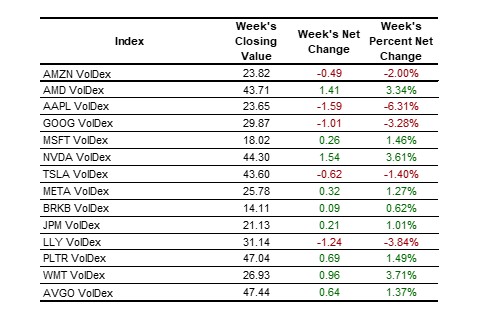
- VolDex was mixed on the single names we cover with AAPL VolDex falling 6.31% but no other VolDex measure moving by more than 4%;
- The Nations Investor Optimism Index rose by 63.42% to close at 51.25.

Equity Index Volatility:
Implied volatility and option prices in the S&P were mixed in the 30-day tenors with CallDex (1 standard deviation out-of-the-money calls) and TailDex (3 standard deviation out-of-the-money puts) climbing while every other metric fell. The divergence between CallDex (+5.93%) and PutDex (-4.09%) is noteworthy.
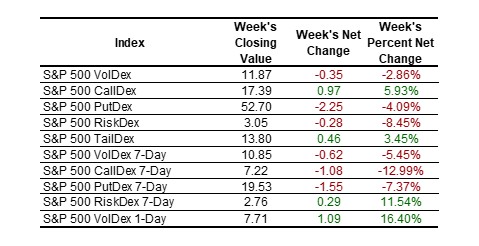
S&P 500 RiskDex fell by 8.45% after falling 32.36% in the previous week and while it is below its long-term average price, it remains above 3.00.

7-Day CallDex and 7-Day PutDex both fell on the week.
Implied volatility remains very low so short volatility option structures are to be avoided. 30-day tenors catch next month’s release of jobs data, CPI, and PPI and will soon fully capture the results of the September 17 Fed meeting so we expect 30-day volatility metrics to ramp.
Why It Matters…Historical data for all our indexes is available to subscribers at the Everything! level and they allow option traders to understand the context of the current option pricing environment. Volatility is mean-reverting and that is a phenomenon traders can take advantage of in both directions. But you have to understand what normal is, what the “mean” is, in order to do so.
You can see the week’s results for our indexes on the Nasdaq-100 below.
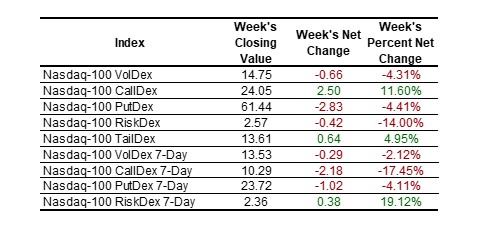

While VolDex, CallDex, and PutDex on the Nasdaq-100 are all below the 10th percentile of their respective 52-week ranges, RiskDex is at the 47th percentile signaling a reasonable amount of concern for the fate of the big tech names. This is good news for investors.

Nations Investor Optimism Index:
The Investor Optimism Index rose by 63.42% and is back above 50 with a close of 51.25.

The index takes into account the current levels of S&P VolDex, TailDex, and RiskDex and compares them to their rolling 2-year ranges.
Our Optimism Index is now available in real-time on our home page at NationsIndexes.com.
Other Equity Indexes:
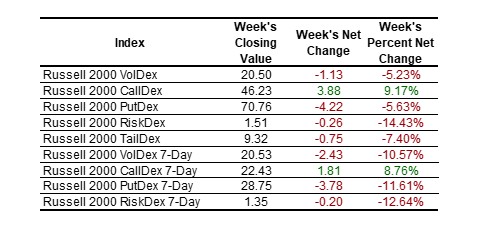
In a repeat of the previous week’s relative price action, you can see how 30-day option prices for the Russell 2000 were lower with the exception of CallDex. Russell-2000 RiskDex is now at the 48th percentile of its 52-week range.
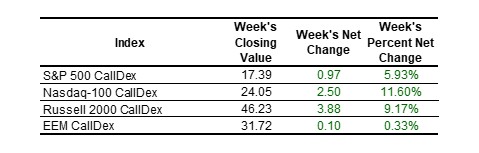
Why It Matters…CallDex for the 4 equity indexes we cover was universally higher this week as traders seek long exposure in defined risk structures.
Other Asset Volatility:
Treasury Bonds:
The yield on 10-year treasury notes rose by 4.3 basis points after gaining 6.5 basis points in the previous week and closed at 4.328%.
The price action in treasury bond options was odd with VolDex falling slightly and every other metric climbing. Traders seem to be expecting little volatility during the next weeks but want protection from out-of-the-money options in case there is an unexpected move.
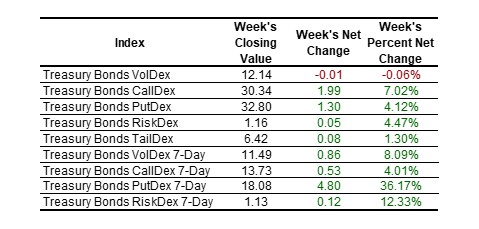
Treasury bond VolDex closed at just the 3rd percentile of its 52-week range making the week’s price action all the more odd.

Last week we said, “Traders will be looking for opportunities to buy treasury bond call options as the prospects for a rate cut solidify” and that panned out with CallDex gaining 7.02% and closing at the 35th percentile of its 52-week range.

Why It Matters…Treasury bond prices move inversely to interest rates which are impacted by jobs data, CPI, PPI, and the looming Fed decision. We will watch Treasury Bond VolDex as all those catalysts approach because the current level seems very low despite traders not wanting to own volatility in August.
Bitcoin:
Bitcoin volatility lurched higher in all 30-day metrics despite bitcoin gaining just 0.47% this week. VolDex ended the week at 36.60 but closed at 39.73 on Wednesday.
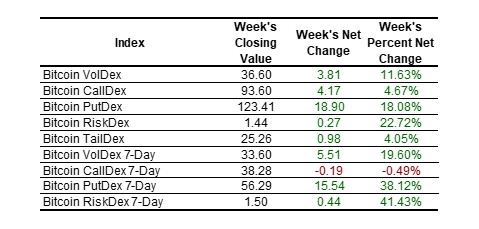
We have been looking for opportunities to short bitcoin volatility at higher levels and this week’s volatility action demonstrates why we don’t sell volatility when it is already depressed.

We still believe that Bitcoin RiskDex should move to resemble RiskDex values for other “Risk On” assets like equity indexes. Bitcoin RiskDex rose by 22.72% this week to close at 1.44, erasing last week’s decline of 15.02%.
Precious Metals:
Gold fell by 1.80% after rising 1.27% during the previous week. Gold futures made a key reversal last week, which we highlighted, and gold continues to trade in a broad sideways range.
Traders looking for a breakout should note that Gold CallDex is trading at the 16th percentile of its 52-week range and Gold PutDex is trading at the 1st (lowest) percentile of its 52-week range.
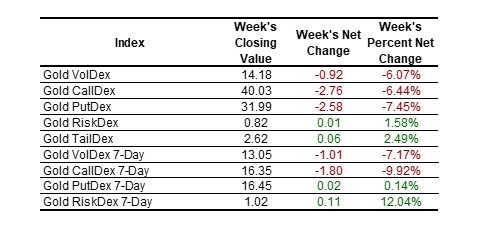
You can see the Gold CallDex chart below.

You can see the Gold PutDex chart below.

VolDex Term Structure:
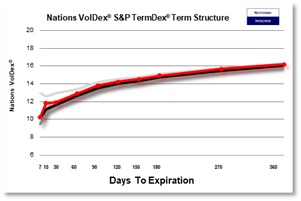
Term structure for S&P VolDex maintains a very normal shape although there is a kink at the 15-day tenor. Friday’s closing VolDex term structure is in red while the week’s other closes are in black (Thursday) and gray for earlier days in the week.
Option Window:
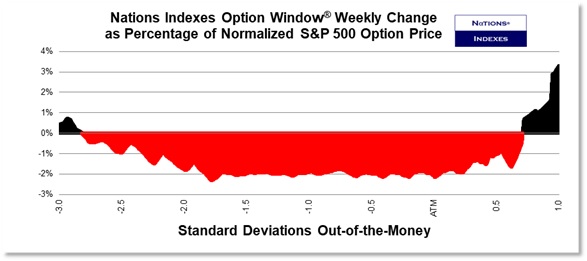
Option Window® is a graphical display of where option flows were concentrated this week. The black areas show where buying drove prices higher at constant points of moneyness (horizontal axis) while red shows where selling drove option prices lower. This week, the option selling took place in the heart of the skew and was evenly spread from 2 standard deviations below at-the-market to 0.6 standard deviations above at-the-market. Buying predominated at the extremes of the skew.
0DTE and 1DTE Options:
Zero day to expiration (ODTE) options accounted for 60.40% of all SPY option volume this week.
Very short-dated volatility measures which use a variance swap methodology, as 1-day VIX does, inject significant error into the resulting measure because of the way out-of-the-money options trade in the hours before expiration. The VolDex at-the-money methodology is particularly suited for these very short-dated tenors.

Equities:
We have expanded the list of single names we cover to include not only the most dynamic stocks in the S&P 500 and the stocks with the highest option volume, but also the largest names in the S&P 500.
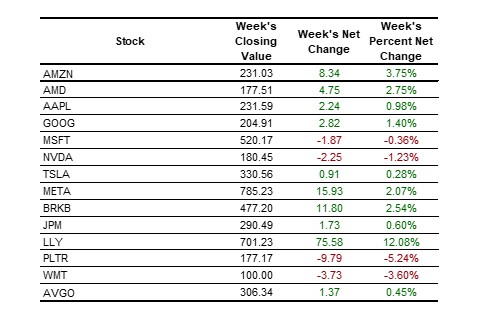
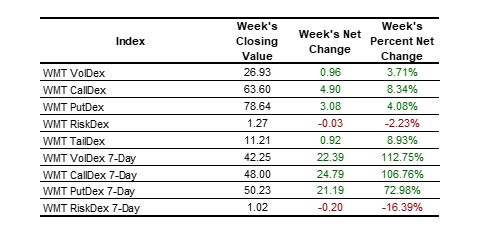
The single names we cover had a good week with only MSFT (-0.36%), NVDA (-1.23%), PLTR (-5.24%), and WMT (-3.60%) losing ground. LLY was the big winner, gaining 12.08% as it partly recovered from the previous week’s news that the company’s new weight loss pill did not perform as well as hoped.
The decline in PLTR can be dismissed given its YTD gain of 134.26%.
The loss in WMT is more troubling as traders believe the company is still trying to come to grips with the impact of tariffs. Despite these concerns, WMT is up 10.68% YTD.
VolDex was mixed for the single names we cover.
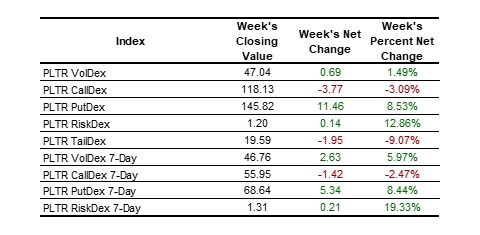
The price action in PLTR options echoed the stock’s 5.24% decline as VolDex, PutDex, and RiskDex rose while CallDex fell. Thanks to this week’s decline, PLTR is no longer overbought (i.e., RSI above 70).
While WMT is not a megacap tech stock, we continue to watch the price action in its options as it seeks to navigate tariffs on China.
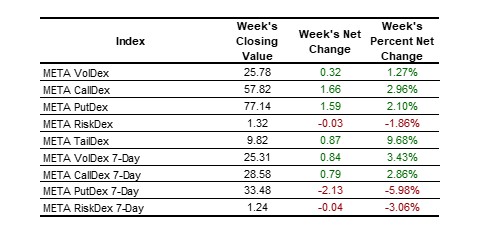
Despite being up 34.11% YTD and its making waves in AI, META options are trading at very low levels. VolDex and CallDex are both at the 1st (lowest) percentile of their 52-week ranges and PutDex is at just the 7th percentile.
Traders with an opinion as to the next move in META can take advantage using options.
The META VolDex chart below clearly shows seasonality tied to earnings releases but that offers an opportunity for traders with a directional opinion for the next 30 days.

In our July 19 edition of Volatility Insights we highlighted that AMD was a prime candidate for a covered call with a CallDex value of 141.67 (62nd percentile at the time) and the stock technically overbought with an RSI of 72.72. We used the 185 strike call option expiring on August 15, which could be sold at 1.75 with the stock at 156.99, as an example of the power of our indexes when used in concert with momentum indicators.
This option expired worthless on Friday and the trade worked extremely well, illustrating the value of using our CallDex and PutDex metrics in concert with momentum indicators like RSI. Traders who sold this covered call made money on both legs as AMD shares continued to rally but not enough for the covered call to expire in-the-money.

We’ll continue to comment during the week via our X account, @Nations_Indexes.
Scott’s Weekly Commentary:
This week’s inflation data was not what anyone wanted with PPI seeming to highlight the impact of tariffs. The benign CPI data indicates that businesses are trying to absorb higher prices without passing them along to customers. I think this indicates that they expect the tariffs to be temporary. We’ll see.
The market’s estimate of the likelihood of a Fed rate cut at their September meeting ramped even more despite the inflation data. I think the Fed will cut because FOMC members would be warning otherwise if a cut was not almost certain. That does not mean they SHOULD cut. The Fed’s dual mandate calls for them to act to preserve price stability, generally defined as inflation at 2%, and full employment, generally defined as an unemployment rate of 5%. With inflation higher than that and unemployment below, there is no reason to cut rates. But once the momentum for a rate cut gets going it is tough to stop it. What is the likely impact of an unneeded rate cut? More inflation.
A rate cut will help stocks continue to rally. And while the broad market has rallied thanks to a small number of megacap names, there is little reason to think it is all going to come unraveled in the next two weeks as we’ll get little news and many traders are paying little attention. So enjoy the rest of August but be ready for more volatility after Labor Day.
Everyone at Nations Indexes hopes you have a healthy and profitable week.
Scott
