

Your Week’s Volatility Market Commentary — Information Is Your Edge
Stocks Settle as Trade Tensions Ease, Earnings Impress
The Weekly Takeaway:
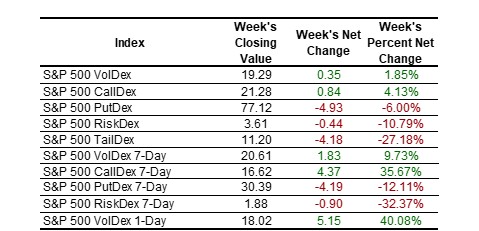
- The S&P 500 fell 0.47% this week but no day had a closing move of more than 1% in a sign markets are settling after tariff turmoil. The index is now down 3.77% YTD and 7.93% from its 52-week high;
- The Nasdaq-100 lost 0.20% this week (its smaller loss relative to the S&P is telling for the strength of technology). It is down 4.52% YTD and 9.73% from its 52-week high;
- VolDex (ticker VOLI) rose 1.85% for the week to close at 19.29, ending a streak of 4 weekly declines;
- TailDex (ticker TDEX) fell by 27.18% after falling 6.56%, 21.62%, and 25.32% in the previous weeks in the final capitulation of those hedging against tail risk. The speed with which sellers of these options return following a spike in volatility has been a trend for several volatility cycles;
- Nasdaq-100 VolDex rose by 1.32% in sympathy with the broad volatility market but PutDex fell slightly and TailDex fell by 18.37% as tail risk sellers hit the NDX;
VolDex was decidedly mixed in the single names we cover as the earnings cycle dominated. We discuss more below; - TailDex fell on all the single names we cover with the exception of NVDA (NVDA TailDex rose 4.23%). TailDex on AAPL and TSLA both fell by more than 30%;
- The Nations Investor Optimism Index rose 108.70% to close at 27.20;
- Nations Indexes is happy to announce that, starting with the coming week, we’re expanding the range of broad markets and individual names we cover to include treasury notes, high-yield bonds, and the largest and most exciting equities in the American stock market.

Equity Index Volatility:
Implied volatility and option prices settled a bit along with equity prices although sellers targeted OTM puts, particularly deep OTM puts. This corollary to “buy the dip” has existed since the steep selloff last summer and is a phenomenon to monitor.
VOLI rose slightly to close at 19.29 but is at just the 30th percentile of its 52-week range. However, the average closing price for the past 52-weeks is 15.13 so don’t be fooled by the recent range. However, until the tariff situation is resolved with China, our largest trading partner, and mutual tariffs of more than 100% don’t qualify as “resolved,” volatility will remain above recent levels – as it should. This is one of the rare situations when opportunities exist for both long volatility and short volatility strategies.
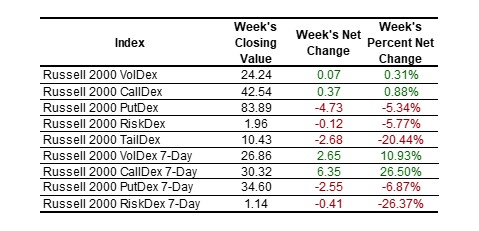
TDEX fell by 27.18% in the S&P, by 18.37% in the Nasdaq-100, and by 20.44% in the Russell 2000. Tail risk buyers were hesitant to step in during this most recent cycle because this trade had not worked during the two most recent episodes of sharp equity selloffs in August and December. They eventually appeared but sellers, in contrast, were quick to express their point of view as soon as the worst appeared over. That was a repeat of the price action in August and December. Scott will discuss this more in his commentary below but this is a dangerous game deep out-of-the-money put option sellers are playing. When it works it’s good. When it doesn’t, it’s ugly.

The collapse of TailDex back toward the 10.00 level is striking. Compare this chart to the VolDex chart above.
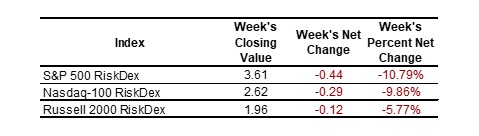
PutDex fell in the big three equity indexes we follow. CallDex rose in all three. This is resounding evidence that option traders are leaning toward bullish strategies.
Why It Matters…Historical data for all our indexes is available to subscribers at the Everything! level and they allow option traders to understand the context of the current option pricing environment. Despite their recent weakness, particularly for puts and deep out-of-the-money puts, option prices still remain historically high (with the exception of TailDex) and you can see that in the VOLI chart above. Volatility is mean-reverting and that is a phenomenon traders can take advantage of in both directions. But you have to understand what is normal, what the “mean” is, in order to do so.
You can see the week’s volatility results for the S&P 500 below.
The Nasdaq-100 fell only slightly and by less than the S&P 500 as investors fall back in love with tech names following great earnings. Put prices fell slightly but call prices gained.

Nasdaq-100 VolDex closed at 23.36, just the 29th percentile of its 52-week range but CallDex closed at 33.81, the 50th percentile of its 52-week range.

This divergence between out-the-money call option prices as expressed by CallDex, and out-of-the-money put prices, as expressed by PutDex should be used by option traders.
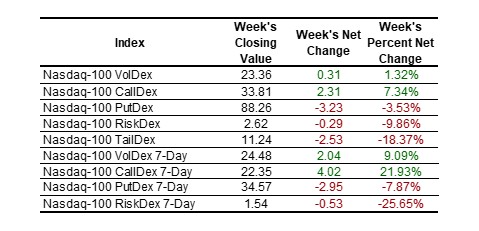
Two weeks ago we noted “the buying interest in Nasdaq-100 CallDex and willingness of traders to sell puts, particularly deep out-of-the-money puts is instructive.” We reiterated this last week as well and noted last week’s move in Nasdaq-100 RiskDex as confirming.
Why it Matters…Traders will eventually overdo this, as they always do, and it will be something to take advantage of. We’ll watch Nasdaq-100 RiskDex for the signal. When Nasdaq-100 RiskDex is back below 2.00 will be the time to buy out-of-the-money puts and sell out-of-the-money call spreads (we would never suggest selling naked call options).

Nations Investor Optimism Index:
The Investor Optimism Index rose another 108.70% this week to close at 27.20 so it has managed to climb out of the cellar. It is logical for optimism to be climbing as markets move past the most spasmodic episodes of the tariff drama but they also demonstrate that, to a degree, the market is still holding its collective breath.
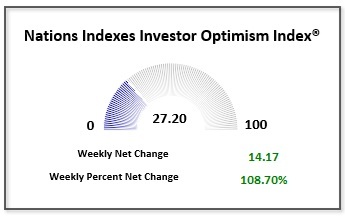
The index takes into account the current levels of S&P VolDex, TailDex, and RiskDex and compares them to their rolling 2-year ranges. It has not closed above 50 since January 24.
Other Equity Indexes:
The Russell 2000 index of small capitalization stocks fell 0.16% this week. It is now down 9.29% YTD and 17.98% from its 52-week high.
In many ways, the Russell telegraphed this week’s bullish lean as the Russell CallDex rallied by 6.35% last week as RiskDex collapsed by 15.28%. It looked like some timid bulls were buying calls. While that trade didn’t work out, the trade structure made sense.
You’ll note RiskDex the Russell is back below 2.00.
Why It Matters…Savvy traders will realize that each index has its own history for each index and take advantage. Our indexes are intended to provide insight but successful traders realize buying puts and selling call spreads when RiskDex is historically low is a good, but not guaranteed setup. The goal is to use our indexes to get the math on your side and increase your odds of success by buying options that are cheap and selling those which are expensive.
Other Asset Volatility:
Treasury Bonds:
The yield on 10-year treasury notes rose slightly on the week as bond and note prices fell slightly.
Treasury bond volatility eased across the board with VolDex, CallDex, and PutDex all dropping. Some reflexive buying of treasury bond volatility which was driven by April’s ramp in yields and decline in bond prices continues to come out of the option market. Much of that was driven by thinking that China was using its stockpile of $750 billion in treasuries as a weapon in the trade war. That may still happen but those concerns have eased.
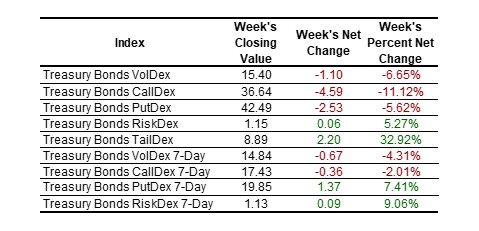
Treasury Bond VolDex has dropped well below the high reached in October and is back in the mid-teens level where it spent much of the last 52 weeks. Friday’s close of 15.40 is the 33rd percentile of the 52-week range.

Why It Matters…The trend in treasury bond volatility is clearly to the downside.

The most interesting move is in Treasury Bond TailDex which is coming out from under those concerns that China might throw treasuries on the market as a trade tool. Traders rarely have to worry about tail risk in treasuries.
Bitcoin:
VolDex on bitcoin rose by 6.26% after setting a new all-time closing low during the previous week.
We’re happy to announce that beginning this week we are calculating all our metrics on Bitcoin and we’ll share those in next week’s Volatility Insights.
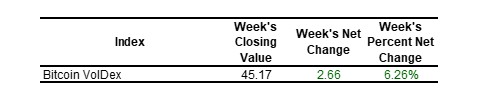
While Bitcoin VolDex rose slightly this week, it still appears to be trending lower and seeking its equilibrium level. A meaningful move above 45 which was the double bottom level from February and March would be meaningful and one to fade.

Gold:
The rally in gold has decelerated but just slightly as tensions ease. Interestingly, volatility was higher across the board with the exception of TailDex.
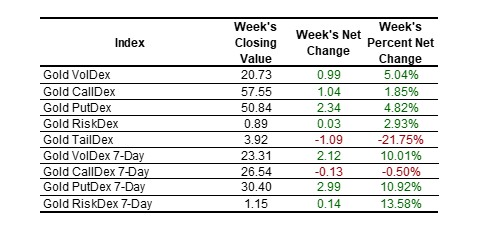
VolDex in gold has shown less of the tendency to come back to earth that we’ve seen in VolDex in the equity indexes.

How To Trade It? The hesitancy of gold implied volatility to fall offers an opportunity for option selling strategies. Gold bulls are usually loathe to sell away their upside but covered calls offer an opportunity to pocket very attractive premiums and establish an effective selling price, if your GLD gets called away. Take a look at Gold CallDex below.

GLD is the underlying for our gold metrics including CallDex. CallDex measures the normalized price of the precisely 30-day, 1 standard deviation (1 standard deviation out-of-the-money corresponds to a 16 delta) out-of-the-money call. GLD closed on Friday at 306.84. The option approximating CallDex could be the June 6 expiry 327 strike call. A trader could sell that at $1.45 on Friday’s close. The $145 per option would be theirs to keep and if their GLD shares got called away the effective selling price would be $328.45 or about $11 above GLD’s all-time high.
0DTE and 1DTE Options:
Zero day to expiration (ODTE) options accounted for 59.75% of all SPY option volume this week. It accounted for more than 60% of all SPY option volume on Monday, Tuesday, and Friday, reaching 64.38% on Tuesday.
Very short-dated volatility measures which use a variance swap methodology, as 1-day VIX does, inject significant error into the resulting measure because of the way out-of-the-money options trade in the hours before expiration. The VolDex at-the-money methodology is particularly suited for these very short-dated tenors.

Equities:
This week’s news was mixed for the single names we cover. AMD was the big winner after posting better than expected earnings.

VolDex was similarly mixed. AMD saw the biggest decline because the earnings catalyst had passed. MSFT VolDex continued to fall post earnings but is nearing 20 and is at just the 13th percentile of its 52-week range. You can sell all the volatility metrics for MSFT and their performance this week.
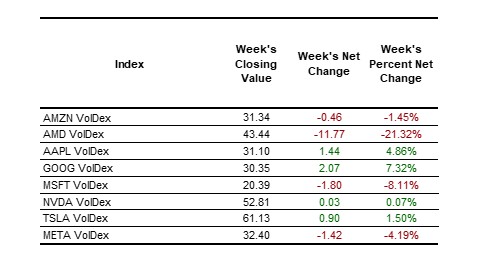
The moves in MSFT are interesting. MSFT VolDex is below.

MSFT CallDex is below.

Given the recent performance of tech and the demand for call options, traders should consider buying calls in MSFT either as speculation or stock replacement. The June 6 expiry, 460 strike call (with MSFT at 438.73) could have been bought at $3.10 on Friday’s close. We’re generally not fans of just buying call options in the expectation of upside but this is the rare occasion.
TSLA is again the single name we cover with the most bullish option set up. RiskDex fell back below 1.00 meaning out-of-the-money calls are more expensive than out-of-the-money puts. You would never expect to see this in the index world but it’s not uncommon amount single name equities. You can see the week’s action for all our metrics on TSLA.
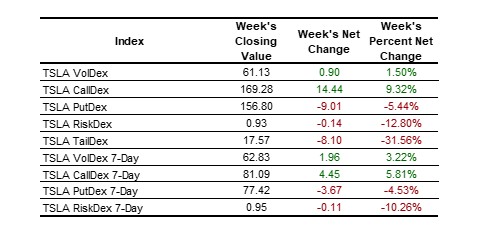
And below you can see the history of TSLA RiskDex. You’ll note it spent several months with RiskDex below 1.00 until concerns rose in February.

When RiskDex falls below 1.00 that signals that markets see more implied upside than implied downside for the stock. RiskDex for an individual name can stay below 1.00 for some time, and can fall further below 1.00. But there is a natural lower bound for RiskDex and savvy traders will take advantage of that.
We’ll continue to comment during the week via our X account, @Nations_Indexes.
Scott’s Weekly Commentary:
The stock market is settling into a more normal pattern and, as my mother used to say, congratulations, you’re normal. Tech investors like to talk about creative destruction but we’ll have to see how creative the recent volatility end up being. I think the answer will be, “not very.” The concern is that while the rhetoric is dying down some the level of tariffs that remain imposed on Chinese imports is very high. There remains the real possibility of an ill-considered comment, or purposefully belligerent comment, by either party. That could tip equities back to a down trend. Earnings have been great and if that’s all we had to focus on I’d be very pleased.
Consumer confidence remains at a low ebb and I can’t blame anyone for feeling that way. Tariffs are going to be inflationary – there’s no other way to imagine their impact on prices. And I’m one of those people who think it will have a continuing impact rather than being a one-time thing. When I spent all day in the pit we used to say the Chair of the Federal Reserve was the second most powerful person in the world. But I wouldn’t want Jay Powell’s job now. The administration hates you and wants you gone; you’d like to cut rates to prevent or ameliorate a slowdown in the economy and a surge in unemployment; yet you’re worried about inflation so raising rates seems reasonable. What a conundrum.
Everyone at Nations Indexes hopes you have a healthy and profitable week.
Scott
