

Your Week’s Volatility Market Commentary — Information Is Your Edge
Stocks Strong as Trade Tensions Ease and Earnings Impress
The Weekly Takeaway:
- The S&P 500 gained 4.59% for the week as the Trump administration signaled willingness to modulate tariffs on China, as concerns about the tenure of Fed Chair Jerome Powell eased, as earnings for Alphabet (GOOGL) beat expectations, and as the chip makers and AI companies reported strong demand. The index is now down 6.06% YTD and is 10.12% below its 52-week high;
- The Nasdaq-100 gained 6.43% thanks to those tech names. The index is now down 7.52% YTD and is 12.56% below its 52-week high;
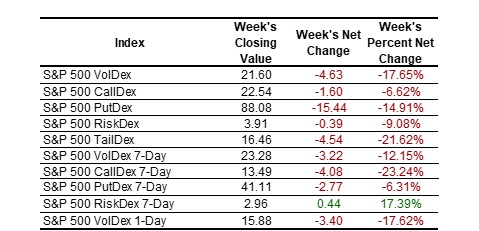
- VolDex (ticker VOLI) fell 17.65% after falling 18.34% in the previous week as the worst of the tariff volatility seems to have passed and as tensions ease. Worries about leadership at the Federal Reserve also appear to be resolved for now;
- TailDex (ticker TDEX) fell by 21.62% after falling 25.32% in the previous week. Traders were quick to short these options following the downdrafts in August and December of last year. In response they were slow to buy these options this most recent cycle. This won’t always be the case;
- S&P 500 RiskDex fell below 4.00 as out-of-the-money put prices fell by more than out-of-the-money call prices. Hedgers are liquidating their long put positions as markets recover;
- Nasdaq-100 VolDex fell by 16.27% after falling 14.37% in the previous week and TailDex fell by 25.31% after falling 35.19%. Speculators are willing to short these deep out-of-the-money put options described by TailDex. Nasdaq-100 CallDex rose by 3.21%;
- VolDex fell for all the individual names we cover as each of these stocks gained on the week. GOOG VolDex fell by 26.42% as the earnings catalyst passed with good news;
- The Nations Investor Optimism Index rose 100.59% to close at 11.30.

Equity Index Volatility:
Implied volatility fell during the week as stocks rallied. Tariff tensions have eased and it appears the U.S. and its largest trading partners are trying to deescalate. It also appears settled that Jerome Powell will serve the remainder of his term as Chair of the Board of Governors of the Fed. That term ends on May 15, 2026 and while he is unlikely to be re-nominated, this unwelcome distraction has been laid to rest.
The broad stock market was helped by Google’s earnings beat, along with the company announcing a dividend increase and $70 billion stock buyback. TSLA was the best performer among the names we cover, gaining 18.06%, thanks to expectations that the company will enter the Indian market, refreshed hopes for the self-driving market, and CEO Elon Musk retreating from the polarizing public eye.
VOLI fell by 17.65% and is now at just the 37th percentile of its 52-week range. TDEX is at just the 29th percentile of its 52-week range. We have discussed investors reluctance to buy these deep out-of-the-money puts for protection. They refused to buy these puts when tensions were at a low simmer with TDEX closing below 10.00 for 4 days in late March until jumping above 30 on April 4 when it gained more than 68%. They only capitulated in early April when fears peaked. Traders have been VERY aggressive in selling these options once it appears the worst is past.
Why It Matters…Historical data for all our indexes is available to subscribers at the Everything! level and they allow option traders to understand the context of the current option pricing environment. Despite their recent weakness, option prices still remain historically high. For example, going back to initiation of calculation of VOLI on 1/31/2005, the average closing price is 17.17, the median is 14.57, the 75th percentile value is 20.08, and the 90th percentile value is 26.48. This insight allows you to trade with data rather than intuition.

S&P CallDex fell by just 6.62%, the smallest decline in any 30-day measure on SPY. This comes after it rose by 17.44% in the previous week when it was the only measure in the green. It is now at the 43rd percentile of its 52-week range.

S&P RiskDex (the ratio of PutDex to CallDex) fell by 9.08% and closed back below 4.00 at 3.91.
Option prices are retreating from recent highs but are generally higher than normal. That is to be expected but it is also something for traders to take advantage of.
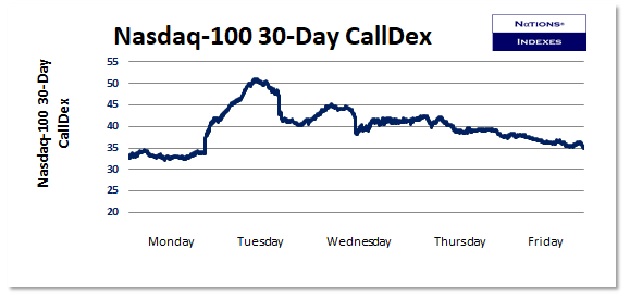
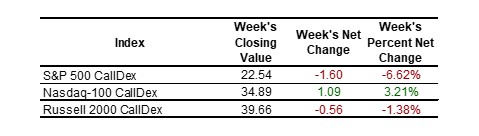
The Nasdaq-100 had a great week, led by TSLA which gained 18.06%. Nasdaq-100 CallDex gained 3.21% as bullishness returned to the tech sector.
This divergence in CallDex from measures which target other portions of the options skew is the reason savvy traders deconstruct skew. It allows them to understand what is happening at different parts of the option skew rather than looking at a single index like VIX which amalgamates all these strike prices, making it impossible to understand what the market is really saying.

Out-of-the-money call buyers in the Nasdaq-100 might look at a VIX-type calculation and think those calls are cheaper than they were a week ago. They’re not.
In Nasdaq-100, VolDex is at the 37th percentile of its 52-week range, CallDex is at the 54th percentile, and PutDex is at the 37th percentile.
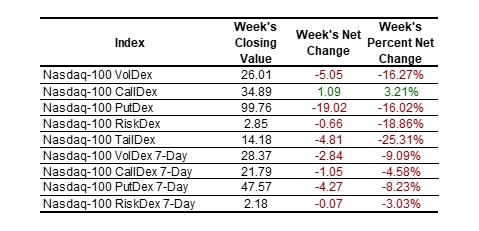
How to Use This Data…The buying interest in Nasdaq-100 CallDex and willingness of traders to sell puts, particularly deep out-of-the-money puts is instructive. Once any of these measures gets to an historical extreme it is time to fade that move.
Nations Investor Optimism Index:
The Investor Optimism Index rose 101% for the week to close at 11.30 but that remains an anemic level.
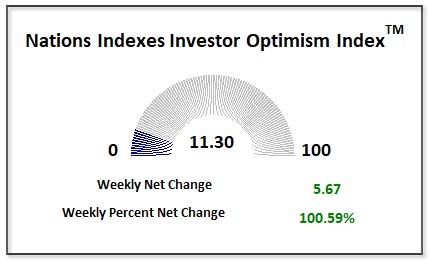
The index takes into account the current levels of S&P VolDex, TailDex, and RiskDex and compares them to their rolling 2-year ranges. It has not closed above 50 since January 24.
Other Equity Indexes:
The Russell 2000 index of small capitalization stocks gained 4.09% this week. That comes after it managed to gain 1.10% during the previous week when equities were generally lower. It is now down 12.22% YTD and is 20.63% below its 52-week high meaning it remains in “bear market” territory.
Nearly 40% of the names in the Russell 2000 posted operating losses in the past 12 months. It is difficult to see investors getting excited in the Russell 2000 with its lower quality constituents as long as the focus remains on tech and AI names which are growing earnings per share. Option prices for the Russell 2000 index fell as you can see below.
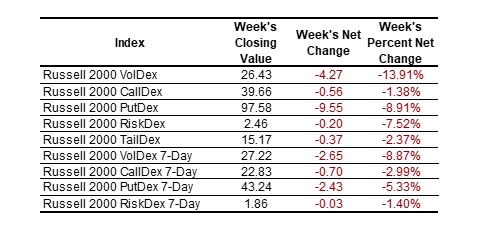
We continue to pay attention to the differences in RiskDex regimes for the 3 major equity indexes and have noted that CallDex is so much lower for the S&P than for the Russell and Nasdaq. This is telling in two ways, first, investors choose to get defined risk exposure to the Russell 2000 by buying calls rather than the shares. Second, owners of the S&P are very willing to sell covered calls. Much of this selling is being done by the covered call ETFs available.
Why It Matters…Savvy traders will take note of these tendencies and factor them into their trade structures.
Other Asset Volatility:
Treasury Bonds:
The yield on 10-year treasury notes and 30-year treasury bonds both fell and prices rose this week as bond and note prices rebounded from their “Sell America” drubbing.
Treasury bond volatility eased as bond prices rallied but note how the price of put options fell as fears of more “Sell America” downside eased. The collapse in TailDex is particularly noteworthy and again signals that traders are willing to rush in and sell deep out-of-the-money puts in any asset class after a big spike.
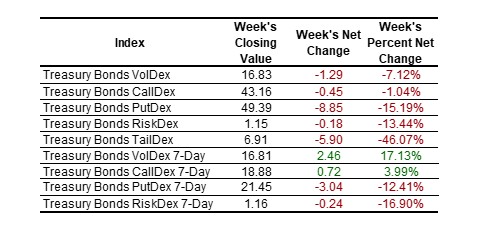
Treasury Bond VolDex has dropped well below the high reached in October. It ended the week at the 44th percentile of its 52-week range while TailDex closed at its 33rd percentile.

Why It Matters…TailDex is a more important measure in those assets which tend to see gaps to the downside. This includes equities. It is less important but still useful in assets which tend to gap upward. This includes treasuries and gold. But this means fewer traders are paying attention to deep out-of-the-money puts in treasuries and gold leaving more opportunity for those who are.

Treasury bond puts remain expensive relative to call prices although this reversed some this week, particularly in the 7-day RiskDex measure.

The unusual state of the dynamic between equity prices and treasury prices offers an opportunity. If equities swoon for reasons beyond tariffs and “Sell America,” then treasuries are likely to perform very well and the relative cheapness of calls to puts will reverse very quickly.
Bitcoin:
VolDex on bitcoin fell by 5.15% after falling 17.65% during the previous week. Friday’s closing value of 44.80 is an all-time low for Bitcoin VolDex.
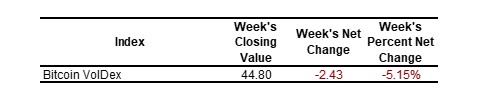
As we pointed out last week, “Bitcoin VolDex has resumed its trend to the downside as bitcoin shows less realized volatility and as traders sell options to take advantage of relatively expensive options. We expect this to continue although the nature of bitcoin means there will be some savage moves in price. We would not recommend owning at-the-money options.”
That clearly worked and absent some renewed trend in the price for bitcoin the decline in volatility is to be expected although we think traders have likely missed the bulk of the decline, for now, and would not recommend new short positions in bitcoin volatility. Given the nature of bitcoin, those who want to short volatility will get the opportunity at better levels.

Gold:
Gold posted a new all-time high on Monday before falling back a bit. Gold has enjoyed buying from traders and investors looking for assets not tied to any particular tariff belligerent and as tariff concerns eased, so did some of the buying interest in gold.
The volatility picture reflects this. Gold VolDex fell slightly but CallDex fell by 5.97% and PutDex gained 1.90%. Clearly traders are less euphoric about the prospects for gold absent avoidance of U.S. denominated assets. Gold VolDex closed at its 64th percentile on Friday.
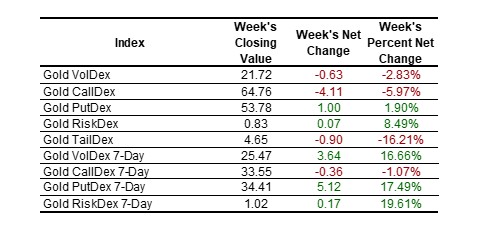
Concerns that the risk in gold has shifted to the downside is particularly obvious in the 7-day RiskDex measure.

Gold VolDex remains very elevated, as you can see. This is likely something to take advantage of with defined risk structures.
0DTE and 1DTE Options:
Zero day to expiration (ODTE) options accounted for 58.42% of all SPY option volume this week. It accounted for 63.66% of all SPY volume on Friday.
Very short-dated volatility measures which use a variance swap methodology, as 1-day VIX does, inject significant error into the resulting measure because of the way out-of-the-money options trade in the hours before expiration. The VolDex at-the-money methodology is particularly suited for these very short-dated tenors.

Equities:
This week’s news was universally good for the single names we cover. TSLA led the way higher, gaining 18.06%. GOOG gained 6.84% after reporting better than expected earnings, increased its dividend, and announced a stock buyback plan. Even AAPL and MSFT managed to gain more than 6% for the week.

The news for TSLA was particularly good because most of it was fundamental rather than focused on Elon Musk.
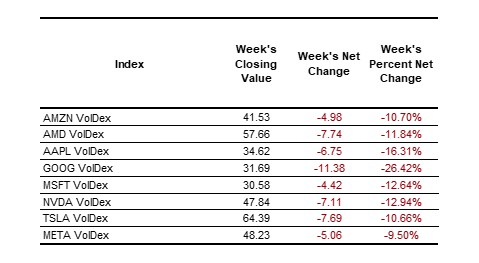
VolDex fell in all these names, as you would expect. The outsize decline in GOOG VolDex is due to the earnings catalyst passing benignly.
This is the third consecutive week which saw VolDex decline for every single name we cover; clearly implied volatility is reverting. However, CallDex rose for 6 of these names, spurred by expectations for more upside in tech.
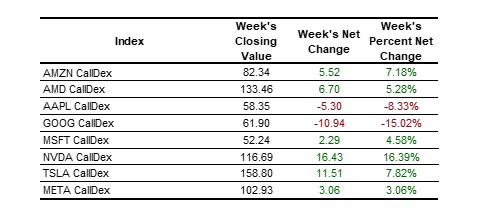
Again, this is why you have to deconstruct skew. Let’s look at the CallDex history for some of these names.

All TSLA options are expensive in relation to the other single names we cover. CallDex is reasonably priced in relation to its history since last summer but simply buying these calls would require a substantial move in TSLA so buyers should temper their expectations. This is not a comment on expectations for the shares to appreciate but a warning that it is possible to buy very expensive call options, get the direction correct, and still lose money.

NVDA CallDex seems compelling given the 52-week history and that NVDA is trading with a forward PE of just 25.1. Again, these call options are also very expensive.
But below you can see MSFT CallDex. It is the lowest CallDex measure on any of the single names we cover.

Why It Matters…Options that are cheap are cheap for a reason. But that doesn’t mean the market is correct or that owning out-of-the-money calls as a speculative trade focused on a stock rallying won’t be profitable.
RiskDex collapsed in all the single names we cover as traders shun puts and snap up calls. We’ll watch for this trend to get overdone at which point we’ll be able to take advantage of it.
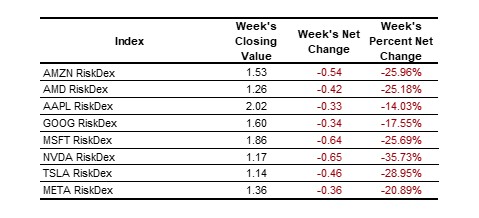
Below you can see the RiskDex history for NVDA.

When RiskDex falls below 1.00 that signals that markets see more implied upside than implied downside for the stock. RiskDex for an individual name can stay below 1.00 for some time, and can fall further below 1.00. But there is a natural lower bound for RiskDex and savvy traders will take advantage of that.
We’ll continue to comment during the week via our X account, @Nations_Indexes.
Scott’s Weekly Commentary:
Despite all the noise coming from the stock market recently, and the volume has been cranked up to a considerable level, it can be helpful to remember that the bulk of long term equity returns are driven by earnings (the more the better) and interest rates (the lower the better). GOOGL was not the only good news we got on the earnings front this week as projections for Q1 earnings rose to growth of 10.1% versus last week’s projection of growth of just 7.0%. Over 73% of companies who have reported beat EPS during this cycle have bested expectations. That sort of performance goes a long way toward easing tariff concerns.
The current administration may not want Jay Powell to be Chair of the Fed but Fed independence is good for everyone. Tensions between the president and the person many Wall Streeters call “The second most powerful man in the world” should ease and its good that they have. There is no reason for the administration to stir this pot; there is nothing good for them here.
I still believe Chinese leadership wants to “teach the United States a lesson” regarding China’s place in the economic world and will take the opportunity if it presents itself. This is the current risk to our stock market: that someone miscalculates and the trade war between China and the U.S. escalates. Remember that China does not have an electorate its leadership has to answer to. China seems to have been preparing for an economic confrontation with the U.S. since 2013. Since then their holdings of U.S. treasuries have declined by 42% to $760 billion. Does China now believe that a protracted trade war with the U.S. would no longer result in mutually assured economic destruction? Does that mean it is impossible to predict how they will respond? That’s the scary scenario.
Everyone at Nations Indexes hopes you have a healthy and profitable week.
Scott
