

Your Week’s Volatility Market Commentary — Information Is Your Edge
The Tariff Pause That Refreshes Stocks
The Weekly Takeaway:
- The S&P 500 rose 5.27% this week and gained ground all 5 days. It is now up 1.30% YTD and is just 3.08% below its 52-week high. Most of the gain came on Monday with the news that tariffs on China would be paused;
- The Nasdaq-100 gained 6.81% this week and it also rose all 5 days. It is now up 1.98% YTD and is 3.58% below its 52-week high;
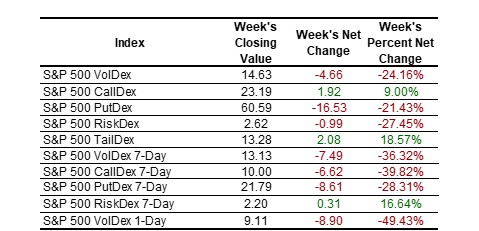
- VolDex (ticker VOLI) fell by 24.16% to close at 14.63. It has now declined 5 of the last 6 weeks;
- TailDex (ticker TDEX) rose by 18.57% as traders sold at-the-money options (VolDex) but bought deep out-of-the-money puts for protection and in recognition that they had been beaten down to attractive levels;
- Nasdaq-100 VolDex fell 18.94% as investors fall back in love with technology. NVDA and AMD got good news in terms of a partial rollback of a ban on selling AI chips overseas as well as a commitment by the Saudi AI project to buy billions of dollar’s worth of chips;
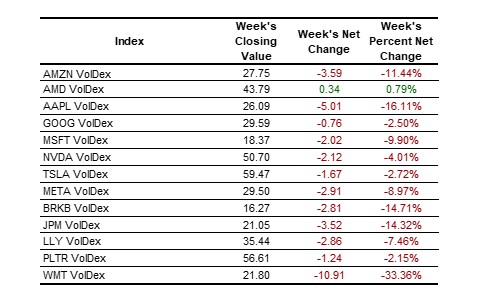
- We have expanded the list of equities we cover to include BRKB, JPM, LLY, PLTR, and WMT. We now cover not only the most active names but the 10 largest names in the S&P;
- All of the equites we cover were higher on the week with TSLA, PLTR, AMD, and NVDA all gaining more than 10%;
- VolDex on the single names we cover all fell with the exception of AMD. AMD VolDex rose by 0.79%;
- The Nations Investor Optimism Index rose 41.67% to close at 38.53;

Equity Index Volatility:
Implied volatility and option prices generally fell during the week following Monday’s news of a 90-day pause in new tariffs on Chinese goods.
VOLI fell as the S&P rallied on Monday’s news and then followed through. Friday’s closing level for VOLI is just the 15th percentile of the 52-week range but that is a factor of last month’s spike above 40. Anything below 12.00 is a buying opportunity in volatility.
TailDex (TDEX) rose after put sellers punished it once the S&P seemed to have bottomed. Now traders seem to realize they have to have some sort of protection against the specter of renewed tariffs and that TDEX had gotten too cheap. This tendency for sellers to hit implied volatility once the worst seems to have passed is occurring more rapidly in each cycle. This is an opportunity to take advantage of because selling volatility after the worst seems to have passed won’t always work.
Traders rushed to buy out-of-the-money calls. CallDex rose by 9.00% for the week. Coupled with the selling in puts, this drove RiskDex down 27.45%. In short, traders hated puts and loved calls this week. You can compare the two below:


Why It Matters…Historical data for all our indexes is available to subscribers at the Everything! level and they allow option traders to understand the context of the current option pricing environment. Volatility is mean-reverting and that is a phenomenon traders can take advantage of in both directions. But you have to understand what is normal, what the “mean” is, in order to do so.
You can see the week’s volatility results for the S&P 500 below.
The Nasdaq-100 outgained the S&P as the focus shifted back to tech names with an emphasis on AI. Nasdaq-100 VolDex is comfortably below 20.00 once again as you can see.

Last week we pointed out that Nasdaq-100 VolDex closed at 23.36, just the 29th percentile of its 52-week range but CallDex closed at 33.81, the 50th percentile of its 52-week range. That disparity grew more pronounced this week with Nasdaq-100 VolDex at the 16th percentile and CallDex at the 57th percentile. That puts RiskDex (the ratio of PutDex to CallDex) at just the 12th percentile of its 52-week range.

You can see the week’s action in Nasdaq-100 volatility below.
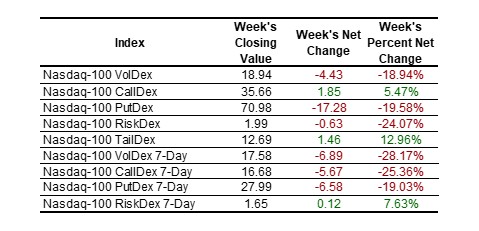
Why it Matters…Last week we flagged the 2.00 level in Nasdaq-100 RiskDex and the index closed at 1.99 on Friday. This means out-of-the-money puts are very cheap relative to out-of-the-money calls. It is time for opportunistic bearish positions in QQQ options that take advantage of this.

Nations Investor Optimism Index:
The Investor Optimism Index rose another 41.67% this week as traders sold volatility. We’ll be watching the all-important 50 level which the index hasn’t touched since January 24.
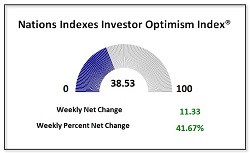
The index takes into account the current levels of S&P VolDex, TailDex, and RiskDex and compares them to their rolling 2-year ranges.
Other Equity Indexes:
The Russell 2000 index of small capitalization stocks gained 4.46% this week. Unfortunately, it is still down 5.24% YTD, the only major index still lower on the year, and is 14.32% below its 52-week high.
Last week we noted the aggressive call buying in the Russell 2000 as an indicator that traders were getting bullish on the RUT. The trade would have worked if held through this week but note that CallDex fell slightly this week, bucking the trend in the S&P and the Nasdaq-100.
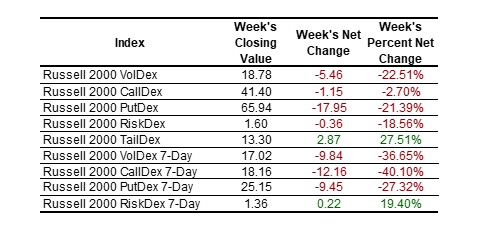
Why It Matters…VolDex on the Russell 2000 closed at just 18.78 which is the 8th percentile of its 52-week range. This is a time when buying at-the-money options to express your trade thesis in the Russell makes sense. That’s not usually the case.

Other Asset Volatility:
Treasury Bonds:
The yield on 10-year treasury notes rose slightly on the week, ending at 4.44%, as bond and note prices fell slightly.
Treasury bond volatility rose across the board in the 30-day tenors. PutDex rose by 16.63% as bond holders worry about downside now that an equity-induced “flight to quality” seems less likely.
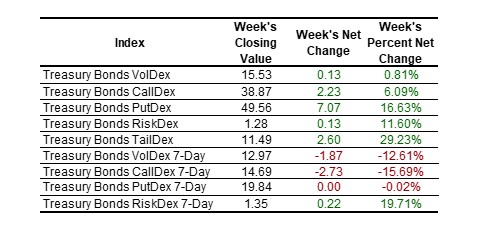
Treasury Bond VolDex has dropped well below the high reached in October and is back in the mid-teens level where it spent much of the last 52 weeks but seems stuck at the 15 level. This means that structures that are long at-the-money TLT options are unlikely to be hurt by volatility dropping dramatically.

Why It Matters…RiskDex remains high so traders who are bullish on treasuries can take advantage with structures which sell puts or put spreads.
The most interesting volatility index in treasuries remains TailDex. Tail risk is a new phenomenon for treasuries.

Bitcoin:
VolDex on bitcoin fell by 7.04% after rising 6.26% in the previous week. Traders continue to sell bitcoin volatility when option prices advance.
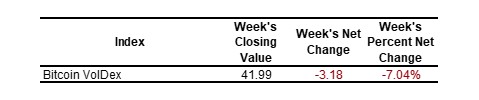
Bitcoin VolDex continues to trend lower and posted a new all-time closing low on Friday.

How To Trade It? We are hesitant to be naked short bitcoin options but selling a put spread if you’re bullish on bitcoin is a logical trade. Bears can sell a call spread. Those who are agnostic as to direction, or who think bitcoin is unlikely to move over the next 30 days can do both. We would not be long volatility in bitcoin.


0DTE and 1DTE Options:
Zero day to expiration (ODTE) options accounted for 55.21% of all SPY option volume this week. Interestingly, it was just 49.73% on Monday when the S&P rallied by 3.26%.
Very short-dated volatility measures which use a variance swap methodology, as 1-day VIX does, inject significant error into the resulting measure because of the way out-of-the-money options trade in the hours before expiration. The VolDex at-the-money methodology is particularly suited for these very short-dated tenors.

Equities:
We have expanded the list of single names we cover. This week’s news was good for all of them with the chip stocks leading the way.

VolDex was similarly one-side as VolDex fell for all the names we cover except for a small gain for AMD.
The moves in AMD were particularly interesting for a name that is usually lost in NVDA’s shadow.
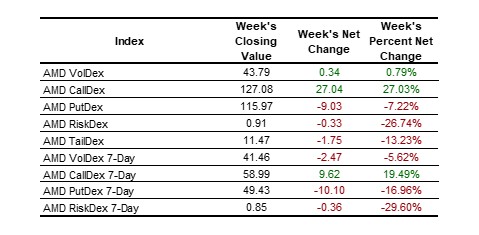
The option flows were clearly bullish with CallDex gaining 27.03% and PutDex falling.
The bounce off the 100 level for CallDex is striking. The natural trading range seems to be 100-150.

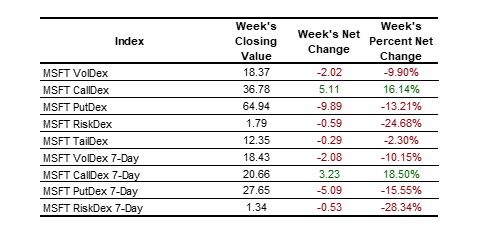
Last week we noted interest in calls among tech names and suggested “traders should consider buying calls in MSFT either as speculation or stock replacement. The June 6 expiry, 460 strike call (with MSFT at 438.73) could have been bought at $3.10 on Friday’s close. We’re generally not fans of just buying call options in the expectation of upside but this is the rare occasion.”
So how did that trade work out? Those calls could be sold for $5.05 on yesterday’s close. They are now nearing at-the-money and are 20 days from expiration so erosion is going to start eating way more earnestly. It’s time to take a profit or roll up and out.
The bullish stance in TSLA only strengthened this week with RiskDex falling another 18.79% to 0.75. Out-of-the-money calls are now much more expensive than out-of-the-money puts.
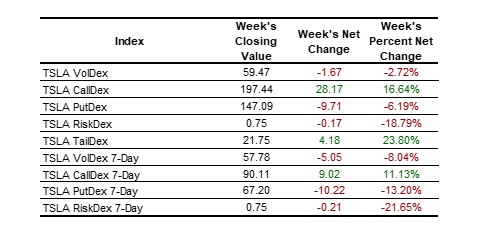
This bullishness can get overdone and RiskDex is the best metric for measuring this.

When RiskDex falls below 1.00 that signals that markets see more implied upside than implied downside for the stock. RiskDex for an individual name can stay below 1.00 for some time, and can fall further below 1.00. But there is a natural lower bound for RiskDex and savvy traders will take advantage of that.
We’ll continue to comment during the week via our X account, @Nations_Indexes.
Scott’s Weekly Commentary:
The market clearly loves the idea of a “do over” regarding tariffs. Even the staunchest fans of “fair trade” as opposed to “free trade” would have to agree that once you get other countries and other personalities involved the issues become more difficult to resolve. We’re a long way from resolving our trade disputes with China so the current peaceful pause could curdle into a renewed spat and I think, given the bellicose way the Trump administration has approached the issue, that some spasm of conflict will occur and the stock market will pay the price. That’s not a warning to stay away; it is instead a suggestion that you buckle up for the rollercoaster ride that I think is inevitable.
When that selloff occurs option volatility will spike again. And once again, option sellers will race in to profit from the reversion to the mean. But those option sellers are rushing in more quickly and more emphatically after each cycle as if the bottom they think they see in stocks is undeniably the bottom and there is no chance it is just a midway point of the break in stock prices. Eventually there is going to be a market that breaks, pauses, sees option sellers aggressively sell volatility, and breaks again. Those option sellers will be hating their lives at that point but sometimes people have to relearn the important lessons.
AI chipmakers are basking in the warming light of the market again. AI will change our lives in ways we cannot imagine yet so it’s disappointing that the purest plays in AI remain the chipmakers. The first IPOs from the real AI names will define frothy and the process will be fun to watch but until then we’re stuck with the chipmakers and big names that may want to focus on AI but still have huge legacy businesses. META may be all about AI in 20 years but right now it’s an advertising play. MSFT still gets 58.5% of its revenue for Windows and Office. Those are great businesses but they’re not AI.
Everyone at Nations Indexes hopes you have a healthy and profitable week.
Scott
